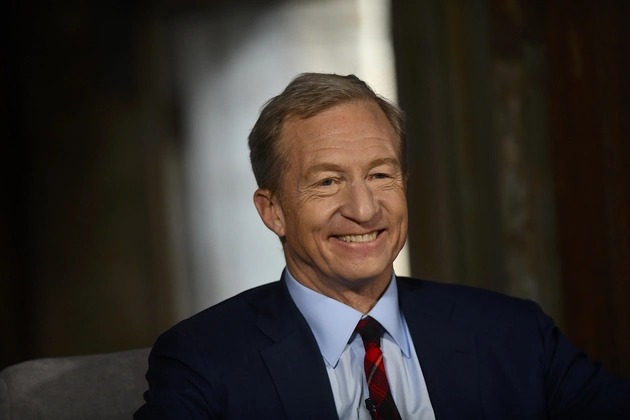
Tom Steyer just gave California 12 million reasons to believe he’s weighing a political comeback. The longtime megadonor and onetime presidential candidate sprang off the political sidelines and into a swirl of speculation on Thursday by announcing a massive ad buy in support of Proposition 50, Democrats’ ballot initiative to gerrymander California’s House maps. Steyer’s foray instantly prompted chatter about his potential interest in a still-fluid 2026 governor’s race that has been jolted by frontrunner Katie Porter’s dismal week. “I know it brings up the question of whether he’s going to run. There’s been some buzz about that,” said Gil Duran, a former Steyer adviser. “The race is wide open. I’m sure the thought has crossed his mind.” It wouldn’t be the first time Steyer poured millions of dollars into ballot measure campaigns while weighing a statewide run — though his previous flirtations never went anywhere. Now, with California’s governor race looking ripe for a reset, political insiders are once again watching for Steyer to deploy his fortune to shake up a marquee race. Steyer himself does not appear in the Prop 50 spot — which would be a giveaway, Duran said, that “you’re trying to focus-group and poll and see if people like you and would vote for you.” Still, Steyer’s decision to spend heavily in the race’s critical final stretch, going on air as ballots hit inboxes, is further fueling speculation about his motivations. People who have worked with Steyer deflected questions about whether he intends to run for office. They portrayed his intervention as a continuation of years of work to combat Trump, including by funding an impeachment drive during Trump’s first term. “Tom launched the ‘Stick it to Trump’ campaign because he has always stood up to Donald Trump,” Steyer spokesperson Kevin Liao said in a statement. “He launched the Need to Impeach campaign in 2017 long before Democrats in D.C. acted on impeachment, and he’s strongly backing Prop 50 now because he knows it’s our best shot at stopping Trump’s power grab in Congress.” Steyer took a step back from California politics several years ago after launching an investment firm that legally limits his involvement, but operatives and elected officials have learned to never discount a possible Steyer candidacy. After passing on runs for Senate and governor, Steyer initially decided not to seek the presidency in 2020 — only to reverse course and dump more than $200 million into a doomed campaign. Porter created opportunity for potential rivals this week with the emergence of a combative television interview and a 2021 video of her berating a staffer that, together, fanned concerns about her temperament and viability as a candidate. Former California Senate President Pro Tem Kevin de León, who worked closely with Steyer for years and won his endorsement in 2018 for a longshot challenge to then-Sen. Dianne Feinstein, said in an interview that he was “quite surprised (Steyer) has not thrown his hat into the ring” for governor. “Tom has been around the block, so while he’s wealthy, he’s politically savvy. He’s no neophyte,” de León said, and “he happens to have the financial wherewithal to run a credible race.” If he could run a winning campaign is unclear. Steyer has historically had more success as a funder than as a candidate — a recurring dynamic in California, whose political shores are littered with the wrecks of self-funded governor campaigns that proved money can’t buy votes. Steyer became a major player in California politics nearly 20 years ago, channeling more than $66 million into campaigns starting in 2007. The vast majority of that money went to ballot initiatives, including more than $40 million on a pair of campaigns to tax tobacco products and to fund school energy efficiency upgrades by upping corporate taxes. Along the way, he became a Democratic fixture, snagging speaking slots at state conventions and channeling millions — both personally and through his organization NextGen California — to candidates and party committees. Newsom tapped Steyer in the spring of 2020 to lead a pandemic recovery panel. The megadonor also plunged into national politics by pouring more than $50 million into a push to impeach President Donald Trump during his first term, irking Democratic officials, and spent tens of millions of dollars on voter registration drives before embarking on his longshot presidential campaign. California campaigns were happy to accept Steyer’s money, and his commitment to combating climate change was never in doubt. But his largesse and mode of operating — like pushing to star in a ballot measure commercial — have occasionally prompted criticism that he was using the ballot to burnish his political stature. “He’s been a big environmental funder and advocate, and he’s been positioning himself to run for office,” said Ned Wigglesworth, a ballot initiative consultant who worked on the tobacco tax campaign. “Without denigrating his sincerity about pursuing the environmental track, pursuing the environmental issues as far back as at least 2012 served as a platform to elevate his profile and position himself potentially for office.” Consumer Watchdog President Jamie Court, who has worked with Steyer, said in an interview that he observed a “tension between wanting to change climate politics and wanting to advance Tom Steyer.” He argued Steyer’s success as an investor has informed his approach to politics, likening his Prop 50 spending to a hedge on his future. “I’m not sure he’s going to turn the tide on anything, but it does place him in a position to be credited if the tide turns,” Court said. “It’s a bet on democracy, and maybe it’s a bet on his future in the Democratic Party.”
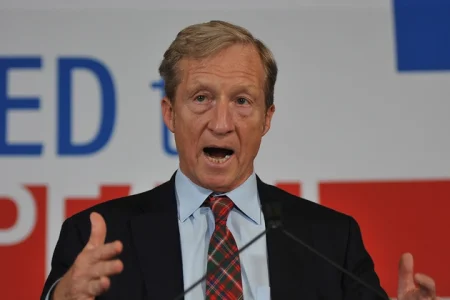

Porter’s Recent Stumbles Amplify Speculation
Katie Porter’s recent missteps have only heightened the intrigue around Steyer’s potential entry. Just this week, a combative CBS News interview where she abruptly threatened to walk out after being pressed on appealing to Trump voters went viral, drawing sharp criticism from fellow Democrats and Republicans alike. The day before that, Politico released a 2021 video of Porter berating a staffer during a recorded meeting with then-Energy Secretary Jennifer Granholm, yelling “Get out of my f***ing shot!” after the employee interrupted to correct her on a statistic. In the clip, Porter also vented about not being invited to the White House despite raising a “shit ton” of money for Biden. The incidents have fanned long-standing concerns about her temperament, with rivals like Steve Hilton and Stephen Cloobeck seizing on them to question her fitness for governor.
The timing of Steyer’s $12 million infusion into Prop 50 — a measure to redraw congressional maps in Democrats’ favor in response to Republican gerrymandering in Texas — couldn’t be more pointed. The ad campaign, launching with a spot on ABC’s “Jimmy Kimmel Live” on Thursday night, depicts a furious Trump hurling french fries at a TV while watching Prop 50 pass, tying the ballot fight directly to the president’s “election-rigging power grab.” Steyer’s team frames it as a continuation of his anti-Trump activism, including the 2017 “Need to Impeach” campaign, but insiders see it as a classic Steyer move: using ballot measures to build his brand while testing the waters for higher office.
Steyer’s Track Record: Megadonor, Not Megacandidate
Steyer’s history is a tale of bold bets and unfulfilled ambitions. A hedge fund billionaire with a net worth estimated at $1.6 billion, he’s poured over $300 million into Democratic causes since 2007, much of it on ballot initiatives like tobacco taxes and school bonds. He flirted with runs for California Senate in 2018 and governor in 2021 but backed out each time. His 2020 presidential bid, self-funded with $200 million, fizzled in the early primaries, ending with a whimper in Iowa.
Yet Steyer’s political savvy is undeniable. He co-founded NextGen America, which registered over 500,000 young voters in 2018, and led Newsom’s pandemic recovery panel in 2020. Operatives like Duran, who advised him, say Steyer’s Prop 50 play is “positioning” — a way to remind California Democrats of his clout without committing to a run. “He’s no neophyte,” de León echoed, noting Steyer’s ability to “run a credible race” with his wallet.
Critics, however, see a pattern of self-promotion. Ballot consultant Ned Wigglesworth, who worked on Steyer’s tobacco tax push, said his environmental advocacy since 2012 “served as a platform to elevate his profile.” Jamie Court of Consumer Watchdog observed a “tension” between Steyer’s causes and his ambitions, likening the Prop 50 ad buy to a “bet on his future in the Democratic Party.”

The Open Field: Porter’s Woes and a Crowded Primary
Porter’s front-runner status has crumbled under scrutiny. Her viral CBS interview meltdown — where she snapped, “I don’t care” at a reporter asking about Trump voters — came on the heels of the 2021 staffer video, reigniting accusations of a toxic workplace. Rivals pounced: Steve Hilton called her “weak and self-destructive,” while Stephen Cloobeck questioned how she’d “handle California” if she can’t handle a question. The clips have amplified whispers of her unfitness, creating an opening in a race that includes heavyweights like Xavier Becerra, Tony Thurmond, and Betty Yee.
Steyer, if he jumps in, would face a crowded field of 20+ Democrats, but his $1.6 billion war chest could level it. Past self-funded flops like Michael Bloomberg’s 2020 bid ($1 billion, 8 delegates) loom large, but California’s history of rejecting billionaire outsiders (e.g., Eli Broad’s 2013 flirtation) is tempered by Steyer’s grassroots ties via NextGen. “He’s politically savvy,” de León said. “Money can’t buy votes, but it can buy visibility.”
What’s Next: A Hedge or a Hail Mary?
Steyer’s team insists the ad buy is pure anti-Trump activism, not a launchpad. “It’s our best shot at stopping Trump’s power grab,” Liao said, citing Steyer’s early impeachment push. But with Prop 50 polls showing a tight race (48% yes, 45% no, per Berkeley IGS), Steyer’s $12 million — the largest donation yet — positions him as a kingmaker, or candidate.
If Steyer runs, he’d enter as an environmental heavyweight in a state where climate is king. But California voters have spurned self-funders before, and Porter’s stumbles may not be enough to propel him past a crowded primary. As Duran put it: “The race is wide open, but winning it? That’s another story.”
For now, Steyer’s bet looks like a hedge — on democracy, on the Democratic Party, and perhaps on his own political future. In a state where money talks but votes walk, all eyes are on whether this $12 million whisper becomes a roar.
Πηγή: Pagenews.gr