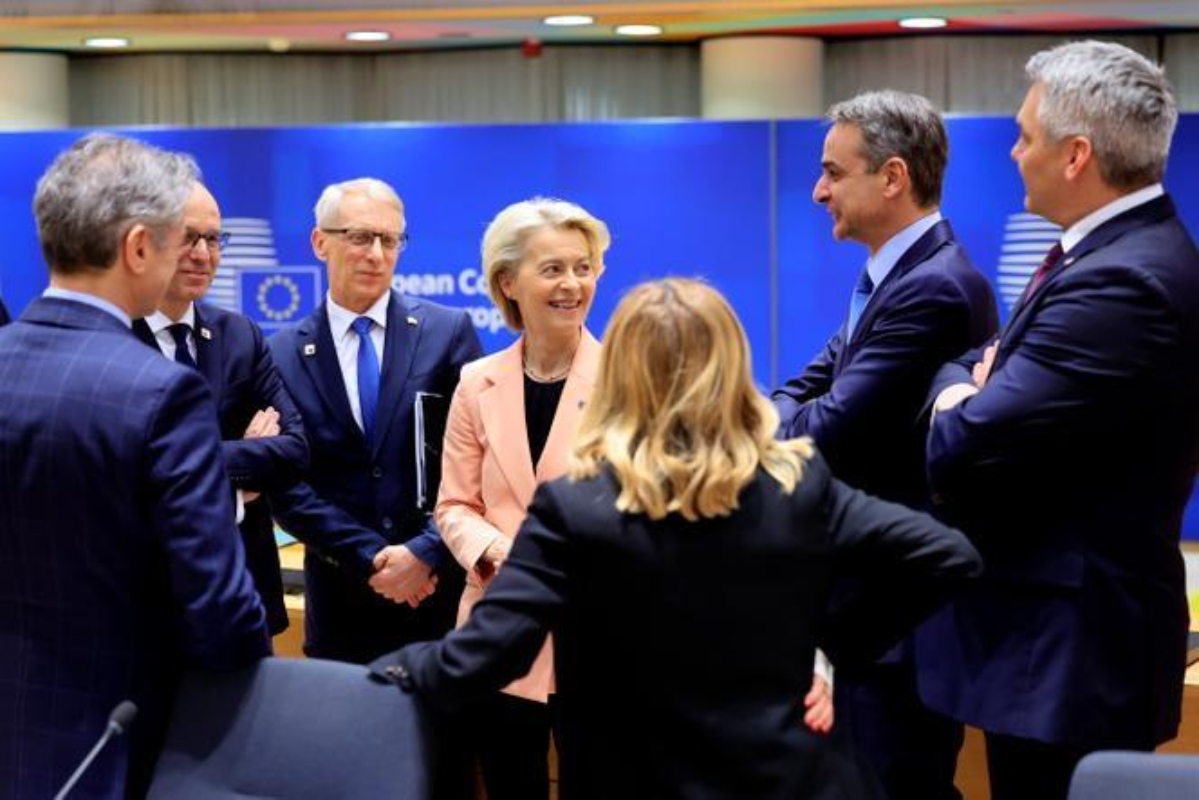
The EU is preparing the most expensive – and politically explosive – financial shield for Ukraine since the beginning of the war.To unlock a €210 billion loan package for Kyiv, every member state must pledge national guarantees, triggering deep divisions inside the bloc.
A Continent of Guarantees: The Bigger Picture
According to a leaked document obtained by Politico, EU governments must provide massive state guarantees to enable the European Commission to issue up to €210 billion in loans for Ukraine.
The logic is simple:No guarantees → no loan. No loan → Ukraine faces a budget meltdown by April.
The allocation of financial burdens, based on GDP shares, has created a map of European asymmetry – with major states paying disproportionately more.
Who Pays What: The Numbers That Shocked European Capitals
The “big payers”
- Germany: €51.3 billion
- France: €34 billion
- Italy: €25.1 billion
- Spain: €18.9 billion
- Netherlands: €13.4 billion
Greece’s share
1.3% of the total → €2.8 billion in guarantees.
A smaller number compared to the major economies, but for Greece – a country still rebuilding fiscal buffers – it is far from insignificant.
Belgium’s Block – and the Fear of Paying Russia Back
Belgian PM Bart De Wever is the central obstacle. His concern: Belgium may ultimately be forced to reimburse Russia if international courts rule against the EU’s use of frozen assets.
Key facts:
- €185 billion in Russian assets are held by Euroclear (Brussels).
- €25 billion are scattered across EU private banks.
De Wever demands EU-wide backstops so that: If things go wrong, all EU states share the cost – not just Belgium.
Hungary’s Veto: Orbán Once Again Pulls the Brake
Hungary blocked the issuance of new EU debt last Friday. The message is clear: Without Orbán on board, the EU must either use frozen Russian assets or fund Ukraine directly from national budgets.
No scenario is comfortable.
What the €210B Package Includes
The Commission’s plan is split as follows:
- €115 billion → Ukraine’s defence industry (over five years)
- €50 billion → Kyiv’s fiscal needs
- €45 billion → Repayment of last year’s G7 loan
Funds will be released in six tranches, under strict monitoring, including pre-approved defense contracts and spending plans.
Geoeconomic Analysis: Why This Loan Is a Defining Moment
1. Europe is entering a de facto wartime economic mode
Such guarantees reflect a strategic shift: the EU is preparing for prolonged conflict dynamics, not short-term crisis management.
2. Brussels is assuming risks traditionally taken by NATO
Supporting Ukraine’s defence industry signals the transformation of the EU from a mere political union into a strategic security actor.
3. National budgets are exposed
Guarantees may not be direct payments, but they restrict fiscal flexibility, affecting:
- sovereign debt
- borrowing costs
- investment plans
- public expenditure
For countries like Greece, Italy, or Spain, the pressure is real.
Geopolitical Analysis: Where Ukraine Goes, Europe Follows
This package is:
- a direct challenge to Moscow,
- a signal to Washington that Europe can shoulder responsibility,
- a major test of EU unity.
If De Wever does not shift position by 18 December, member states may have to finance Ukraine from national coffers– a politically radioactive scenario.
A Europe That Is Reinventing Itself
The debate over Ukraine’s €210 billion loan is not only about finances.It is a stress test of European cohesion, strategic autonomy, and political courage.
Greece’s €2.8 billion share reflects both its economic capacity and its commitment to Europe’s collective security architecture.
The final battle will unfold on 18 December.And it will reveal whether the EU acts as a unified geopolitical force – or as a mosaic of national fears.
Source: pagenews.gr