A meeting heavy with geopolitical symbolism
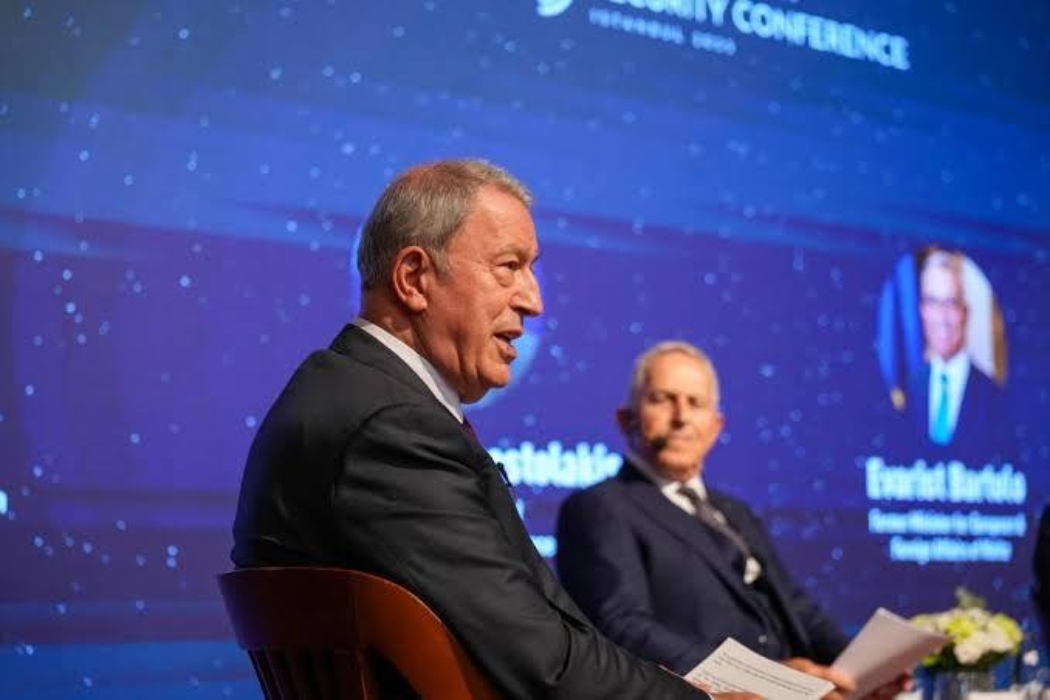
Away from formal diplomatic settings but squarely within the strategic spotlight, former Greek Minister of National Defence Evangelos Apostolakis and former Turkish Defence Minister Hulusi Akar confronted each other in Istanbul, laying bare the enduring fault lines in Greek–Turkish relations.
The encounter took place during the conference“The Great Art Security Conference: Shifting Security Dynamics Within and Around the Mediterranean”, hosted by the Bogazici University and organized by the Great Art Foundation. The event brought together former defence and foreign ministers from Turkey, Greece and Malta, along with senior diplomatic figures, highlighting the Mediterranean’s renewed centrality in global geopolitics.
This was not a ceremonial exchange. It was a strategic dialogue with clear political subtext, reflecting the fragile balance between engagement and deterrence in the Eastern Mediterranean.
Akar: Dialogue without unilateralism
Chairing the panel, Hulusi Akar adopted a calm but firm tone, reiterating Ankara’s long-standing positions. Stressing the importance of dialogue, he framed the discussion within a volatile global environment, noting that:
“The goal is not to solve every crisis, but to achieve a shared understanding and situational awareness.”
Describing the Eastern Mediterranean as a strategic crossroads where energy security, diplomacy and stability intersect, Akar argued that Turkey seeks peace while safeguarding what it calls its legitimate maritime rights.
“Turkey is not a threat. Turkey is an ally,” he stated, while firmly rejecting unilateral actions that, according to Ankara, violate its interests.
He emphasized that maritime disputes should be resolved through dialogue and international law — a reference critics view as selective, given Turkey’s longstanding objections to key legal frameworks governing maritime boundaries.
Apostolakis: Revisionism risks regional destabilization
Responding from the Greek side, Evangelos Apostolakis delivered a pointed and strategic message. He warned that the Eastern Mediterranean is already under constant pressure from armed conflicts, energy rivalries, migration flows and shifting alliances, compounded by the weakening of state structures across the wider region.
His core argument was unequivocal:“International law — including humanitarian law — must be our compass.”
Apostolakis cautioned that any attempt to revise the existing legal status quo carries the risk of broader destabilization, a clear reference to Turkish claims and practices in the Aegean and Eastern Mediterranean.
He underlined that energy resources could either become a platform for cooperation or a trigger for escalation, depending on whether states adhere to established legal norms. Migration pressures, water scarcity and external interventions, he added, further intensify regional insecurity.
Stable actors in an unstable neighbourhood
Despite the sharp differences, Apostolakis described Greece and Turkey as two of the more stable actors in a region marked by chronic turbulence. This remark reflected Athens’ strategic approach: deterrence combined with dialogue, without conceding on sovereignty or international legality.
The statement also underscored a broader reality — that regional stability cannot be sustained through power politics alone, but neither can it ignore persistent revisionist pressures.
Beyond rhetoric: what the confrontation reveals
At a deeper, geopolitical level, the Apostolakis–Akar exchange exposed the true limits of Greek–Turkish dialogue:
- Turkey promotes dialogue while challenging the existing legal framework
- Greece insists that dialogue without full respect for international law is negotiation under pressure
- The Eastern Mediterranean remains a theatre of strategic rivalry, not merely a diplomatic disagreement
The repeated invocation of international law by both sides highlights not consensus, but a battle over interpretation and applicability.
The Istanbul encounter demonstrated that, despite diplomatic language and calls for engagement, the strategic gap between Athens and Ankara remains wide. International law continues to be both the main point of contention and the only viable foundation for de-escalation.
In a region where energy, security and geopolitics are increasingly intertwined, dialogue may be necessary — but without clear red lines, it is insufficient.
Source: pagenews.gr