
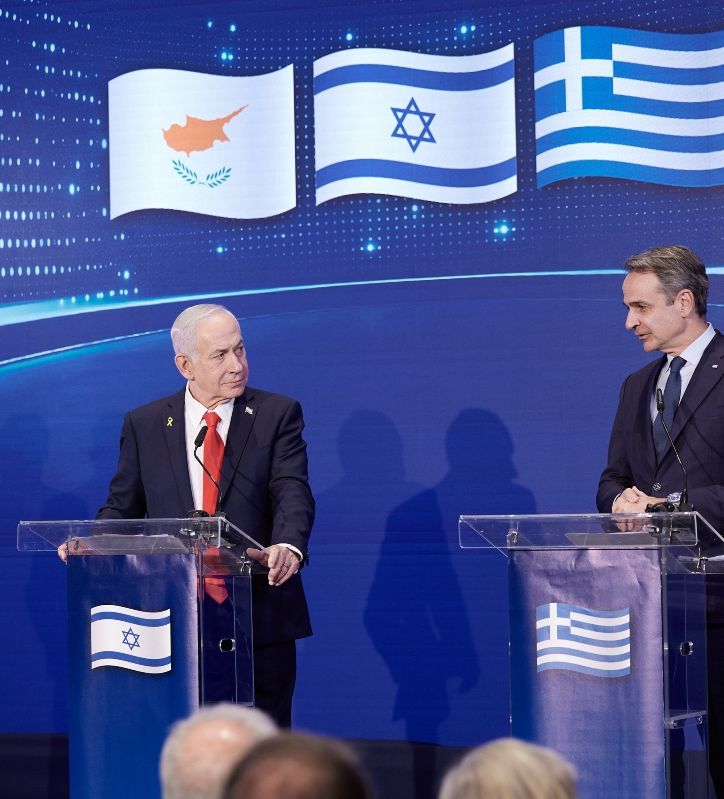
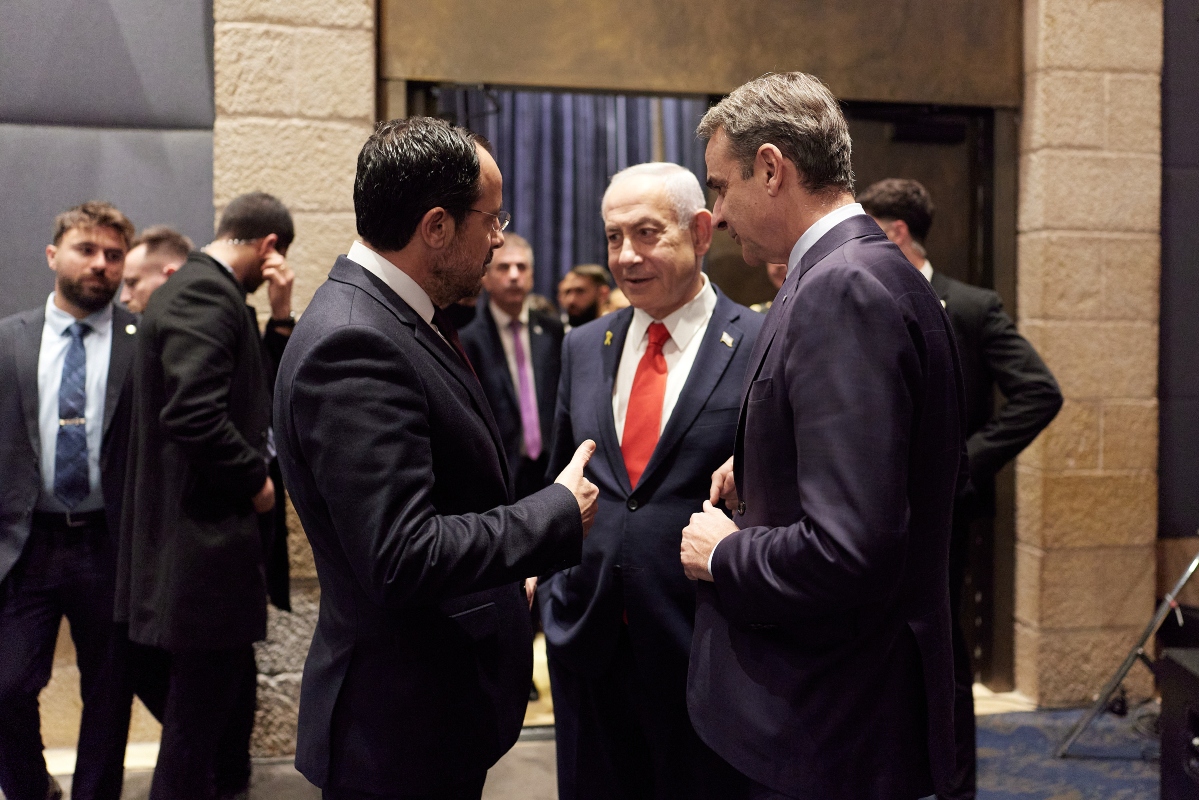
Against the backdrop of a fragile Eastern Mediterranean and shifting balances of power, the 10th trilateral Summit of Greece–Cyprus–Israel in Jerusalem functioned less as a routine diplomatic meeting and more as a political signal. One that, predictably, was read in Ankara as a provocation.
Although there was no official agenda, the summit’s focus was clear: strengthening the trilateral framework as a durable pillar of political, energy, and defense cooperation. It is precisely this multi-dimensional focus that has raised tensions with Turkey.
Cautious Mitsotakis and Christodoulides, Assertive Netanyahu
Unlike previous summits, Athens and Nicosia maintained a low profile. Prime Minister Kyriakos Mitsotakis and President Nikos Christodoulides used measured language, emphasizing stability, international law, and the strategic importance of cooperation in a region full of crises.
By contrast, Benjamin Netanyahu sent pointed signals interpreted as direct messages to Ankara. His reference to those “dreaming of restoring empires” functioned as a verbal warning, sparking new waves of Turkish reactions.
Behind the scenes, diplomatic sources note that the Israeli side aims to institutionalize the trilateral format, aware that the Netanyahu–Erdogan rivalry adds extra weight to the partnership.

Maximos Palace “Measures” Turkish Reactions
In Athens, the government sees the Turkish response as an indicator of the summit’s success. Officials recognize that portraying an active geopolitical axis enhances the prime minister’s image of decisiveness, especially amid internal friction over the Defense Ministry bill and reactions from non-commissioned officers.
It is no coincidence that even traditionally moderate media now interpret the trilateral as an implicit message of deterrence toward Turkey, reducing Ankara’s maneuvering space in the region.
From Diplomacy… to the Field
Turkey’s response has not remained purely verbal. FIR Athens violations, overflights, and a recent armed aerial encounter, the first in nearly three years, mark an escalating scenario.
Military sources estimate that Ankara reacts primarily to the trilateral defense pillar, particularly Greece–Israel collaboration on air defense systems for the Aegean islands. Despite Athens’ public denial of a 2,500-strong rapid reaction force, suspicion in Ankara remains high.
Turkish Defense Minister Yaşar Güler tried to strike a dual tone: he downplayed the cooperation as “non-threatening,” but simultaneously accused Greece of militarizing islands and of lobbying the U.S. on F-35 deliveries.

IMEC, 3+1, and the Trump Factor
Ankara is further unsettled by the support of the three countries for the India–Middle East–Europe Corridor (IMEC), a project Turkey perceives as geo-economic exclusion.
Meanwhile, reviving the 3+1 framework (Greece–Cyprus–Israel–USA) signals a desire to keep Washington actively engaged in the Eastern Mediterranean. Netanyahu’s upcoming meeting with Donald Trump at Mar-a-Lago adds U.S. leverage to the equation, a development closely monitored in Ankara.
The Jerusalem trilateral is not seeking conflict, but it cannot go unnoticed. In a region where the balance of power is being redrawn, the message was clear: The Eastern Mediterranean is developing new axes of stability – and Turkey must take note.
The question now is not if there will be reactions, but how far they will go.
Source: pagenews.gr