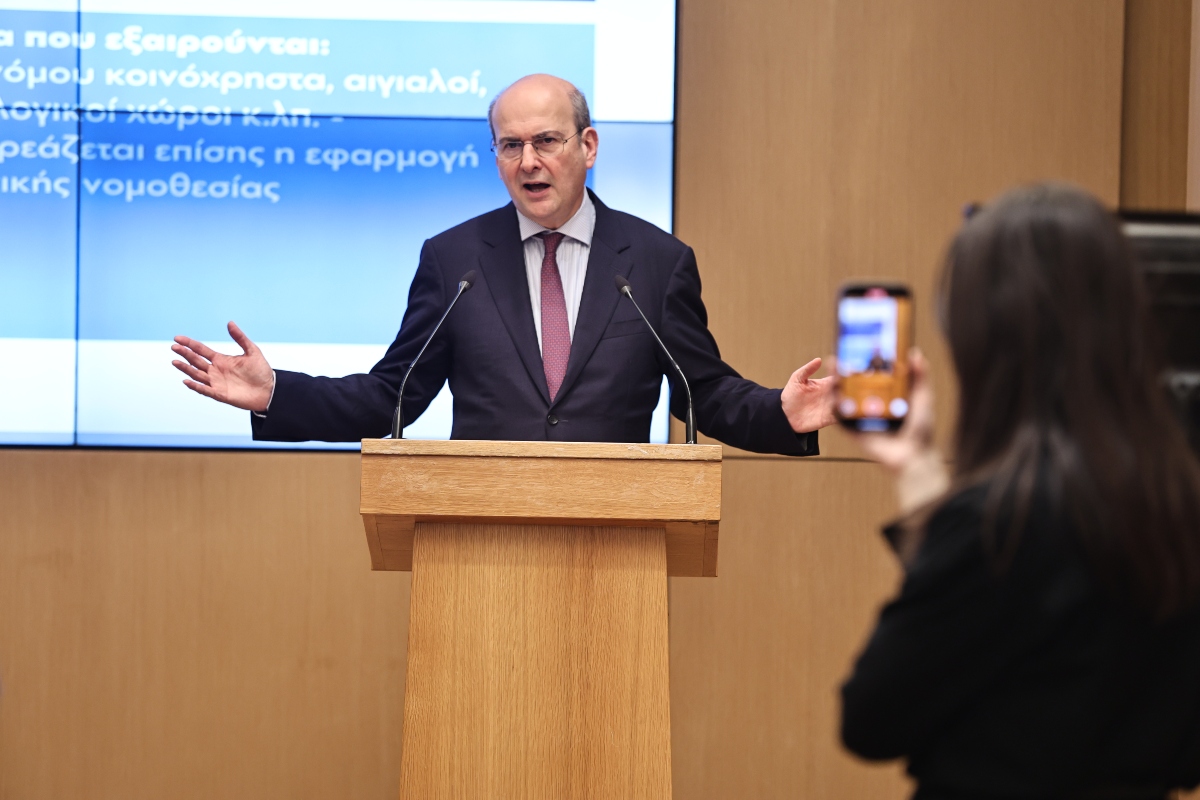
With a package of 14 targeted interventions, Greek Deputy Prime Minister Costis Hatzidakis is launching a direct assault on bureaucracy, placing the fight against the “deep state” at the center of the government’s political agenda. The draft bill, titled “Interventions for a More Citizen-Friendly State”, aims to fundamentally change the daily relationship between citizens and public administration.
The reform is not merely technical. Politically, it signals a renewed commitment by the government to confront structural inefficiencies that have long fueled public frustration. As Hatzidakis himself noted, the goal is to put an end to the “stories of everyday madness” that define interactions with the State.
A reform with political weight
In his introductory remarks, Hatzidakis underlined that the government already has tangible reform credentials: the introduction of performance evaluation in the public sector, the transfer of OPEKEPE to AADE, and the expansion of digital public services. The new bill builds on that foundation with reforms that directly affect citizens’ everyday lives.
Behind the scenes, the initiative is widely seen as a strategic move to reinforce the government’s reformist profile at a time when institutional credibility and administrative efficiency are becoming central political battlegrounds.


Trusting the citizen, controlling the system
A cornerstone of the bill is the replacement of dozens of certificates with sworn declarations. Citizens will no longer be required to submit documents already held by the State—such as civil registry certificates, degrees, citizenship records or land registry documents. The administration will accept declarations automatically, while imposing strict penalties and criminal sanctions for false statements, including the loss of the right to use sworn declarations in the future.
Ending absurd property disputes
One of the most socially sensitive reforms concerns state claims on private property. The State will abstain from asserting ownership over properties legally registered before 1975, as well as properties allocated through official public authority decisions, such as refugee housing settlements. The measure seeks to close long-standing legal disputes that have burdened courts and unsettled thousands of households.
Digital transparency and accountability
Citizens will now be able to track their applications online, see which official is responsible, and receive an estimated processing timeline. At the same time, the Integrity Advisor gains expanded powers to systematically monitor citizen complaints and report directly to the relevant minister.
Court rulings will no longer remain unimplemented. All decisions will be transmitted to ministerial Internal Audit Units, addressing the chronic problem of citizens having to return to court simply to enforce a ruling already in their favor.
Clear rules, one interpretation
To combat legal fragmentation, the bill mandates the uniform interpretation of legislation in citizen appeals. Centralized appeal bodies will be established to prevent regional discrepancies that have long undermined trust in public administration.
Administrative circulars must now be published on official websites within six months of their appearance in the Official Gazette, or they will cease to apply. Public service working hours must also be digitally published within three months, eliminating one of the most common sources of citizen confusion.
The EFKA model goes mainstream
One of the most strategically significant reforms is the expansion of the EFKA model across the public sector. Certified professionals—such as accountants, agronomists and veterinarians—will be authorized to carry out specific administrative procedures on behalf of the State, under strict supervision and constitutional safeguards.
Politically, this marks a shift toward a state that regulates and supervises, rather than one that insists on doing everything itself.
Notaries as one-stop shops
The role of notaries is significantly upgraded. They will act as one-stop service points for property transactions, handling documentation, tax declarations, debt offsets and payments to the State and social security funds. Citizens will only need to appear for the final signing.
Further simplifications include the abolition of mandatory topographic surveys for property transfers within urban planning zones, flexibility in inheritance tax payments, and the authority of AADE to permanently release seized properties.
The broader political message
Taken together, the 14 interventions form a coherent reform narrative: fewer documents, clearer rules, digital transparency and faster outcomes. Parapolitically, the message is unmistakable—this is a government willing to confront entrenched administrative practices, even at political cost.
As senior officials privately acknowledge, winning the battle of everyday bureaucracy is key to winning the broader political argument. With this reform package, Costis Hatzidakis places himself firmly at the forefront of that battle.
Source: pagenews.gr