


Nuclear shift from Paris: Mitsotakis opens debate on reactors as Europe seeks energy independence

Πηγή Φωτογραφίας: eurokinissi/Nuclear shift from Paris: Mitsotakis opens debate on reactors as Europe seeks energy independence



Europe reopens the nuclear debate
A new chapter in Europe’s energy debate is unfolding — and Greece is stepping into it.
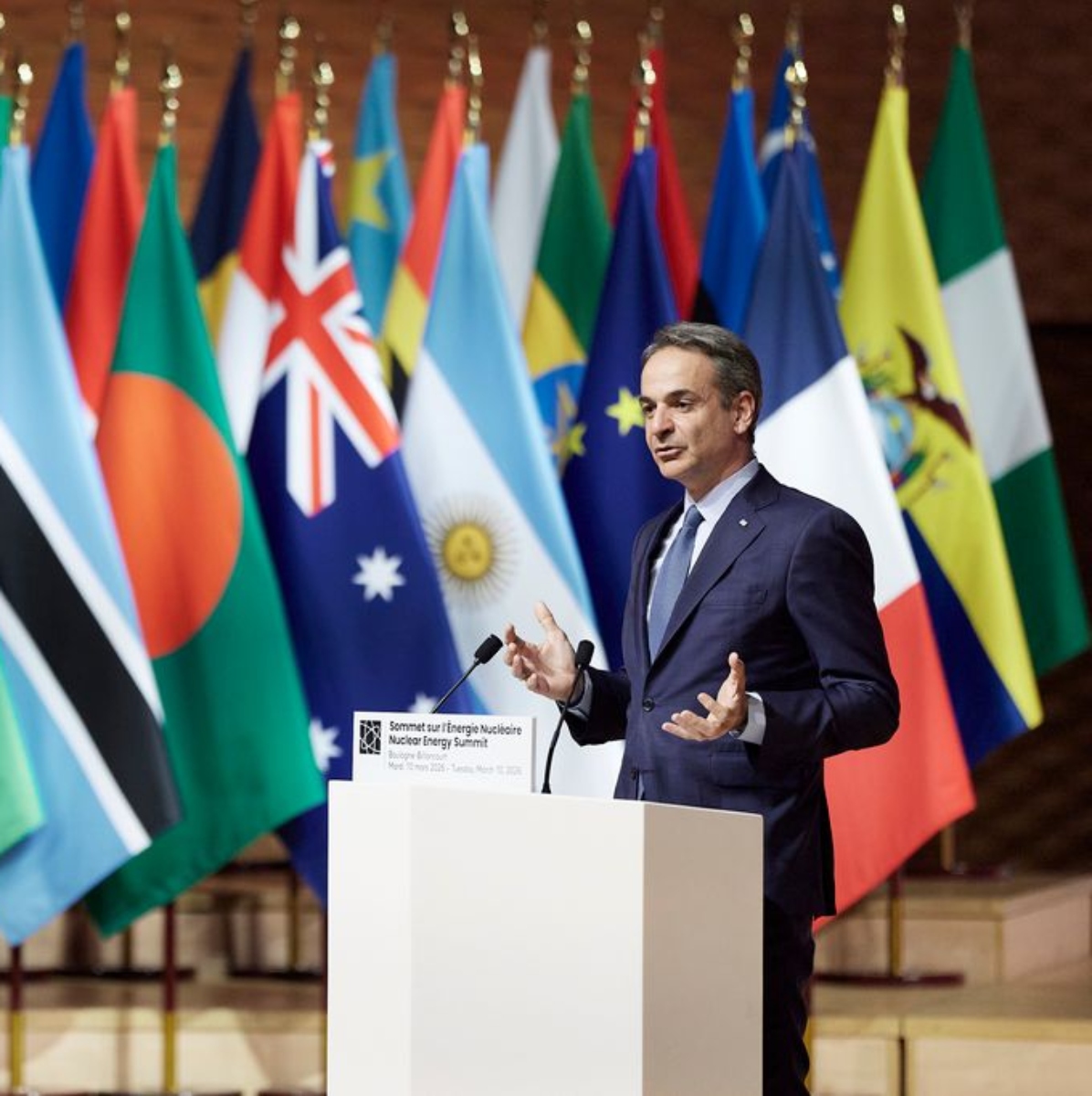
Speaking at the World Nuclear Energy Summit in Paris, Greek Prime Minister Kyriakos Mitsotakis signaled that Athens is ready to explore the potential role of nuclear technology in the country’s future energy mix.
“Greece is turning a page, and it is time to explore whether small modular reactors can play a role,” Mitsotakis said, pointing to the rapidly rising demand for electricity across Europe.
The remark marks a significant shift in tone for a country that has historically stayed outside the nuclear power debate, reflecting broader changes in Europe’s strategic thinking about energy security and decarbonization.
Greece faces a new energy dilemma
Greece is already undergoing a major energy transition.
The country has been expanding:
- renewable energy sources such as solar and wind
- natural gas infrastructure to support the power grid
At the same time, Athens plans to fully phase out lignite power plants by 2028, part of its commitment to climate neutrality and the EU’s Green Deal targets.
However, as Mitsotakis emphasized, Europe’s electricity demand is expected to rise dramatically in the coming decades, driven by electrification, artificial intelligence infrastructure and digital technologies.

“Even with an aggressive expansion of renewables, they may not be enough,” he noted.
This has led policymakers across Europe to reconsider nuclear energy as a stable baseload power source capable of supporting a carbon-neutral economy.
Small Modular Reactors: the new nuclear frontier
At the center of the discussion are Small Modular Reactors (SMRs) — a new generation of nuclear technology designed to be:
- smaller and faster to build
- less expensive than traditional reactors
- more flexible for national energy systems
SMRs can also be deployed near industrial zones or energy-intensive infrastructure, including data centers and hydrogen production facilities.
The Greek government has indicated that it plans to establish a specialized committee to examine the feasibility of integrating SMRs into the national energy strategy, signaling the start of a long-term policy conversation.
Macron’s geopolitical energy strategy
The Paris summit was not only about technology. It was also about geopolitics.
French President Emmanuel Macron used the event to call for a deep integration of Europe’s nuclear industry, arguing that nuclear energy must become a pillar of the continent’s strategic autonomy.
France already operates one of the world’s largest nuclear fleets and exported roughly 90 terawatt-hours of low-carbon electricity last year, reinforcing its role as Europe’s nuclear powerhouse.
According to Macron, this energy capacity also underpins the development of large-scale computing infrastructure, artificial intelligence systems and data centers, which require vast amounts of stable electricity.

Energy, technology and sovereignty are becoming inseparable in Europe’s strategic agenda.
The emerging “Nuclear Alliance” in Europe
In recent years, a group of European countries has begun advocating for a stronger role for nuclear energy in the EU’s energy transition.
This informal coalition — often referred to as the “Nuclear Alliance” — includes countries such as:
- France
- Poland
- Czech Republic
- Hungary
- Finland
These states argue that nuclear power is essential to ensure energy independence from fossil fuels and geopolitical suppliers, particularly after the energy crisis triggered by the war in Ukraine.
Greece has not joined the group formally but is increasingly participating in the broader strategic discussion shaping Europe’s future energy architecture.
Public opinion and political resistance
Despite growing strategic interest, nuclear power remains politically sensitive in Europe.
Memories of disasters such as Chernobyl and Fukushima still shape public perception, while environmental movements continue to push for a fully renewable energy model.
Mitsotakis acknowledged that public opinion remains divided, emphasizing the need for “an honest and transparent discussion across Europe” on the role nuclear energy might play in the continent’s transition.
The strategic question for Greece
The debate sparked in Paris goes far beyond energy policy.
It touches on three major strategic challenges:
- Europe’s energy security
- technological competitiveness in the AI era
- industrial resilience in a volatile geopolitical environment
For Greece, the question is becoming increasingly clear:
Should the country rely solely on renewable energy — or consider nuclear technology as part of a diversified energy strategy?
The answer will not come quickly.
But the conversation that began in Paris suggests that Europe’s nuclear comeback may already be underway.
Source: pagenews.gr
Διαβάστε όλες τις τελευταίες Ειδήσεις από την Ελλάδα και τον Κόσμο






Το σχόλιο σας