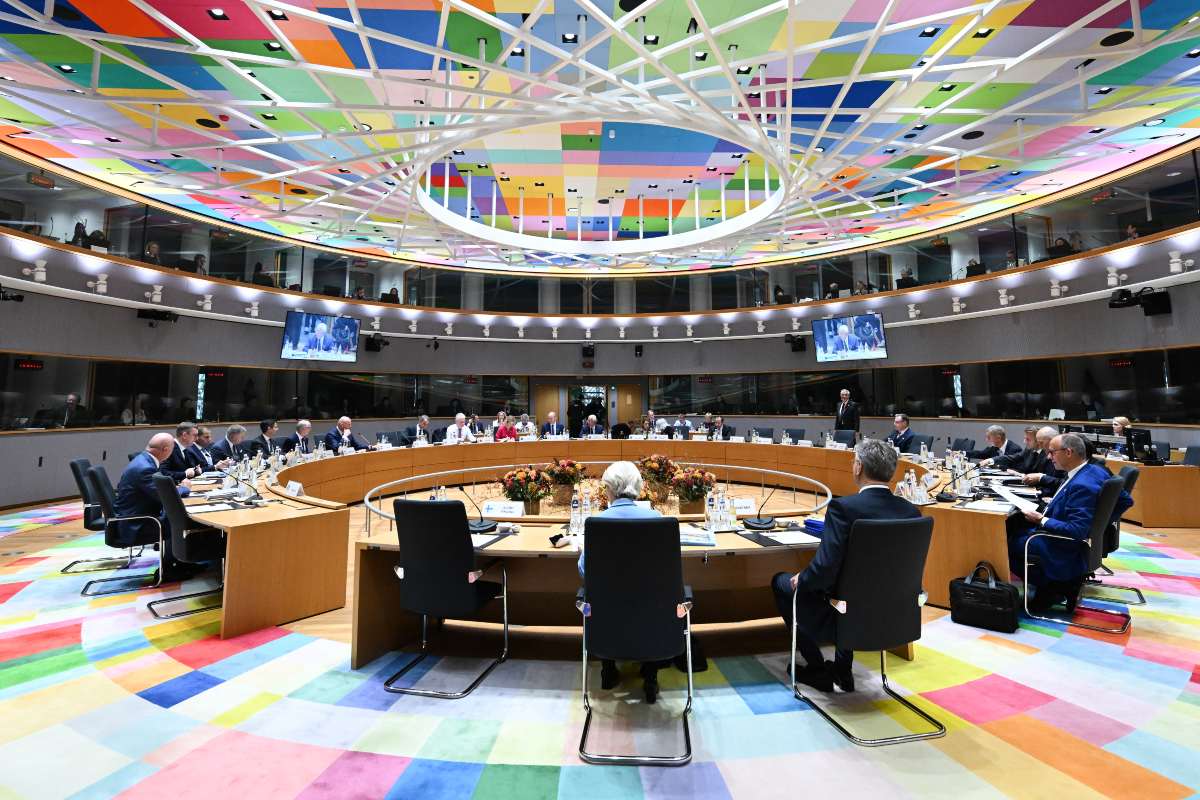
European Union leaders are gathering in Brussels on October 15–16, 2026, for a summit dominated by mounting economic pressures, geopolitical uncertainty and disagreements over the future direction of European policy.
At the centre of the discussions are the renewed energy crisis, negotiations over the EU’s next long-term budget, developments in Ukraine and the increasingly contentious issue of migration.
For Greece, the immediate priority is securing additional flexibility to protect households and businesses from rising energy costs.
Prime Minister Kyriakos Mitsotakis is pressing for a stronger European response, arguing that national measures alone cannot adequately address a crisis affecting the entire European economy.
However, disagreements over fiscal discipline, spending priorities and relations with Russia complicate the prospects for an immediate agreement.
Energy Crisis Returns to the Top of the EU Agenda
Energy prices have once again become a major concern for European policymakers, with rising costs placing pressure on household purchasing power, industrial production and economic competitiveness.
The challenge extends beyond fuel prices. European governments must determine how to respond to renewed inflationary pressures while preserving fiscal stability.
Athens is calling for additional European measures that would allow member states to provide targeted financial assistance to households and businesses.
The central question is whether the EU can develop a coordinated response or whether individual governments will continue to rely primarily on their national budgets.
The latter approach risks widening economic differences between member states, as countries with stronger public finances generally have greater capacity to introduce substantial support packages.
For Greece, the issue is particularly important because higher energy costs affect not only household budgets but also manufacturing, transport, agriculture and the wider economy.


Mitsotakis Seeks Greater Fiscal Flexibility
Prime Minister Mitsotakis wants the European Council conclusions to include a request for the European Commission to examine additional measures and greater fiscal flexibility.
The Greek government argues that an energy crisis affecting the entire European Union requires a response that goes beyond existing national initiatives.
Such flexibility could take different forms, including targeted fiscal arrangements, exceptional support measures or special mechanisms designed to address extraordinary energy-related expenditure.
One possibility being discussed is a specific escape clause or temporary fiscal accommodation for energy support.
However, any such arrangement would require agreement on eligible expenditure, activation conditions and compatibility with the EU’s fiscal framework.
No new mechanism of this kind has yet been formally agreed by the 27 member states.
Athens is therefore seeking a political commitment that would encourage the European Commission to develop further proposals.
Mitsotakis has also acknowledged that negotiations are unlikely to be completed during the current summit.
Trump–Putin Diesel Deal Complicates Europe’s Energy Strategy
The energy debate has become more politically sensitive following US President Donald Trump’s announcement concerning imports of Russian diesel.
The initiative has prompted criticism from European governments concerned that easing economic pressure on Moscow could undermine efforts to restrict Russia’s energy revenues.
The disagreement exposes a difficult balance between two priorities.
On one side is the need to reduce energy costs and ease the burden on consumers and businesses.
On the other is the European strategy of maintaining sanctions and economic pressure on Russia over its war against Ukraine.
Trump’s statements about a possible energy ceasefire have also raised questions about the extent of any understanding between Washington and Moscow.
Public statements from the parties involved do not establish that a comprehensive and operational energy ceasefire has been agreed.
For European leaders, the challenge is to maintain a coherent policy toward Russia while managing the economic consequences of higher energy prices.
Ukraine: Energy Security Becomes a Geopolitical Test
Ukraine remains a central issue on the European Council’s agenda, with energy security increasingly intertwined with diplomatic and military developments.
European governments must assess the implications of Washington’s initiatives, the future of sanctions against Russia and Ukraine’s support requirements ahead of winter.
The resilience of Ukraine’s energy infrastructure remains essential to the country’s economic stability and civilian population.
At the same time, attacks involving energy facilities and fuel infrastructure have increased the strategic significance of the energy sector in the wider conflict.
The possibility of changes in US policy toward Russian energy exports introduces additional uncertainty for European governments.
Some member states remain focused on maintaining maximum economic pressure on Moscow, while others are concerned about the consequences of prolonged energy market disruption.
The EU’s central challenge is to reconcile energy security, economic stability and continued support for Ukraine.
EU Budget Negotiations Open Another Front
The next Multiannual Financial Framework represents another major source of disagreement among European leaders.
Negotiations concern both the overall size of the EU budget and the allocation of resources across competing priorities.
Some member states support stronger common European financing to address rising requirements in defence, energy, competitiveness and infrastructure.
Others favour spending restraint and stricter budgetary discipline.
Greece is placing particular emphasis on preserving funding for cohesion policy and the Common Agricultural Policy.
These programmes remain essential to regional investment, rural development and agricultural activity.
Athens argues that emerging European priorities should not be financed by weakening established programmes supporting less-developed regions and farming communities.
The debate reflects a broader question about the future of European integration: how should the Union balance traditional redistributive policies with new strategic ambitions?
The Frugal Countries Versus the Friends of Cohesion
The budget negotiations are revealing increasingly visible differences among groups of EU member states.
Governments advocating tighter spending controls are prioritising fiscal sustainability and the containment of overall expenditure.
By contrast, the so-called Friends of Cohesion, including Greece, argue that reducing regional development resources could widen economic disparities within the Union.
Similar concerns surround agricultural funding, particularly in countries where farming plays an important economic and social role.
For Greece, protecting these resources is a central negotiating objective.
Cohesion funding supports infrastructure, investment and regional development, while the Common Agricultural Policy provides important financial support for agricultural producers and rural communities.
The dispute is therefore about more than budget figures.
It concerns the economic priorities and political identity of the European Union over the coming years.
Pressure to Reach a Budget Agreement
European leaders are also facing pressure to make progress before the end of 2026.
A series of national electoral contests in the following year could complicate negotiations by changing domestic political priorities and government positions.
However, reaching a political understanding does not necessarily mean that all stages of the budget’s adoption will be completed immediately.
The next long-term EU budget will require extensive negotiations between European institutions and member states.
The central difficulty lies in reconciling demands for additional investment with resistance to higher common expenditure.
This tension is especially pronounced as the EU seeks to strengthen its defence capabilities, energy independence and technological competitiveness.


Migration: Another Potential Source of Division
Migration is also expected to generate difficult discussions among European leaders.
Member states continue to disagree over border management, responsibility-sharing, asylum procedures and returns.
Greece is advocating a European mechanism designed to address exceptional migration crises at the Union’s external borders.
The proposal draws on experiences such as the pressure at the Greek-Turkish border in Evros in 2020 and similar developments in Ceuta.
According to the Greek government, the initiative has received support at the European level.
However, the final legislative arrangements will need to define the circumstances in which exceptional measures may be introduced, together with the relevant legal safeguards.
Any mechanism must comply with applicable EU and international law, including fundamental rights protections and the principle of non-refoulement.
Disagreements over how responsibility should be distributed among member states remain a significant obstacle to a fully unified European migration policy.
Greece’s Agenda and the Domestic Political Dimension
For the Mitsotakis government, the summit comes at a politically sensitive moment.
The cost of living remains a central issue for Greek households, while businesses continue to face pressure from energy prices and operating expenses.
Securing additional European flexibility could give Athens more options for targeted financial support.
Meanwhile, negotiations over the EU budget will influence future funding opportunities for farmers, regional authorities and investment programmes.
With Greece’s next national elections expected in 2027, economic conditions are also likely to carry significant domestic political importance.
Nevertheless, the government’s ability to deliver additional support will depend partly on decisions made at the European level.
The outcome cannot be determined by Athens alone.
A Crucial Test of European Unity
The October 15–16 European Council highlights the competing priorities confronting the European Union.
The energy crisis requires economic intervention, but governments disagree over how far common support should extend and how it should be financed.
The next EU budget must address new strategic challenges while preserving existing commitments to agriculture and regional development.
Ukraine remains central to European security, while US initiatives involving Russia have introduced additional diplomatic uncertainty.
Migration continues to expose differences over external border management and asylum policy.
For Greece, the objectives are clear: greater capacity to support the economy, protection of key European funding programmes and stronger mechanisms for managing exceptional migration pressures.
The outcome of the Brussels negotiations will indicate whether the 27 member states can develop common responses or whether national differences will continue to delay major decisions.
At stake is not only the EU’s immediate response to the energy crisis but also its ability to reconcile economic resilience, geopolitical security and long-term financial priorities.
Source: pagenews.gr