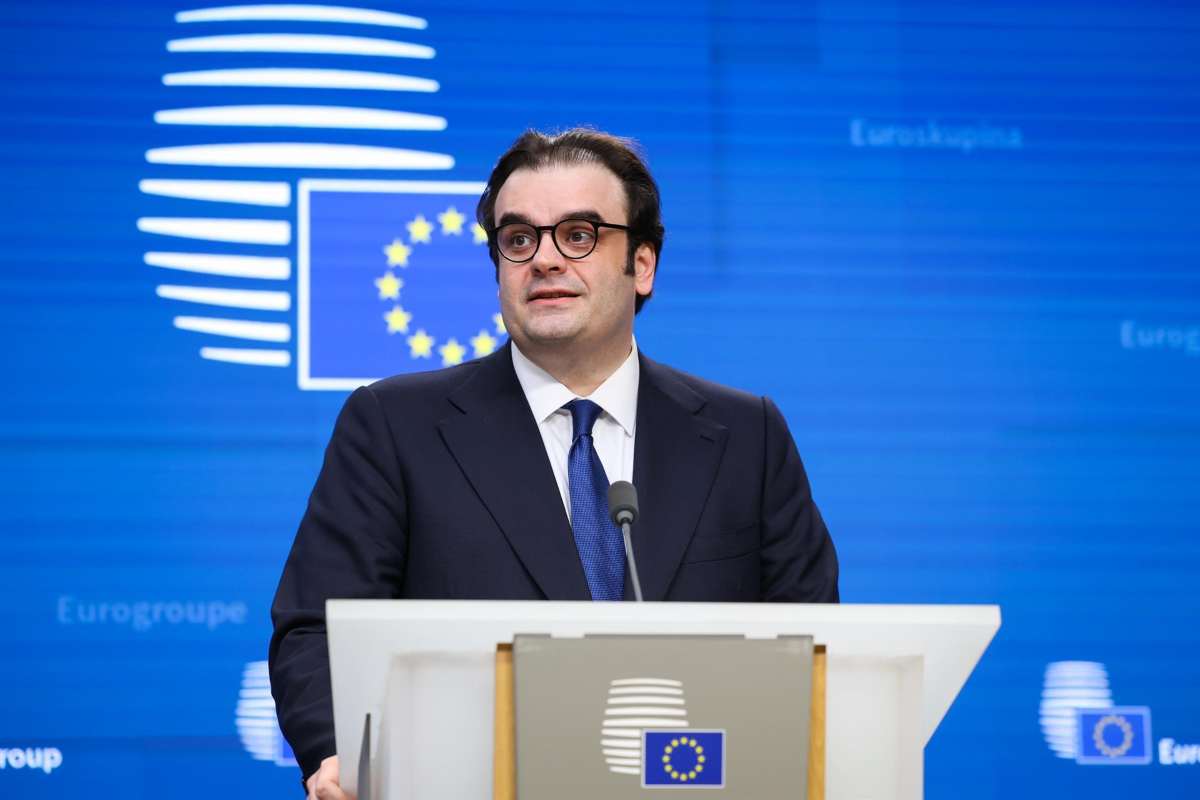
Kyriakos Pierrakakis delivered a message of confidence in Europe’s economic resilience at the IMF Annual Meetings in Bangkok, presenting Greece’s fiscal progress as evidence of the importance of credible economic policy.
Greece’s Minister of National Economy and Finance and President of the Eurogroup joined IMF Managing Director Kristalina Georgieva for a discussion on building resilient and dynamic economies.
The conversation focused on public finances, investment and Europe’s productivity gap with the United States. Georgieva praised Greece’s progress while warning that the foundations of global economic resilience remain fragile.
The shared challenge is turning the capacity to withstand crises into sustained gains in productivity, investment and living standards.
Fiscal Discipline as a Foundation for Growth
Pierrakakis linked Greece’s experience to the need for reliable economic management.
“The message Greece sends is that fiscal discipline is a prerequisite for growth,” he said.
He stressed that sound public finances must be accompanied by reforms at both national and European levels.
That argument carries particular weight as higher sovereign bond yields increase refinancing costs. Rising interest payments can absorb resources that governments would otherwise direct towards investment, public services or support during an economic shock.
For Greece, maintaining credibility remains central to securing stable financing and preserving room to respond to future pressures.
Georgieva Praises Greece’s Changed Position
The IMF managing director highlighted Greece’s early repayment of its loans to the Fund, alongside its contribution to financing technical assistance for other economies.
Her remarks illustrated a significant change in the country’s relationship with the institution: Greece has moved from requiring financial support to helping strengthen capacity elsewhere.
Pierrakakis also expressed the government’s ambition for Greek growth next year to exceed the IMF’s forecast, describing the Fund as traditionally more conservative in its projections.
That remains a government objective. Its achievement will depend on investment, economic activity and the wider international environment.
Monitoring Developments Without Being on High Alert
On Europe, the Eurogroup president emphasised resilience while acknowledging substantial challenges.
“We are monitoring developments, but we are not on high alert,” he said.
He pointed to high energy prices, fragmentation within the single market and major investment requirements. At the same time, he argued that European banks are better capitalised and the institutional framework is stronger.
“Europe is resilient to geopolitical developments and successive shocks,” Pierrakakis said, linking that resilience to an opportunity for deeper reform.
His argument was that Europe has stronger foundations from which to act, even as external pressures persist.


Capital Markets Integration Moves Up the Agenda
Pierrakakis placed particular emphasis on the Capital Markets Union and the Banking Union.
He referred to political agreement at the latest Eurogroup on unified supervision of European capital markets, arguing that progress over the past ten months had exceeded that of the preceding decade.
The practical objective is to channel more European savings into investment and help businesses access funding across borders.
Political agreement is an important starting point. Legislative implementation and effective supervision will determine how far integration advances.
Lagarde: Europe Must Capture the Benefits of AI
A related argument was made by ECB President Christine Lagarde in Vienna on September 14, 2026.
She highlighted how European savings are helping finance the artificial intelligence boom, with substantial investment flowing to the United States.
“The question is whether it will also get the growth that goes with it,” she said of Europe’s exposure to the boom’s financing costs.
Lagarde argued that Europe needs deeper capital markets and more equity financing to help innovative businesses grow.
Her intervention complements Pierrakakis’s case for stronger European companies and greater investment: adopting new technology offers benefits, but Europe also needs the financial capacity to develop parts of that technology itself.
Europe’s Productivity Gap Remains a Central Problem
Pierrakakis identified weak productivity growth as Europe’s biggest economic challenge.
According to the figures he presented, productivity increased at an average annual rate of 1.8% in the United States, compared with 1.1% in Europe, over the past thirty years.
Such differences accumulate over time, affecting income growth, public revenues and the ability to finance new commitments.
His proposed response combines financial integration, structural reform and European businesses capable of competing internationally.
The underlying goal is to expand Europe’s productive capacity rather than rely solely on its ability to absorb shocks.
Lagarde’s Warning on Energy Prices
Lagarde set out the limits of monetary policy’s role in an energy shock during a speech in Frankfurt on March 25, 2026.
“Monetary policy cannot bring down energy prices,” she said.
The ECB’s task, she explained, is to assess when higher energy costs risk spreading into broader inflation through indirect effects, wages and inflation expectations.
She also argued that targeted government policies can help lower-income households, while broad and open-ended measures may stimulate demand excessively.
That distinction remains important to Europe’s policy debate: protecting vulnerable households while limiting additional inflationary and fiscal pressures.
Georgieva Warns That Resilience Has Limits
Georgieva offered a more cautious assessment of the global outlook.
She highlighted widening differences between economies benefiting from artificial intelligence and countries burdened by energy imports.
Higher energy and food prices, pressure on central banks and elevated public debt add further risks.
Her question on AI concerned the durability of a major source of growth: what happens if the investment enthusiasm supporting the expansion weakens?
The warning reinforces the case for rebuilding fiscal buffers and strengthening productive capacity.
Greece’s improved standing offers a positive example. For Europe more broadly, the next challenge is to combine that kind of credibility with the investment and reforms needed to sustain growth.
Source: pagenews.gr