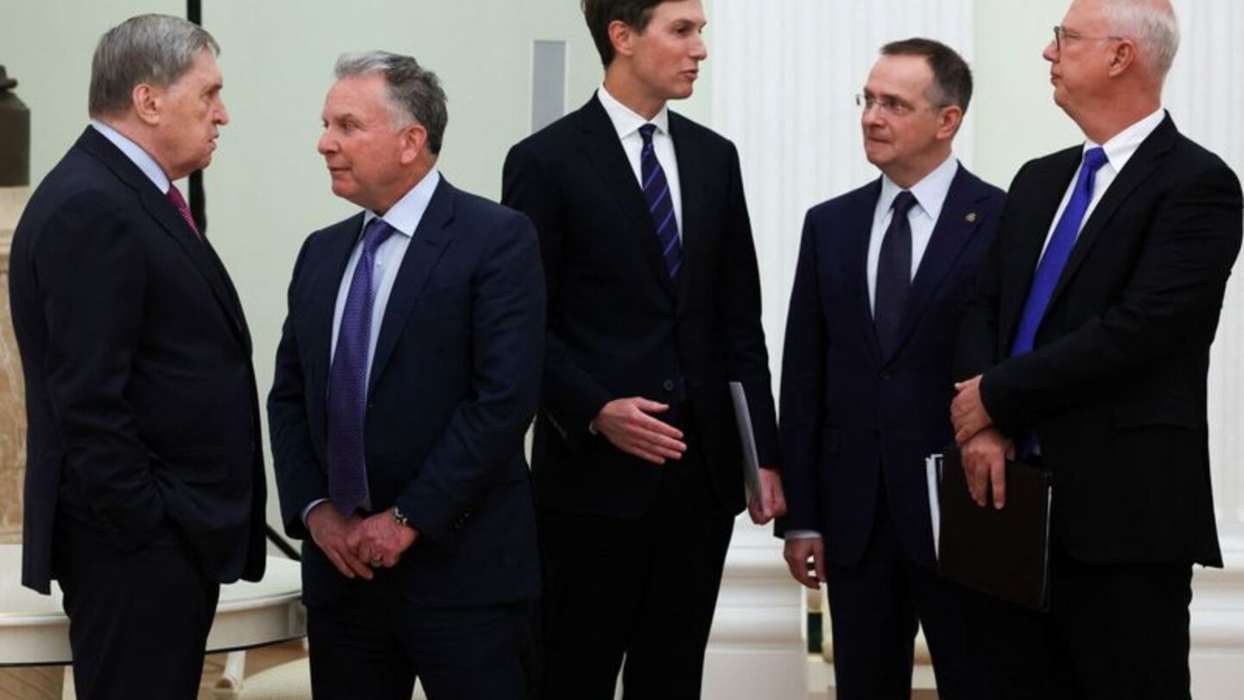
Russia has delivered a pointed diplomatic message to Washington and Europe’s political leaders: European participation in the next round of Ukraine peace negotiations has not been agreed.
In a statement that directly contradicts the account given by American negotiators following their meeting with Russian President Vladimir Putin, senior Kremlin aide Yuri Ushakov said on Monday, November 16, that Moscow had not consented to expanding the existing trilateral format.
The intervention comes just days after Russian, Ukrainian and American officials resumed negotiations in Abu Dhabi for the first time in nine months.
What initially appeared to be a diplomatic breakthrough has now exposed a disagreement over the structure of the next phase of negotiations.
The issue extends far beyond diplomatic protocol.
At stake is whether Europe will have a direct role in shaping a potential settlement that could redefine its own security for decades.
Kremlin Draws a Red Line: No Agreement on European Participation
Speaking to reporters in Moscow, Ushakov made clear that discussions currently concern another round of talks involving Russia, Ukraine and the United States.
“What is currently being discussed is holding the next round in a trilateral format,” he said, according to Reuters.
He confirmed that the negotiations had resumed in Abu Dhabi and that the participants had agreed to continue the process.
However, he rejected suggestions that an expanded format had already been approved.
“The date has not yet been agreed and the expansion of the format, some people are talking about it, but it has not been agreed with us.”
The statement leaves little room for ambiguity.
Moscow is not categorically ruling out future European involvement, but it is denying that any such arrangement has been finalised.
The distinction is significant.
By withholding agreement, Russia retains influence over both the timing and the composition of future negotiations.


Washington Says Putin Agreed — Moscow Says Otherwise
The diplomatic dispute follows a sequence of high-level meetings.
Last week, representatives from Russia, Ukraine and the United States gathered in Abu Dhabi, marking the first resumption of their talks in nine months.
Following those discussions, two American envoys travelled to Moscow for a meeting with President Vladimir Putin.
Afterwards, the US negotiators indicated that Putin had agreed to allow European representatives to participate in the next round.
Ushakov’s intervention challenges that interpretation.
Although the Kremlin aide did not explicitly refer to the American statements, his remarks establish a clear contradiction between the two accounts.
The disagreement raises several questions.
Did the American negotiators interpret a preliminary discussion as a commitment?
Did Moscow subsequently reconsider its position?
Or is the Kremlin deliberately preserving flexibility ahead of further negotiations?
The available statements do not establish which explanation is correct.
What is clear is that there is no publicly confirmed agreement between Moscow and Washington on expanding the negotiating format.
Ushakov Sets Conditions: More Talks Before Europe Can Join
Asked what would be required for Russia to accept European participation, Ushakov suggested that the process could take considerably longer.
“A great deal would have to be done before that could be agreed,” he said.
He added:
“In particular, it may be necessary to hold another round, or perhaps more than one round, of trilateral talks.”
This is a revealing diplomatic position.
Moscow is effectively linking any expansion of the negotiating table to further progress within the existing three-party framework.
Rather than allowing European representatives to join immediately, the Kremlin appears to favour additional discussions among Russia, Ukraine and the United States.
Such an approach could give Moscow greater influence over the initial negotiating agenda before other participants become involved.
It also places Washington in a difficult position.
The United States must now reconcile its own public account of the Putin meeting with the Kremlin’s insistence that no agreement has been reached.
Moscow’s Challenge to Europe: What Can You Contribute?
Ushakov went further by questioning what European representatives would bring to the negotiations.
According to the Kremlin aide, Moscow would need:
“A clear signal from the Europeans about what they want and what constructive, substantive contribution they can make to a successful settlement in Ukraine.”
The formulation is politically significant.
Russia is not merely requesting clarification about which European officials might attend future meetings.
It is asking European governments to define their objectives and demonstrate how their involvement would contribute to a settlement.
That effectively turns European participation into a separate subject of negotiation.
It also allows Moscow to scrutinise European positions before agreeing to an expanded diplomatic framework.
The Kremlin’s message is that Europe cannot assume it will automatically receive a seat at the negotiating table.
Whether this represents a genuine procedural concern or an attempt to gain additional leverage remains open to interpretation.


Europe’s Strategic Dilemma: Its Security Is Being Negotiated Without It
The dispute exposes a fundamental problem for the European Union.
The war in Ukraine has transformed the continent’s security environment.
European governments have provided substantial financial, military and political assistance to Kyiv.
They have also imposed extensive sanctions on Russia and committed significant resources to strengthening their own defence capabilities.
Any eventual peace settlement could have direct consequences for European security guarantees, sanctions policy, military deployments and the future relationship between Russia and the West.
Yet the negotiations that resumed in Abu Dhabi involved Russia, Ukraine and the United States, without direct European participation.
This creates a strategic contradiction.
Europe may ultimately be expected to help finance, guarantee or implement elements of a peace settlement in whose initial negotiation it has had no formal role.
For Brussels and major European capitals, the issue is therefore not simply diplomatic recognition.
It concerns their ability to influence decisions that could shape the continent’s security architecture for decades.
France, Germany and other European governments have a substantial interest in ensuring that any agreement addresses the long-term security implications of the conflict.
The Kremlin’s position complicates that objective.
Is Putin Trying to Control the Negotiating Table?
Russia’s preference for retaining the trilateral format may offer several strategic advantages.
A smaller negotiating group can be easier to manage, particularly when the parties are attempting to establish basic principles before discussing detailed arrangements.
But the composition of the talks also affects the balance of influence.
In a three-party format, Moscow negotiates directly with Kyiv and Washington.
European participation would introduce additional perspectives, particularly on sanctions, reconstruction, territorial questions and security guarantees.
Some European governments may advocate positions that differ from those favoured by Washington.
Their inclusion could therefore make negotiations more complex.
From Moscow’s perspective, postponing European involvement could preserve a narrower diplomatic environment in which initial understandings are developed.
This is a geopolitical interpretation rather than a confirmed statement of Russian intentions.
The Kremlin’s official explanation remains that further trilateral negotiations may be necessary and that European governments must clarify their proposed contribution.
Nevertheless, the power to determine who participates in negotiations can itself become an important source of diplomatic leverage.
Trump Faces a Diplomatic Test Between Moscow and Europe
The disagreement also creates a challenge for the Trump administration.
Washington has sought to advance negotiations aimed at ending the war.
But the United States must balance direct engagement with Moscow against the expectations of its European allies.
If American negotiators believe Putin accepted European participation while the Kremlin publicly denies doing so, questions arise about the understandings reached during the Moscow meeting.
Such ambiguity can undermine confidence and complicate preparations for subsequent talks.
It may also increase European concerns about being excluded from decisions affecting their own security.
For the Trump administration, the immediate priority will be to establish whether the disagreement reflects a misunderstanding, an unresolved negotiating point or a substantive difference between Washington and Moscow.
Until that question is clarified, the next phase of diplomacy remains uncertain.
Three Scenarios for the Next Round of Ukraine Peace Talks
Scenario One: The Trilateral Format Continues
Russia, Ukraine and the United States agree to another round of negotiations without European representatives.
This would be consistent with the framework described by Ushakov.
The parties could focus on identifying areas of potential agreement before considering a broader format.
Scenario Two: Europe Joins After Additional Negotiations
Following one or more further trilateral meetings, Moscow agrees to include European representatives.
Such an arrangement might require prior consultations about their role, objectives and participation in specific discussions.
This would allow European governments to become directly involved while preserving the initial negotiating structure.
Scenario Three: Disagreement Over Participation Delays Progress
The dispute over Europe’s role becomes an additional obstacle to the diplomatic process.
Moscow maintains its objections, while Washington and European governments press for a broader format.
Even if the parties remain committed to negotiations, disagreement over representation could delay the next meeting or complicate its agenda.
These scenarios are analytical possibilities, not confirmed plans or probability-based forecasts.
The Larger Question: Who Will Design Europe’s Postwar Security Order?
The Kremlin’s intervention demonstrates how fragile the renewed diplomatic process remains.
Negotiations have resumed after a nine-month interruption, but the date of the next round has not been settled.
Nor has the composition of that round been agreed.
Russia insists that European participation requires additional discussions.
American negotiators have presented a different account of their meeting with Putin.
European governments, meanwhile, face the possibility that the early framework for a settlement could be shaped without their direct involvement.
Moscow has not permanently closed the door to Europe. But it has made clear that European participation will not be granted automatically.
That distinction could become central to the next stage of negotiations.
The war in Ukraine is no longer only a question of ending military hostilities.
It is also a struggle over the future security architecture of Europe, the relationship between Washington and Moscow, and the role European governments will play in shaping the settlement.
For Kyiv, the central concern remains securing a peace that protects Ukraine’s sovereignty and future security.
For Washington, the challenge is to advance negotiations while maintaining coordination with its allies.
For Moscow, the composition of the negotiating table has become another issue over which it can seek influence.
And for Europe, the stakes could hardly be higher.
The next diplomatic battle may not concern territory, sanctions or security guarantees. It may begin with a more fundamental question: who gets a seat at the table where Europe’s future is being negotiated?
Source: pagenews.gr