“Key elements of a peace agreement, whether they concern sanctions or the security architecture, can only be resolved together with us Europeans.”
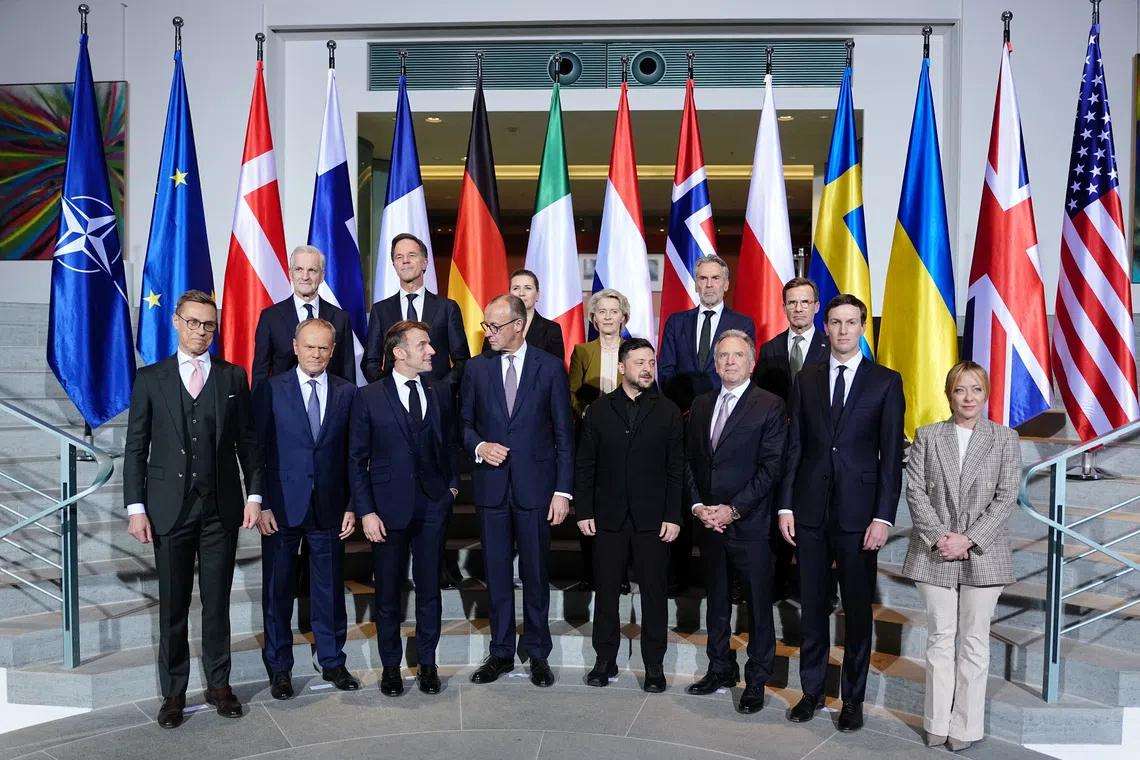
With this declaration, German Chancellor Friedrich Merz set the political tone for the Coalition of the Willing summit taking place in Berlin on Thursday, November 19, 2026.
Under the slogan “United for Peace in Ukraine and European Security,” the German capital is hosting one of the largest international gatherings dedicated to supporting Ukraine since Russia launched its full-scale invasion in February 2022.
According to the summit’s initial briefing, delegations from 36 countries, approximately 30 heads of state and government, and representatives of the European Union and NATO are participating. A subsequent German government announcement refers to 37 participating countries.
Among those attending are Greek Prime Minister Kyriakos Mitsotakis, Ukrainian President Volodymyr Zelenskyy, French President Emmanuel Macron, British Prime Minister Andy Burnham, and US presidential envoys Steve Witkoff and Jared Kushner.
The summit was convened at the invitation of Merz, Macron and Burnham, with a central objective: reaffirming international support for Kyiv while ensuring that Europe plays a decisive role in any future peace negotiations.
The gathering comes amid renewed diplomatic activity surrounding the Ukraine war and growing concern among European governments that major decisions affecting the continent’s security could be negotiated without their full participation.
Berlin’s message is that Europe cannot simply finance Ukraine’s defence and reconstruction while remaining outside negotiations over the continent’s future security arrangements.


Germany Sends a Message to Moscow: Time for Serious Negotiations
German Foreign Minister Johann Wadephul described the summit as an unprecedented demonstration of support for Ukraine.
“This will be the largest gathering of Ukraine’s supporters we have seen so far,” Wadephul told Deutsche Welle on Wednesday evening.
He emphasised that the meeting was intended to send a clear message to Russia.
According to the German foreign minister, Moscow must engage seriously in negotiations aimed at ending the war.
At the same time, the coalition is demonstrating its determination to continue supporting Ukraine into the fifth year of the conflict.
Wadephul stressed that the participating governments remain prepared to take the necessary steps to ensure Kyiv can negotiate from a position of strength.
The German approach combines two objectives: supporting diplomatic efforts to end the war while maintaining military and economic assistance to Ukraine.
For Berlin, an agreement cannot be judged solely by whether it stops the fighting.
It must also provide credible conditions for preventing another Russian attack.
This distinction is central to the European position.
A ceasefire without effective security guarantees could leave Ukraine vulnerable to renewed hostilities.
Merz: No Peace Agreement Without European Participation
One of the strongest statements ahead of the summit came from Chancellor Merz, who insisted that Europe must participate in negotiations affecting its own security.
“Key elements of a peace agreement, whether they concern sanctions or the security architecture, can only be resolved together with us Europeans. Everyone involved knows this very well,” he said.
His remarks address two critical dimensions of any future settlement.
The first concerns sanctions against Russia.
The European Union has imposed extensive economic restrictions on Moscow, and any significant changes would require decisions by the relevant European institutions and member states.
Washington cannot independently determine the future of European sanctions.
The second issue concerns security guarantees.
Any agreement involving military deployments, deterrence arrangements, NATO relations or Ukraine’s future defence capabilities would have direct consequences for European governments.
For Germany, France and Britain, this makes European participation essential.
The summit therefore represents more than another expression of solidarity with Ukraine.
It is also an attempt to establish Europe’s role in the diplomatic process.
Mitsotakis in Berlin: Greece Participates in Europe’s Security Discussions
The participation of Kyriakos Mitsotakis places Greece among the governments discussing Ukraine’s future and the broader European security framework.
Athens has consistently supported Ukraine’s sovereignty and territorial integrity, participating in European sanctions against Russia and assistance initiatives for Kyiv.
The Berlin discussions extend beyond the immediate military situation.
They concern energy security, economic assistance, infrastructure protection, reconstruction and the conditions that could underpin a lasting peace.
For Greece, respect for sovereignty, territorial integrity and international law remains a central principle of foreign policy.
Participation in the Coalition of the Willing allows Athens to contribute to European discussions on Ukraine’s long-term security and financial requirements.
The issue is particularly relevant because decisions concerning Ukraine could influence the broader European security environment for years.
The information available before the summit does not establish any new Greek commitment involving troop deployments or additional financial contributions.
Nevertheless, Mitsotakis’s presence reflects Greece’s participation in the wider European diplomatic effort.
Zelenskyy, Witkoff and Kushner: Washington’s Presence Raises the Stakes
The participation of Ukrainian President Volodymyr Zelenskyy and the two US envoys adds considerable diplomatic weight to the meeting.
Steve Witkoff and Jared Kushner are attending at a time of renewed discussions about possible negotiations to end the war.
Their presence gives European leaders an opportunity to engage directly with representatives of the Trump administration.
For Zelenskyy, the summit offers a platform to seek continued military and financial commitments from Ukraine’s partners.
Kyiv wants any peace settlement to include credible guarantees against future Russian aggression.
The Ukrainian government has repeatedly emphasised that a cessation of hostilities alone would not provide sufficient security.
European governments share concerns about the durability of any settlement that lacks effective enforcement mechanisms.
The American delegation’s participation does not mean that Washington, Kyiv and European capitals have already agreed on a common peace plan.
It does, however, create an opportunity to coordinate positions before the next phase of diplomatic discussions.
A New European Negotiating Format: “Team Europa”
The summit also comes as European governments seek to organise their participation in future negotiations more effectively.
According to information released by the German government, a European negotiating format known as “Team Europa” has been established.
It brings together representatives of European institutions and five countries: Germany, France, Italy, Poland and the United Kingdom.
The initiative is intended to improve coordination between European governments and strengthen their ability to participate in negotiations concerning Ukraine.
The inclusion of Britain, despite its departure from the European Union, reflects the importance of European security cooperation beyond the EU’s institutional boundaries.
Germany and France remain central diplomatic actors within the EU.
Poland plays a significant role because of its geographical proximity to Ukraine and its security concerns regarding Russia.
Italy’s participation broadens the political representation of the format.
The new structure could provide a more coordinated European voice, although its effectiveness will depend on its relationship with other European governments and the wider diplomatic process.
Ukraine Faces a €70 Billion Funding Gap in 2027
One of the most urgent issues on the summit’s agenda is securing Ukraine’s financing for 2027.
According to the figures presented in the summit briefing, Ukraine faces an estimated €70 billion funding gap.
The European Union is considering contributing approximately €45 billion, potentially through a financing mechanism involving additional borrowing.
These figures underline the scale of Ukraine’s economic requirements.
The country’s financial needs extend far beyond military equipment.
Ukraine requires funding to maintain public services, support essential infrastructure, provide electricity and heating, and sustain the functioning of its economy.
Continued attacks on energy facilities and other infrastructure have increased the financial burden.
The approaching winter makes these requirements particularly urgent.
European governments must therefore consider how to maintain Ukraine’s economic stability even if diplomatic negotiations continue without a breakthrough.
The proposed €45 billion contribution should not be treated as definitively approved until the necessary political and legal procedures have been completed.
Wadephul Warns: Europe Must Prepare for Negotiations to Fail
Despite hopes for diplomatic progress, Germany has warned against assuming that negotiations will succeed.
“We are preparing for the prospect of successful negotiations, but failure cannot be ruled out,” Wadephul said.
The German foreign minister stressed that European support must continue even if diplomatic efforts do not produce an agreement.
“In that case, we must continue providing Ukraine with heating, electricity and all essential services, including water, throughout the winter, and we must continue supporting it militarily,” he added.
His comments highlight the connection between diplomatic negotiations and Ukraine’s immediate humanitarian needs.
Winter conditions increase demand for heating and electricity, particularly in areas where infrastructure has suffered repeated damage.
Maintaining these services is essential for civilians and for the broader functioning of the Ukrainian economy.
Berlin’s position is that diplomatic engagement should not result in a premature reduction of assistance.
Instead, Ukraine must retain sufficient resources to withstand continued military pressure if negotiations fail.
Germany Rejects the Need for a New European Security Order
Wadephul also addressed the broader debate over Europe’s future security architecture.
“We do not need a new European security order. We simply need acceptance of the rules and principles we have already agreed upon,” he declared.
The statement reflects Germany’s emphasis on existing international principles governing sovereignty and territorial integrity.
Russia has repeatedly sought discussions about Europe’s security architecture and its relationship with NATO.
European governments, however, have insisted that any settlement must respect established international obligations.
For Berlin, the objective is not to create a new system that legitimises territorial changes achieved through military force.
It is to restore conditions under which existing rules can be respected and enforced.
Wadephul welcomed the American initiative to restart negotiations while emphasising that Europe must participate in the next stage.
Berlin Under Maximum Security: 3,000 Police Officers, Helicopters and Snipers
The summit has triggered one of Berlin’s most extensive security operations.
The German capital has been placed under the highest security protocol, GS1, with major restrictions introduced around the Federal Chancellery and the Bundestag.
Security measures began on Wednesday evening and intensified early Thursday.
Authorities have closed off areas surrounding key government buildings, sealed manholes and restricted access to several central roads.
A nearby underground railway line has been suspended, while additional restrictions affect waterways through the city.
Berlin’s airspace is subject to extensive limitations during the summit.
Air passengers have also been warned to expect delays and schedule changes extending into Friday evening.
More than 3,000 police officers have been assigned to the security operation.
Helicopters, specialised police units and snipers are among the resources deployed.
The operation covers not only Thursday’s summit but also Friday’s German-Ukrainian Economic Forum and the 72nd meeting of the NATO Parliamentary Assembly, scheduled in Berlin from November 20 to 23.
The scale of the security arrangements reflects the presence of numerous heads of state and government, alongside the sensitivity of the issues under discussion.
A Piece of the Berlin Wall: Merz’s Symbolic Gift to World Leaders
The German government has also prepared a symbolic gesture for the visiting delegations.
According to an internal government document cited by German broadcaster ZDF, Chancellor Merz intends to present his guests with pieces of the Berlin Wall.
The gesture is designed to recall the historic significance of the Wall’s collapse in 1989.
That event became one of the defining symbols of the end of Europe’s Cold War division.
The message behind the gift is intended to demonstrate “what is possible when there is determination.”
The symbolism is particularly striking at a summit focused on a major war taking place on European territory.
Germany is using its own history to emphasise the possibility of overcoming entrenched divisions through political determination.
However, the challenges facing Ukraine differ substantially from those surrounding German reunification.
The practical significance of the summit will ultimately depend on diplomatic commitments rather than symbolic gestures.
Summit Schedule: Key Statements Expected Later Today
Delegations are scheduled to begin arriving at approximately 2:00 p.m. Greek time.
A joint press conference involving Friedrich Merz, Emmanuel Macron, Andy Burnham and senior representatives of the American delegation is planned for approximately 6:15 p.m. Greek time.
The statements are expected to provide a clearer picture of the summit’s outcomes.
Particular attention will focus on possible announcements concerning Ukraine’s financing, coordination with Washington and future security guarantees.
Zelenskyy’s participation may also provide further insight into Kyiv’s position on the next phase of peace negotiations.
Until the discussions conclude, however, the precise commitments and agreements remain uncertain.


Europe’s Central Demand: Peace Cannot Be Negotiated Over Its Head
The Coalition of the Willing summit takes place at a decisive moment for European security.
The war in Ukraine continues, Kyiv’s financial and military requirements remain substantial, and diplomatic efforts have yet to produce a lasting settlement.
For European governments, maintaining unity is essential.
The Berlin meeting seeks to combine three objectives: continued support for Ukraine, preparation for a possible peace agreement and meaningful European participation in decisions concerning the continent’s future security.
The presence of Kyriakos Mitsotakis places Greece within this wider effort at a time when the outcome of the Ukraine war could influence strategic balances across Europe.
The participation of US envoys also creates an opportunity to align European and American positions.
Yet the summit’s success will depend on whether political declarations are translated into concrete commitments.
Berlin’s central message is clear: Europe wants peace in Ukraine, but it does not intend to remain merely an observer or financial contributor to an agreement negotiated without its participation.
The coming announcements will reveal whether the gathering has produced new financial commitments, greater coordination or meaningful progress towards a diplomatic settlement.
For now, the summit demonstrates Europe’s determination to maintain its role in shaping the security arrangements that will define the continent’s future.
The central question is no longer simply when the war in Ukraine might end, but who will determine the terms of peace — and whether Europe will have a decisive voice in that process.
Source: pagenews.gr