“It violates the sovereign rights of third states, is null and void, and cannot produce legal effects for third countries.”
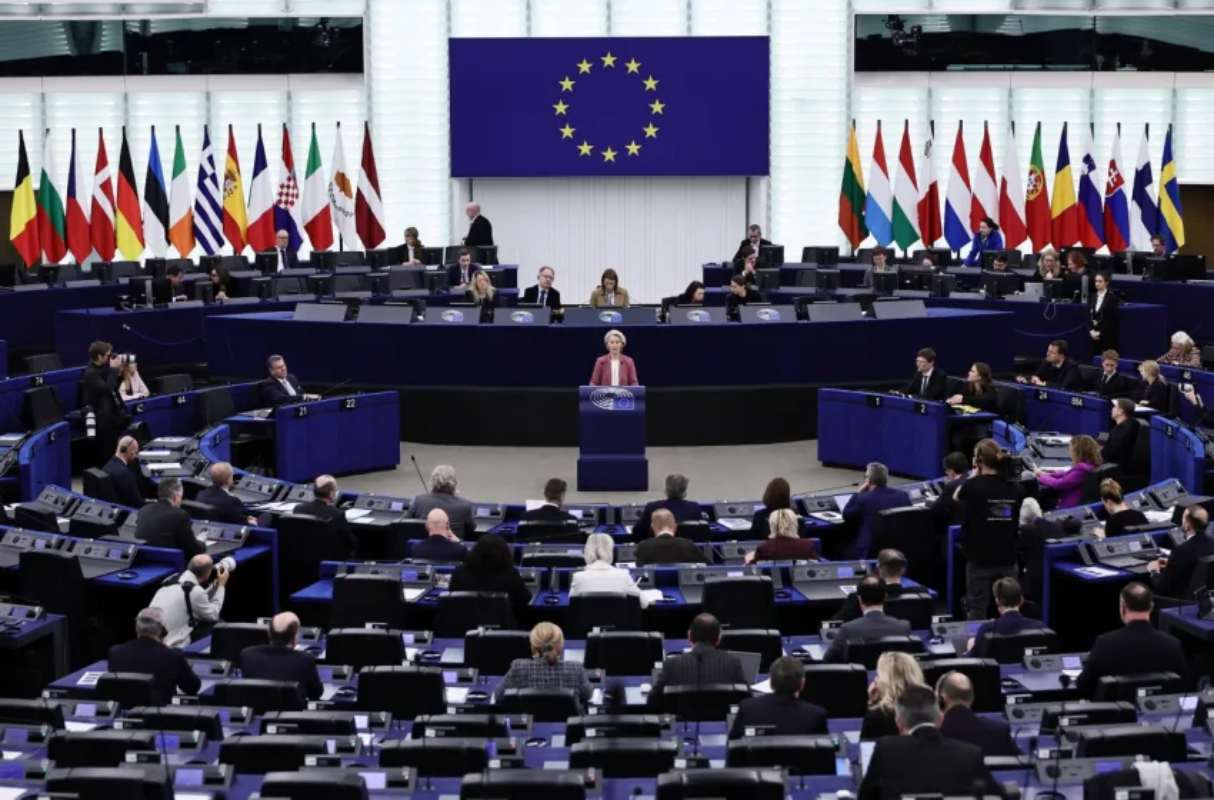
With this unequivocal statement, European Commissioner for the Mediterranean Dubravka Šuica reaffirmed the European Union’s position on the 2019 Turkey-Libya maritime memorandum during a European Parliament plenary debate in Strasbourg.
The debate on Tuesday, November 24, comes amid intensifying diplomatic activity in the Eastern Mediterranean, following the reported ratification of the memorandum by Libya’s House of Representatives and Ankara’s growing engagement with eastern Libya.
Three major issues now dominate the European debate: the legal validity of the Turkey-Libya maritime agreement, the potential expansion of EU sanctions and the protection of the electricity interconnection between Greece and Cyprus.
Šuica: “Null and Void” – Full European Solidarity With Greece and Cyprus
The European commissioner went beyond reiterating the EU’s longstanding position on the maritime memorandum, directly linking Turkey’s conduct in the Eastern Mediterranean to its broader relationship with the European Union.
“The memorandum on the delimitation of maritime zones signed between Turkey and Libya in 2019 is not consistent with the Law of the Sea. It violates the sovereign rights of third states, is null and void, and cannot produce legal effects for third countries,” Šuica stressed.
She explained that the dispute must be viewed within a broader framework encompassing the defence of international law, stability in the Eastern Mediterranean and respect for the sovereign rights of EU member states.
Her intervention reaffirmed the position established by the European Council in December 2019, shortly after Ankara and Tripoli signed the controversial maritime agreement.


Warning to Ankara: “We Are Closely Monitoring Every Action or Statement”
Šuica also addressed Turkey’s EU accession process and the conditions governing future cooperation between Ankara and Brussels.
She emphasised that relations with candidate countries are assessed not only on the basis of domestic reforms but also according to their conduct on the international stage.
“We are closely monitoring every action or statement that could create new tensions in the region or undermine de-escalation efforts,” she said.
The commissioner explained that the EU seeks a constructive relationship with Turkey, but that such cooperation must be founded on mutual respect, adherence to international law and good neighbourly relations.
For Athens and Nicosia, this position is particularly significant because it explicitly links EU-Turkey relations to developments in the Eastern Mediterranean and respect for the rights of European member states.
Message to Tripoli and Benghazi: Libya’s Political Transition Must Not Be Undermined
Turning to Libya, Šuica stressed that the country’s political transition should not be undermined by agreements that deepen internal divisions, create legal uncertainty or infringe upon the rights of third countries.
She identified the maritime agreement with Turkey as an example of such concerns.
The commissioner reaffirmed the European Union’s commitment to Libya’s unity, sovereignty, territorial integrity and stability, noting that the country’s future is closely connected to the security of the wider Eastern Mediterranean.
Her remarks acquire additional significance as Ankara expands its engagement with eastern Libya, whose political leadership had previously opposed the 2019 agreement.
Šuica concluded with a direct commitment to Greece and Cyprus:
“Unilateral actions that disregard the rights of others are unacceptable. The EU will continue to firmly support Greece and Cyprus and raise this issue in its relations with Turkey.”


Irish EU Presidency: “This Is Not a Technical Disagreement, but a Matter of Principle”
Irish Minister of State Charlie McConalogue, speaking on behalf of the Irish presidency of the Council of the European Union, delivered a similarly firm message.
“This is not a technical disagreement, but a matter of principle,” he stated.
Reaffirming the Council’s full solidarity with Greece and Cyprus, McConalogue stressed that the sovereign rights of all EU member states must be respected.
He emphasised that maritime boundaries should be established through dialogue and good-faith negotiations, in full compliance with international law, rather than through unilateral actions that disregard the rights of other countries.
While acknowledging the EU’s strategic interest in maintaining a stable and cooperative relationship with Turkey, the Irish minister warned that de-escalation cannot be selective.
Instead, it must be sustained, credible and accompanied by respect for the rights of all European Union member states.
EU Council Signals Readiness to Respond to Violations of Sovereign Rights
One of the most significant elements of McConalogue’s intervention concerned the Council’s readiness to respond to actions that violate international law.
“The EU will continue to act in unity. The Council will continue to closely monitor developments in the Eastern Mediterranean and stands ready to address actions that undermine the sovereignty, sovereign rights or jurisdiction of member states or violate international law,” he said.
The statement comes as European lawmakers debate the renewal and potential expansion of existing restrictive measures concerning the Eastern Mediterranean.
McConalogue concluded:
“By defending these principles, we are defending not only the rights of Greece and Cyprus, but also the very credibility of the international legal order.”
Kefalogiannis: The 12-Nautical-Mile Limit, Turkey’s Casus Belli and the ‘Blue Homeland’ Doctrine
Greek MEP Manolis Kefalogiannis, representing New Democracy and the European People’s Party (EPP), focused on the broader implications of Turkish maritime claims.
He described the Turkey-Libya memorandum as illegal and incompatible with the Law of the Sea, accusing Ankara of attempting to establish faits accomplis in the Eastern Mediterranean.
Kefalogiannis recalled the international condemnation of the memorandum and referred to Article 3 of the United Nations Convention on the Law of the Sea (UNCLOS), which establishes the right of coastal states to determine the breadth of their territorial sea up to 12 nautical miles.
He also condemned Turkey’s longstanding threat of military action against Greece, commonly referred to as the casus belli, as well as Ankara’s “Blue Homeland” maritime doctrine.
“Challenging the sovereign rights of an EU member state amounts to challenging the European Union itself as a whole,” Kefalogiannis stressed.
The Greek MEP expressed his expectation that the resolution scheduled for Thursday’s vote would constitute a “resounding response to Turkey and its aggressive conduct.”
His intervention placed the maritime memorandum within the broader context of Greek-Turkish disputes concerning the Aegean Sea, territorial waters and maritime jurisdiction.
Maniatis: “We Must Now Move From Words to Action”
Yannis Maniatis, a Greek MEP from PASOK and vice-president of the Progressive Alliance of Socialists and Democrats (S&D), called for concrete European measures following the reported ratification of the Turkey-Libya memorandum by Libya’s House of Representatives.
Maniatis described the condemnation issued by the presidents of the European Council and the European Commission as a useful but preliminary step.
“We must now move from words to action,” he said.
He stressed that protecting the sovereignty and sovereign rights of EU member states is not exclusively a national matter but a “shared European responsibility.”
The Greek MEP outlined the principal elements of the Socialists and Democrats’ proposed resolution, which seeks to strengthen the EU’s response to developments in the Eastern Mediterranean.
Three European Proposals: Expanded Sanctions, Conditional Cooperation and Protection of the Power Cable
The S&D proposal focuses on three major areas:
- Expansion of EU sanctions: Renewing and extending the existing restrictive measures framework for the Eastern Mediterranean to cover unlawful activities based on the Turkey-Libya maritime memorandum.
- Conditional cooperation with Turkey and Libya: Making respect for international law a substantive prerequisite for future European cooperation with both countries.
- Protection of the Great Sea Interconnector: Ensuring European support and protection for the strategic electricity interconnection between Greece and Cyprus.
The proposals seek to move the European response beyond diplomatic condemnation towards concrete political and economic instruments.
Maniatis concluded his intervention with a broader appeal for European strategic capacity:
“The EU is a unique experiment in peace. However, it must possess the strength necessary to defend its principles and protect all its member states equally.”
Great Sea Interconnector: Why the Greece-Cyprus Power Cable Is Becoming a European Strategic Issue
The inclusion of the Great Sea Interconnector in the proposed parliamentary resolution is particularly significant for Athens and Nicosia.
The electricity interconnection is recognised as a European Project of Common Interest, designed to end Cyprus’s energy isolation and connect the island to the continental European electricity system through Greece.
Turkish objections and interference with maritime survey activities have highlighted the geopolitical dimension of a project originally conceived to strengthen regional energy security.
For Greece and Cyprus, the issue increasingly concerns the European Union’s capacity to provide practical support for infrastructure included in its own strategic energy planning.
The project is also relevant to the integration of European electricity markets, the development of renewable energy infrastructure and the diversification of energy connections across the Eastern Mediterranean.
The S&D proposal calls for European protection of the interconnector, although the specific instruments that could be deployed have not yet been determined.
Turkey’s Diplomatic Expansion in Libya
The Strasbourg debate coincides with Ankara’s efforts to strengthen its relationships with competing centres of political and military power in Libya.
Turkey’s rapprochement with eastern Libya is particularly noteworthy because the eastern political establishment had previously opposed the maritime memorandum signed in 2019 by Ankara and the Tripoli-based government.
The evolving relationship could expand Turkey’s diplomatic and economic influence across Libya, while complicating Greece’s regional diplomatic calculations.
Nevertheless, Šuica’s intervention makes clear that the European Union’s position regarding the memorandum’s legal effects on third countries remains unchanged.
The EU’s objections concern the substance of the agreement and its compatibility with the Law of the Sea, irrespective of shifts in Libya’s domestic political landscape.
Egypt and the Wider Diplomatic Dispute in the Eastern Mediterranean
The European intervention follows objections raised by Egypt regarding the Turkey-Libya maritime memorandum, including representations made at the United Nations.
Cairo has challenged the agreement’s capacity to produce legal effects at the expense of third countries, while reserving its position regarding the protection of its own maritime rights.
Egypt’s involvement is particularly relevant given the partial Exclusive Economic Zone (EEZ) delimitation agreement signed between Greece and Egypt in 2020.
The dispute therefore extends beyond Greek-Turkish relations, encompassing overlapping maritime claims, regional energy interests and competing diplomatic partnerships.
The legal uncertainty surrounding maritime jurisdiction can also affect offshore energy exploration, electricity interconnections, investment planning and the development of strategic infrastructure.
November 26: The European Parliament’s Crucial Vote
The next diplomatic milestone is the European Parliament’s plenary vote scheduled for Thursday, November 26.
Attention will focus on whether the final resolution incorporates proposals concerning the expansion of sanctions, conditional cooperation with Turkey and Libya, and European protection of the Greece-Cyprus electricity interconnection.
The adoption of a European Parliament resolution would not automatically trigger new sanctions. Additional decisions by the competent European institutions would be required to implement restrictive measures.
Nevertheless, Tuesday’s debate demonstrated a convergence between the European Commission, the Council presidency and interventions by Greek lawmakers from both the EPP and S&D on the importance of protecting the sovereign rights of EU member states.
For Athens and Nicosia, the central question is whether European diplomatic solidarity will translate into concrete institutional and political measures.
As Commissioner Šuica stated, “unilateral actions that disregard the rights of others are unacceptable.”
And as the representative of the Council of the European Union emphasised, defending the rights of Greece and Cyprus means defending “the very credibility of the international legal order.”
Source: pagenews.gr