
A new flashpoint has emerged in the Aegean after reports that Greece transferred a battery of the Patriot air-defense system to the island of Karpathos—a move that triggered sharp reactions in Turkey and reignited the long-standing strategic rivalry between Athens and Ankara.
The pro-government Turkish newspaper Sabah ran a provocative front-page headline: “Don’t play with fire, Nikos.” The message was directed personally at Greece’s Minister of National Defence, Nikos Dendias.
According to the report, Ankara views the deployment as “dangerous militarization of the Aegean”, accusing Athens of using regional instability as a pretext to strengthen its military presence on the islands.
Ankara’s narrative and diplomatic pressure
Turkish officials argue that Greece is exploiting tensions in the Middle East to reinforce its defense network in the Aegean.
Foreign Ministry spokesperson Oncu Keceli reiterated Ankara’s long-standing claim that Greece is violating the demilitarized status of certain islands, citing the Treaty of Lausanne and the Treaty of Paris (1947).
This argument has become a core element of Turkey’s diplomatic pressure strategy in recent years, particularly as Greece has expanded its defensive infrastructure across the eastern Aegean.
In Ankara’s narrative, every new defensive deployment becomes proof of a broader militarization policy.
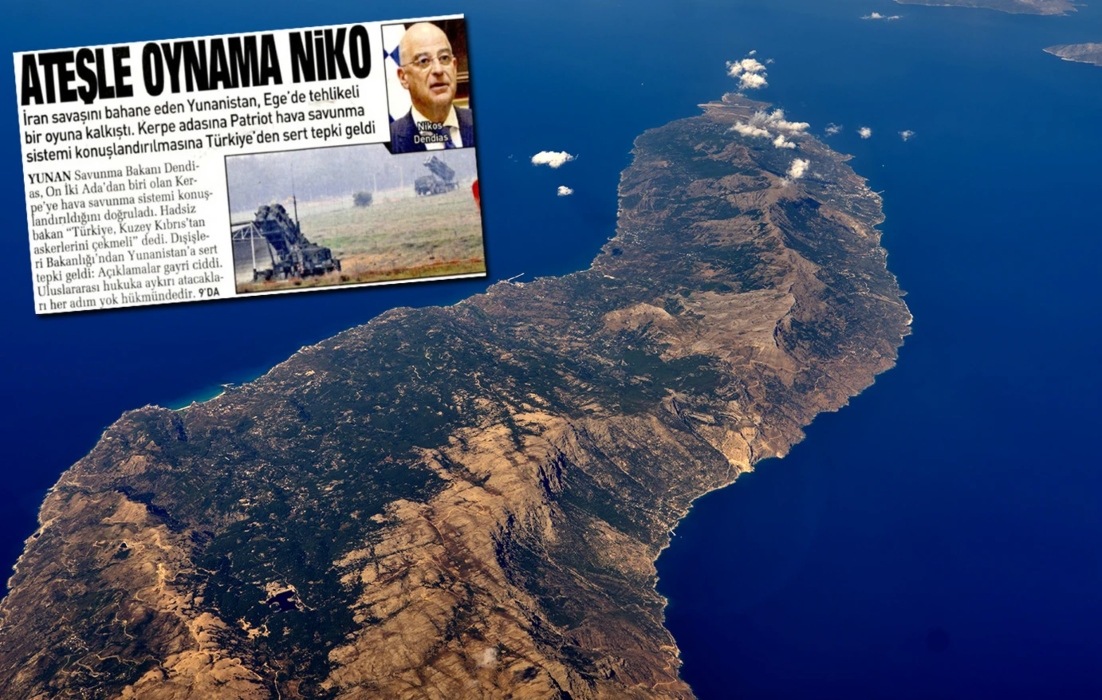

Athens’ response: “Defense is non-negotiable”
Athens responded swiftly and firmly.
Greek Foreign Ministry spokesperson Lana Zohiou dismissed the Turkish accusations as “baseless and unilateral claims”, emphasizing that the legal status of the islands is governed by a broader international framework.
Greece points specifically to:
- the Treaty of Lausanne (1923)
- the Montreux Convention (1936)
- the Treaty of Paris (1947)
Athens also stresses that Turkey is not a signatory to the Paris Treaty, a point repeatedly highlighted in Greek diplomatic arguments.
“Greece’s defensive posture is non-negotiable,” the Foreign Ministry stated.
The strategic importance of Karpathos
Beyond the diplomatic rhetoric, the deployment of a Patriot battery on Karpathos carries clear strategic implications.
The island sits at a critical geographic crossroads between Crete, the Dodecanese and the Eastern Mediterranean, making it ideal for expanding Greece’s layered air-defense network.
From a military perspective, such a deployment can:
- extend radar and interception coverage across key air corridors
- strengthen protection of southeastern Aegean airspace
- integrate with broader NATO air-defense architecture
In practical terms, the system contributes to a wider anti-missile and anti-aircraft shield covering a sensitive part of the region.
The European and NATO dimension
The issue also extends beyond the bilateral dispute.
As a member of both the European Union and NATO, Greece frames its defense planning within the broader context of European security.
Regional instability—from conflicts in the Middle East to the security landscape around the Black Sea—has pushed several European states to upgrade their air-defense capabilities.
Within this context, Athens argues that strengthening its island defenses is not escalation but adaptation to a deteriorating regional security environment.
The political message behind the headlines
The personal targeting of Nikos Dendias in Turkish media is widely interpreted as a deliberate political signal.
In Ankara, the Greek defense minister is often viewed as a central figure behind Greece’s recent military modernization and its expanding network of strategic partnerships.
The Turkish headlines therefore appear to be as much about signaling and domestic messaging as about the actual military move.
Still, the Aegean remains a delicate geopolitical theater.
Every military deployment carries a political meaning—and every political message can quickly become a strategic signal.
Source: pagenews.gr