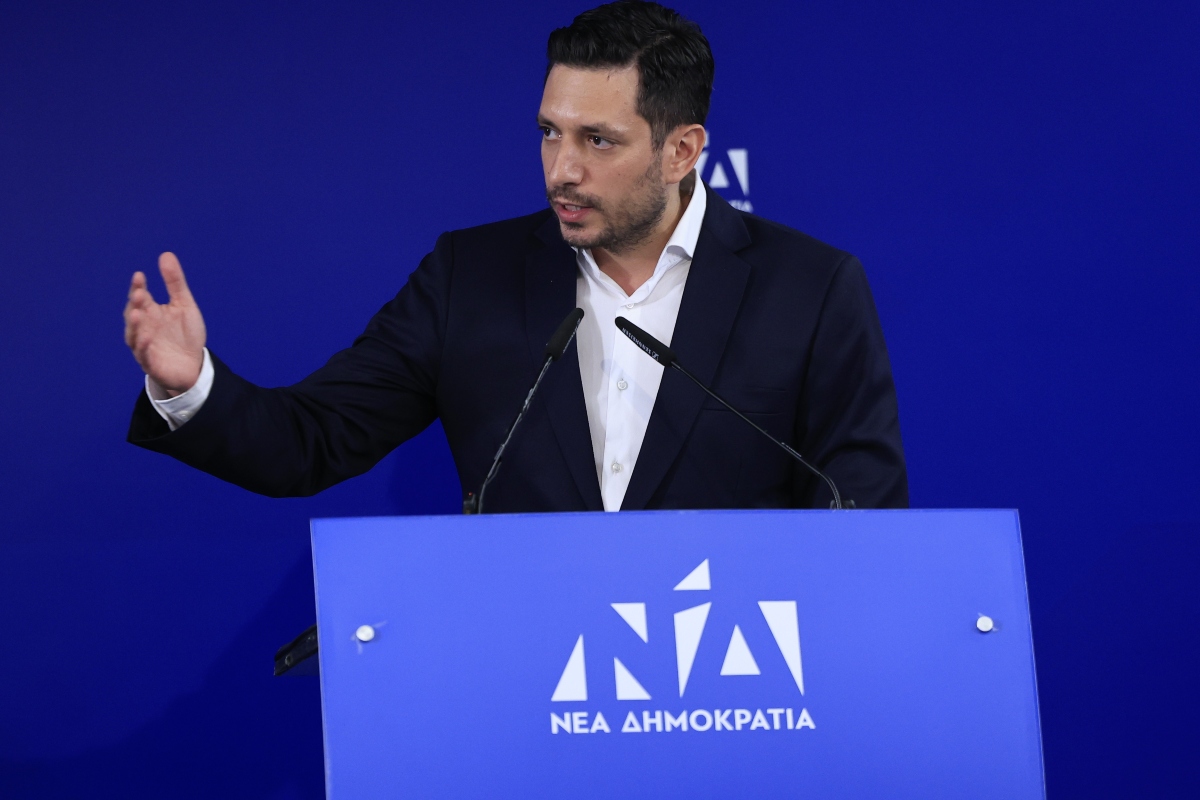
In his first major interview as Secretary of New Democracy, Konstantinos Kyranakis delivered what many inside the governing party interpreted as a carefully crafted message of reconciliation toward former prime ministers Costas Karamanlis and Antonis Samaras, at a time when internal cohesion is emerging as a central challenge for the ruling party.
The message was unmistakable: New Democracy cannot afford divisions as it prepares for the next electoral cycle.
“We need a broad mobilization. No one is expendable. We need unity and cohesion,” Kyranakis declared, before emphasizing that both Karamanlis and Samaras have made significant contributions to both the party and the country.
Most notably, he added:
“I do not believe that either of them wants to harm New Democracy.”
For seasoned observers of Greek politics, the statement was far more than a courtesy. It was a deliberate attempt to lower tensions and reopen channels with influential figures who continue to command substantial support within the party’s traditional base.


A Message Beyond the Former Prime Ministers
While Kyranakis’ comments were directed toward Karamanlis and Samaras, the broader audience was arguably the wider conservative electorate.
Within New Democracy there is growing awareness that portions of the party’s traditional base have become increasingly uneasy over certain government decisions, creating pockets of dissatisfaction that opposition forces hope to exploit.
By publicly acknowledging the historical role of both former leaders, Kyranakis appears to be sending a signal that the party leadership understands the concerns of conservative voters who continue to identify strongly with the Karamanlis and Samaras eras.
The political calculation is straightforward:
Maintaining unity among New Democracy’s different ideological currents is essential if the party wants to preserve its electoral dominance.
The Personal Reference That Caught Attention
One of the most striking moments of the interview came when Kyranakis recalled his own political journey.
“Antonis Samaras gave me the opportunity to be on the European election ballot in 2014. That is not something I can overlook or forget.”
The remark was interpreted by many as more than a personal acknowledgment.
It served as a reminder that despite disagreements and tensions that may have emerged in recent years, personal and political ties remain intact between many younger party officials and the former prime minister.
Such references rarely appear by accident in political messaging.
They are often designed to create political space for future rapprochement.
The Silence That Spoke Volumes
Perhaps the most revealing moment came when Kyranakis was asked whether he intended to take initiatives aimed at facilitating communication with Karamanlis and Samaras.
His answer was brief but loaded with meaning:
“These things are not announced on television.”
In political terms, that response effectively confirmed nothing while denying nothing.
Party insiders interpret it as an indication that informal contacts may already be underway—or at the very least that the new secretary wants to keep every channel open.
The emphasis on discretion suggests that any effort to improve relations will likely occur away from public scrutiny.
The Real Target: Disappointed ND Voters
Beyond internal party dynamics, Kyranakis dedicated a significant part of his interview to addressing voters who have drifted away from New Democracy since its sweeping 2023 electoral victory.
Unlike previous party officials who often downplayed signs of voter fatigue, Kyranakis openly acknowledged the problem.
“We recognize that there are disappointed supporters. We recognize that people who stood with us in 2023 may now see mistakes or decisions that have upset them.”
The admission reflects a growing realization inside the governing party that political dominance cannot be taken for granted.
Government officials increasingly view voter re-engagement—not opposition attacks—as the decisive battlefield ahead.
A Campaign Against Defeatism
The new secretary also identified what he described as a longstanding weakness within the party: a tendency toward pessimism despite repeated electoral successes.
“Even when we lead in the polls and have won major elections, there is always a sense of defeatism. I want us to get rid of that.”
The statement reveals an emerging strategy focused not only on organizational renewal but also on restoring confidence among party members and supporters.
According to party sources, strengthening morale at the grassroots level is expected to become a key objective of the new leadership structure as preparations begin for future national contests.
The Bigger Picture
Kyranakis’ first interview as secretary was not merely about party management.
It was an opening move in a broader effort to stabilize New Democracy’s internal landscape, reconnect with disillusioned voters, and prevent ideological fractures from becoming political liabilities.
His outreach toward Karamanlis and Samaras suggests that the leadership understands a fundamental reality:
Winning the next election may depend less on defeating the opposition and more on keeping the entire center-right family under the same roof.
Whether that strategy succeeds will largely determine how comfortably New Democracy enters the next electoral battle—and whether today’s calls for unity translate into tomorrow’s political strength.
Source: pagenews.gr