“NEARCHOS” Joins the Fleet: Delivery Date Set for Greece’s Second Belharra Frigate
 ΧΡΟΝΟΣ ΑΝΑΓΝΩΣΗΣ 9 '
Πηγή Φωτογραφίας: eurokinissi/“NEARCHOS” Joins the Fleet: Delivery Date Set for Greece’s Second Belharra Frigate



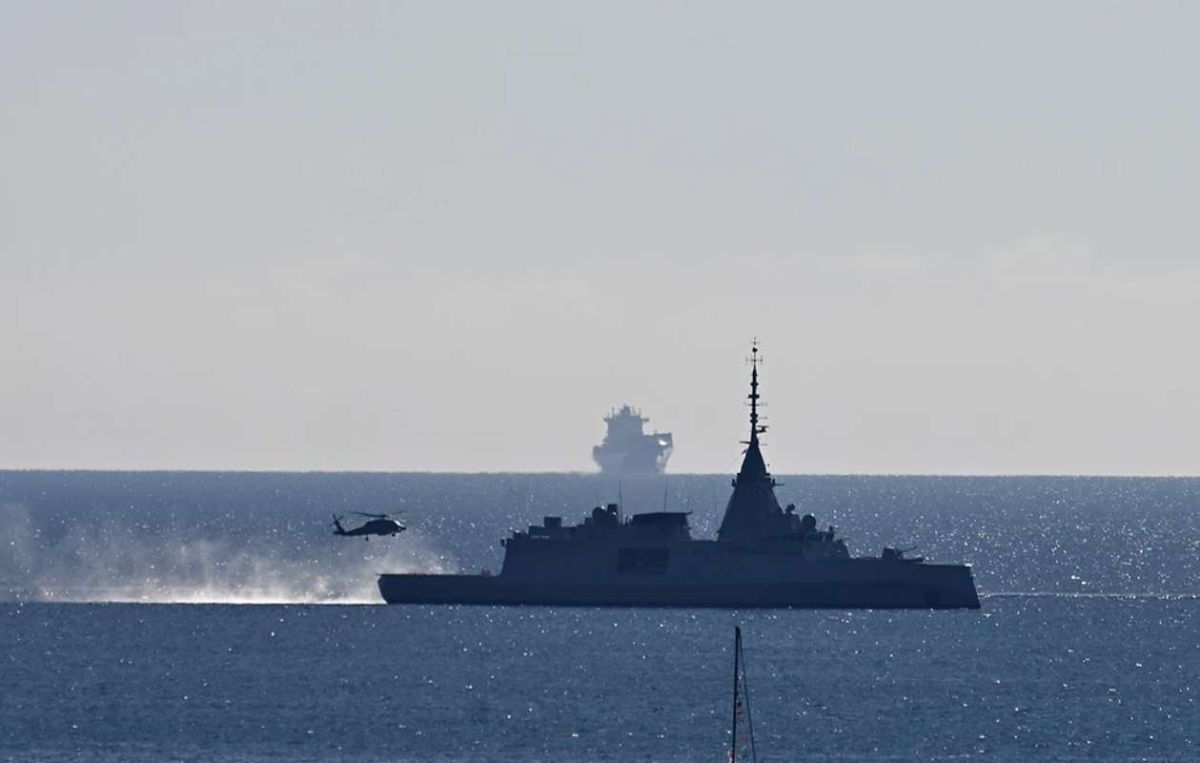
The countdown has begun for Greece’s second FDI HN frigate, “NEARCHOS.”
The crew that will operate the new warship is already in Lorient, France, training aboard the frigate as Naval Group completes the final sea trials, inspections and certification procedures ahead of its handover to the Hellenic Navy.
According to the latest information, October 30, 2026 has been selected as the target date for the official delivery of “NEARCHOS,” provided the remaining procedures are completed without unexpected delays.
Naval Group has officially confirmed that sea trials for the second Greek FDI began in February and that delivery is scheduled for October 2026.
The specific date of October 30, however, has not yet been publicly confirmed by either the Greek Ministry of National Defence or Naval Group. It should therefore be regarded as the current operational target rather than an irrevocably fixed date.
Greece prepares to receive its second Belharra
If the timetable is maintained, the handover ceremony will take place at Naval Group’s facilities in Lorient, where the Greek flag will formally be raised aboard the second FDI HN frigate.
“NEARCHOS” will follow the first ship of the class, “KIMON,” marking an important transition for the programme: from acquisition and construction to the creation of a genuinely operational new-generation surface fleet.
That distinction matters.
One advanced frigate can significantly improve a navy’s capabilities in a particular operational area.
Two, then three and eventually four ships of the same class begin to transform the structure of the fleet itself.
The crew is already training aboard the ship
The presence of the full crew in France is another indication that the programme has entered its final phase.
Officers and non-commissioned officers are no longer limited to classroom instruction.
They are training directly on the ship’s systems, becoming familiar with its operating procedures, combat management environment and the integration of sensors, communications and weapons.
This is particularly important because the FDI HN represents a major technological leap compared with much of the Hellenic Navy’s current surface fleet.
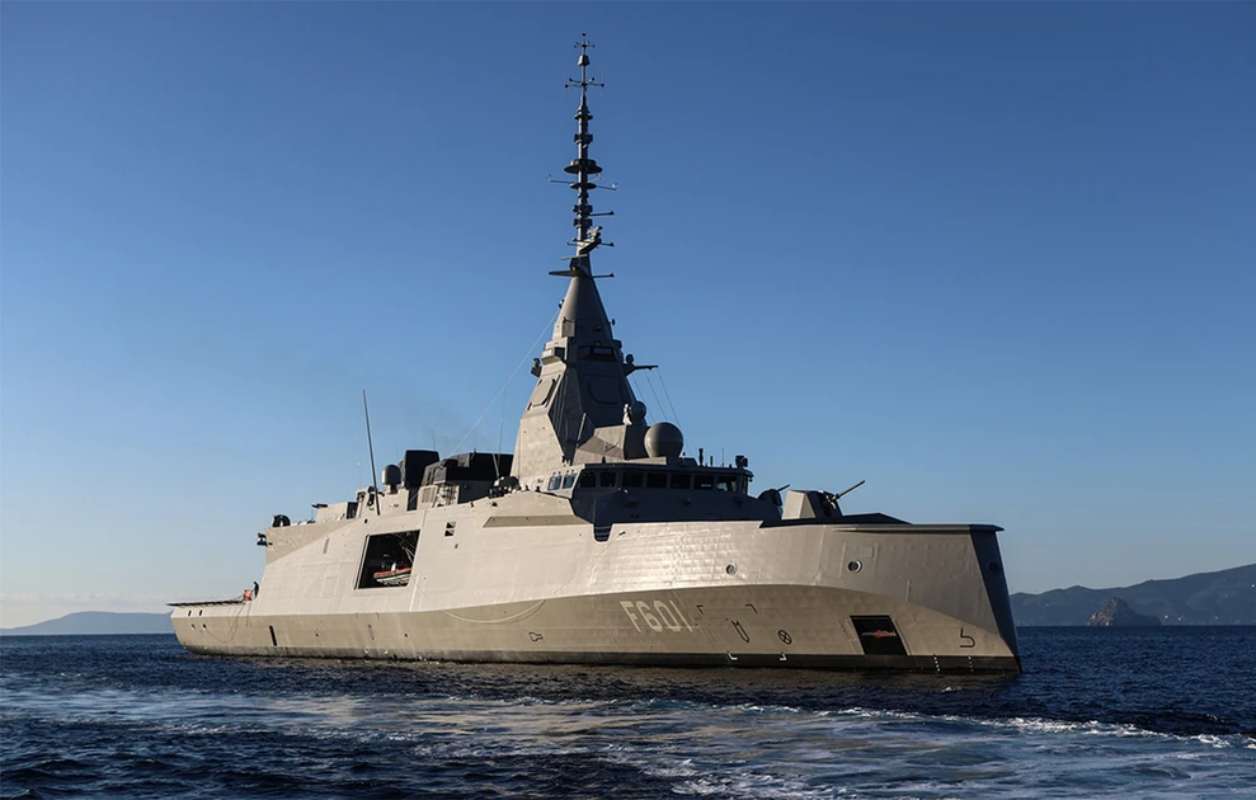
The ship has been designed around a digital architecture, extensive automation and highly integrated combat systems.
Sea Fire: The eyes of the new Greek frigates
At the heart of the FDI is Thales’ Sea Fire, a fully digital multifunction AESA radar featuring four fixed panels.
The system provides continuous 360-degree surveillance and works together with the SETIS Combat Management System to detect, track and engage multiple threats.
In practical terms, “NEARCHOS” is not simply a ship carrying missiles.
It is a floating sensor and combat node.
It can detect targets in the air, on the surface and beneath the sea, distribute tactical information and operate as part of a wider network involving other ships, aircraft and allied forces.
32 Aster missiles and area air defence
One of the most important capabilities introduced by the Greek FDI frigates is robust area air defence.
The standard Greek configuration provides for up to 32 Aster surface-to-air missiles, eight Exocet MM40 Block 3C anti-ship missiles, a RAM close-in defence system, a 76mm gun and MU90 torpedoes.
This changes the way the Hellenic Navy can operate.
The frigate is not designed merely to defend itself.
It can contribute to the protection of other ships and naval formations and, depending on the operational geometry, provide air defence over a broader maritime area.
For the Aegean and Eastern Mediterranean, this capability has considerable operational significance.
Anti-submarine warfare at a different level
The FDI frigates were not designed solely around air defence.
They also possess advanced anti-submarine warfare capabilities.
Their sensor suite includes the Kingklip Mk2 hull-mounted sonar and the CAPTAS-4 Compact variable-depth sonar, combined with MU90 lightweight torpedoes.
In the Eastern Mediterranean, where submarines remain a central element of the regional naval balance, this capability is particularly important.
“NEARCHOS” is therefore not simply replacing an ageing warship.
It introduces a substantially higher level of detection, networking and engagement capability.
The real advantage is connectivity
The strength of the new frigates is not measured only by the number of missiles they carry.
It lies increasingly in information.
In modern naval warfare, the force that detects an opponent first and distributes the tactical picture more quickly can gain a decisive advantage.
The FDI was designed precisely for this environment.
SETIS brings together information from multiple sensors and turns it into a unified operational picture.
The frigate can therefore operate not merely as an independent platform, but as part of a wider combat network involving other frigates, submarines, helicopters, fighter aircraft and allied assets.
That represents the future direction of the Hellenic Navy:
fewer isolated platforms and a more integrated, networked combat force.
After “NEARCHOS” comes “FORMION”
The programme does not end with the second frigate.
The third Greek FDI, “FORMION,” is also at an advanced stage, with delivery currently planned before the end of 2026.
That means Greece could soon have three advanced frigates of the same class entering service within a relatively short period.
This generates advantages beyond pure firepower.
Common training.
Common spare parts.
Common maintenance procedures.
Common combat systems.
And, crucially, a growing pool of sailors and officers experienced with the same platform.
Knowledge gained from “KIMON” can be transferred to “NEARCHOS” and then to “FORMION.”
In this way, the Hellenic Navy is gradually building an entirely new base of expertise.
The fourth FDI adds another dimension
The Greek programme now includes four frigates, with the fourth ship named “THEMISTOCLES.”
The fourth unit has operational significance beyond simply increasing the fleet by one more hull.
With four ships of the same class, the Navy gains greater flexibility to maintain an advanced frigate at operational readiness even while other units undergo maintenance, training or upgrades.
The programme also has an industrial dimension.
Naval Group has already established cooperation with dozens of Greek companies as part of the FDI programme, increasing the involvement of the domestic defence industry.
The fourth frigate is also expected to incorporate a more advanced Greek configuration from the outset, with provisions for increased firepower and potentially longer-range weapons.
If those plans are fully implemented, the Greek FDI fleet could eventually perform missions extending beyond its original emphasis on area air defence.
From ageing frigates to a digital fleet
For decades, the Hellenic Navy has relied heavily on frigates designed in a very different technological era.
The FDI represents a transition to a new model.
Digital systems.
Automation.
Powerful AESA radar.
Area air defence.
Advanced anti-submarine warfare.
Cyber protection.
Naval Group describes the FDI as a frigate designed from the outset with integrated cyber resilience and onboard data centres supporting the ship’s digital architecture.
That illustrates the depth of the transformation.
A modern frigate is increasingly a software and data platform as much as it is a weapons platform.
What changes in the Aegean and Eastern Mediterranean
There is no need to exaggerate the significance of “NEARCHOS.”
A single additional FDI does not by itself overturn every military balance.
But it does substantially strengthen Greece’s ability to protect naval formations, monitor large areas and operate in an environment involving simultaneous air, surface, underwater and electronic threats.
More importantly, it is not an isolated acquisition.
Greece is creating a homogeneous core of highly advanced frigates that will operate alongside Rafale fighters, upgraded F-16 Vipers, Type 214 submarines and, in the future, F-35s.
That is where the broader strategic value lies:
in integrating air, sea and undersea assets into a common deterrence network.
October 30: The next milestone for the Hellenic Navy
If the final tests are completed according to schedule, October 30 could become another landmark date in the modernization of the Greek fleet.
The Greek flag will be raised aboard “NEARCHOS.”
Its crew will formally take command.
And then the most important phase will begin:
turning an ultra-modern warship into a fully operational combat unit of the Hellenic Navy.
Because the true power of a frigate is not measured on the day it is delivered.
It is measured when its crew, sensors, weapons and combat systems operate as a single organism.
With “NEARCHOS” following “KIMON,” “FORMION” close behind and “THEMISTOCLES” set to complete the programme, the message is becoming increasingly clear:
the Hellenic Navy is moving beyond fleet renewal and into a new era of naval power.
Source: pagenews.gr
Διαβάστε όλες τις τελευταίες Ειδήσεις από την Ελλάδα και τον Κόσμο