Message to Washington: Alexis Tsipras argued that the strategic partnership between Greece and the United States must be based on mutual interests rather than the notion of Greece as a “given ally.”
Turkey and F-35s: He urged Washington to send a clear message to Ankara over its regional conduct and reiterated his opposition to the sale of additional U.S. military equipment — including F-35 fighter jets — to Turkey under the current circumstances.
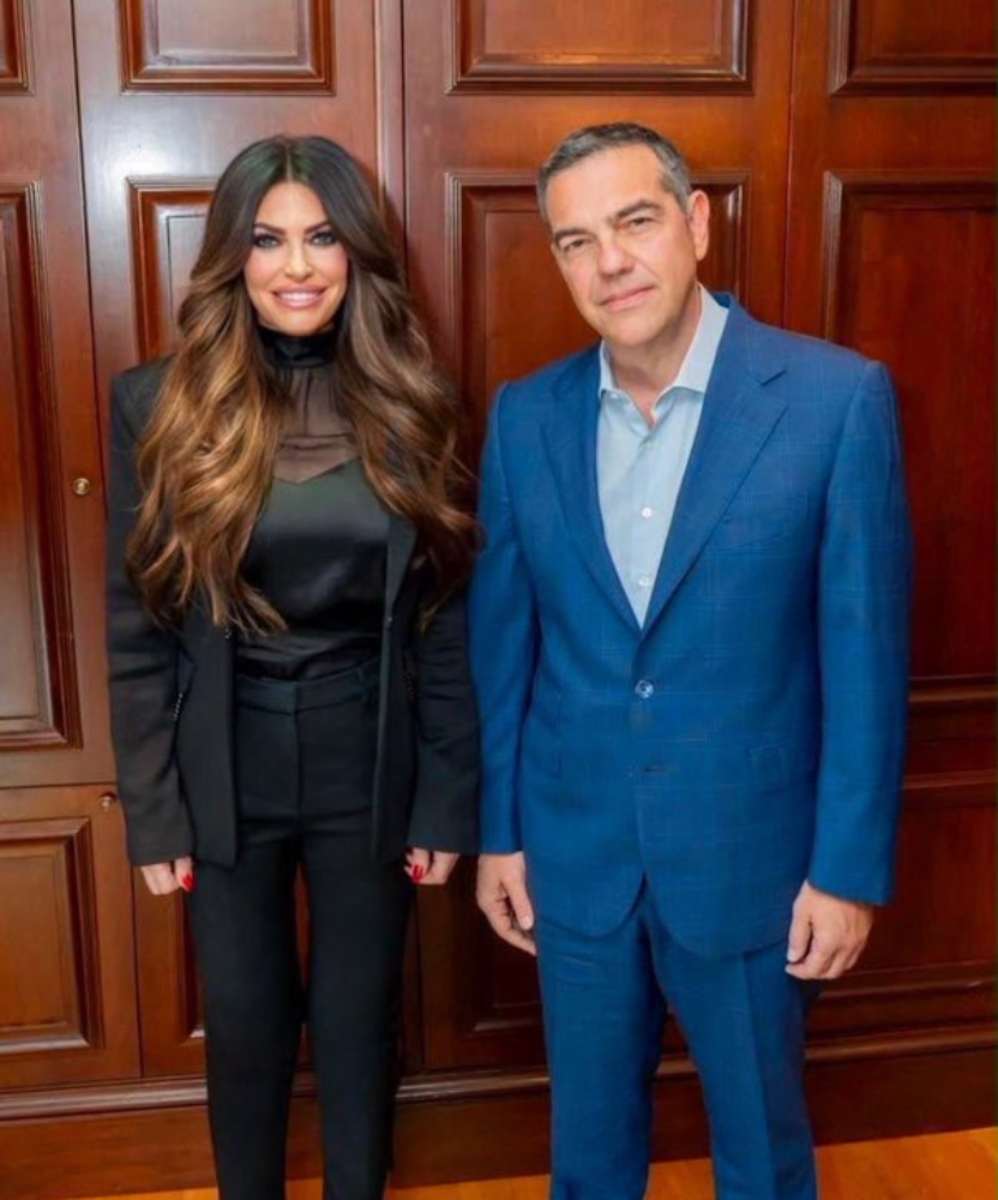
A symbolic photograph: Unlike other Greek political leaders who recently met Ambassador Guilfoyle, Tsipras chose to pose for the official photograph in front of a wooden doorway rather than with the Greek and U.S. flags in the background, a move widely interpreted as carrying symbolic political meaning.
As part of her introductory meetings with Greece’s political leadership, U.S. Ambassador Kimberly Guilfoyle met with former Prime Minister and ELAS party leader Alexis Tsipras, following earlier meetings with Prime Minister Kyriakos Mitsotakis and former Prime Minister Antonis Samaras.
According to ELAS, discussions focused on developments in Greece and the wider Eastern Mediterranean, Greek-American relations, regional security, energy cooperation and current geopolitical crises.
“A relationship based on mutual benefit”
Tsipras stressed that Greece’s strategic relationship with the United States should not operate under the logic of unconditional alignment.
Instead, he argued that bilateral ties must be grounded in reciprocity, shared interests and respect for the national priorities of both countries.
He also highlighted the progress achieved during his 2015–2019 administration in strengthening the U.S.-Greece Strategic Dialogue, particularly in defense, energy and economic cooperation.
Middle East and international law
A significant part of the meeting focused on the ongoing conflict in the Middle East.
Tsipras called for an immediate end to hostilities and described the humanitarian situation in Gaza as a genocide carried out by the Israeli government.
He emphasized that diplomacy and respect for international law remain the only sustainable path toward long-term regional stability.
At the same time, he welcomed recent U.S. initiatives aimed at ending Russia’s invasion of Ukraine and achieving what he described as a “just and lasting peace.”
Cyprus and Greek-Turkish relations
Regarding Cyprus, Tsipras reiterated his support for restarting negotiations under the framework proposed by United Nations Secretary-General António Guterres.
He also argued that the United States should send a clear message to Turkey ahead of the upcoming NATO Summit in Ankara, urging Ankara to respect international law and cease its provocations in the Eastern Mediterranean.
The former prime minister reaffirmed his opposition to the sale of additional U.S. defense systems — including F-35 fighter aircraft — to Turkey while tensions with Greece and Cyprus persist.
He further reiterated his long-standing position in favor of referring maritime disputes over the Exclusive Economic Zone (EEZ) and continental shelf to the International Court of Justice in The Hague.


The symbolism of the official photograph
The meeting also attracted attention because of the official photograph released afterward.
Unlike the images from Ambassador Guilfoyle’s meetings with other senior Greek political figures, Tsipras chose not to pose in front of the Greek and American national flags.
Instead, the photograph was taken against a simple wooden doorway, a choice that many political observers interpreted as a subtle symbolic message distancing himself from traditional diplomatic imagery, although neither side officially commented on the decision.


A broader political message
The meeting comes at a time when U.S.-Greek relations have become increasingly important amid heightened geopolitical tensions in Ukraine, the Middle East and the Eastern Mediterranean.
Through his discussion with Ambassador Guilfoyle, Tsipras sought to project an alternative vision of Greek foreign policy — one centered on diplomacy, international law and balanced strategic partnerships rather than unconditional geopolitical alignment.
His intervention also underscored his position that Greece should pursue strong relations with Washington while maintaining an independent foreign policy based on national interests, regional stability and multilateral diplomacy.
Source: pagenews.gr