Guilfoyle: $1.35 Billion and 10,000 Jobs – Greece Enters the Global Shipbuilding Power Game
 ΧΡΟΝΟΣ ΑΝΑΓΝΩΣΗΣ 10 '

Πηγή Φωτογραφίας: Guilfoyle: $1.35 Billion and 10,000 Jobs – Greece Enters the Global Shipbuilding Power Game



From Shipping Superpower to Shipbuilding Comeback
A new chapter in Greece’s geopolitical and industrial strategy could be opened through cooperation with the United States and South Korea in the shipbuilding sector.
US Ambassador to Greece Kimberly Guilfoyle, speaking in South Korea, outlined the prospect of mobilising $1.35 billion in infrastructure investment and creating up to 10,000 highly skilled jobs.
Her remarks came at Samsung Heavy Industries’ Geoje shipyard during the naming ceremony for the newly built DP2 Suezmax shuttle tanker “Anfield DP”, owned by Tsakos Energy Navigation.
The real message, however, went far beyond the delivery of another technologically advanced commercial vessel.
It concerned the prospect of Greece rebuilding productive shipyard capacity and evolving from a country with one of the world’s largest merchant fleets into a country capable of constructing, maintaining and supporting sophisticated naval platforms.
“Strategic Investment in Shipbuilding Is an Investment in Security”
Kimberly Guilfoyle directly connected the revival of Greek shipyards with maritime security and defence.
“Strategic investment in shipbuilding is an investment in security itself,” she stressed.
That statement reflects a broader American understanding of the sector. Shipyards are no longer viewed merely as industrial facilities or another category of foreign investment.
They are infrastructure of national power, military readiness and economic sovereignty.
In today’s international environment, a country without shipbuilding and repair capacity becomes dependent on third parties not only for trade, but also for its own defence.
Washington Returns to Industrial Geopolitics
The US ambassador’s remarks form part of a broader transformation in American strategic thinking.
Washington increasingly treats shipbuilding as a critical arena of competition with China, which has developed massive production superiority in both commercial and military ship construction.
Partnership with South Korea offers the United States access to one of the most advanced shipbuilding ecosystems in the world.
Greece, for its part, offers:
- a strategically important geographical position,
- direct access to the Mediterranean and Black Sea,
- a powerful maritime tradition,
- shipyard facilities capable of major expansion,
- the requirements of the Hellenic Navy and allied forces.
The trilateral partnership is therefore not a routine commercial agreement. It is part of an effort to establish a trusted industrial network capable of reducing Western dependence on supply chains outside the allied system.
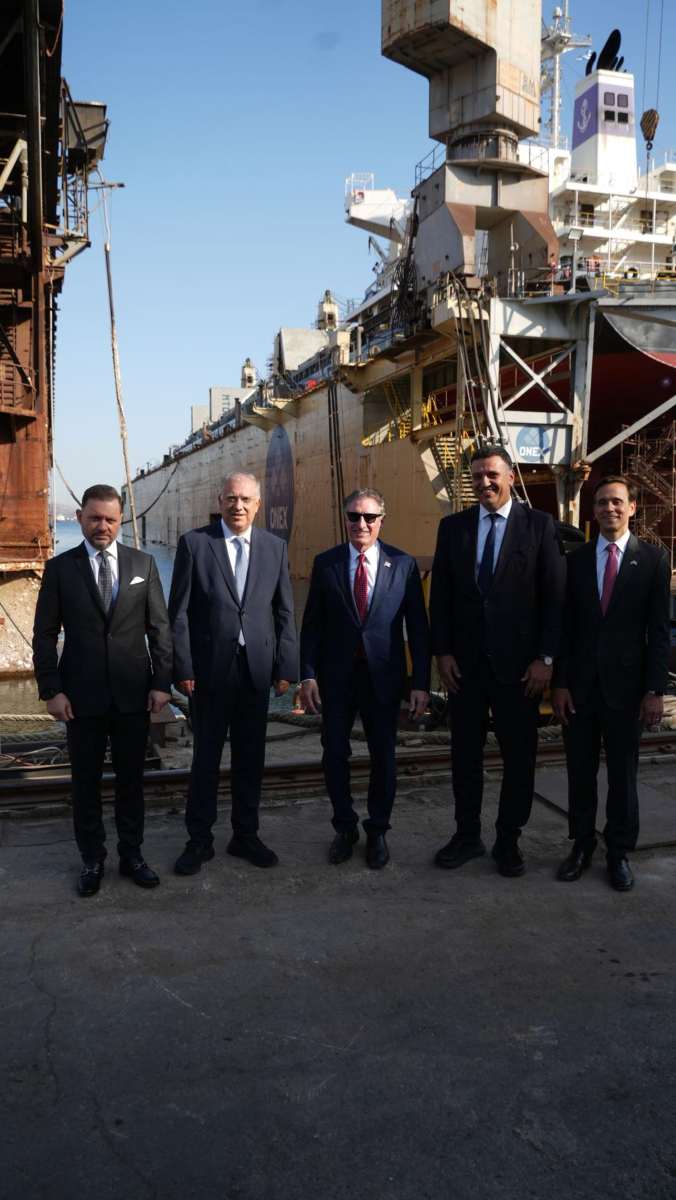
The Three-Pillar Partnership
Guilfoyle presented the trilateral cooperation as the convergence of three different but complementary strengths:
“Korean shipbuilding excellence, American industrial strength and Greek maritime leadership are coming together to revitalise shipyards, restore critical industrial capabilities and secure the maritime routes on which our economies depend.”
South Korea possesses globally recognised expertise in advanced and large-scale shipbuilding.
The United States contributes financial, technological and defence power.
Greece commands one of the world’s largest merchant fleets and occupies a geographical position of immediate strategic value.
The combination could create what Greece has lacked for decades: a stable industrial ecosystem supported by orders, technical expertise, export capacity and defence-related production.
Frigates, Corvettes and Submarines: The Defence Dimension
The most important aspect of Guilfoyle’s intervention was her explicit reference to naval vessels.
She spoke of the potential construction of:
- frigates,
- corvettes,
- submarines.
Such activity would not be limited to meeting the requirements of the Hellenic Navy.
According to the strategic framework she described, Greek facilities could also support the US Sixth Fleet and NATO allies operating across the Mediterranean and Black Sea.
That means Greek shipyards are not being viewed merely as national industrial projects, but as potential components of the wider Western defence infrastructure.
A Hub for Three Geopolitical Theatres
Geography gives the initiative its deeper strategic importance.
Facilities in Greece could support missions and fleets across three critical regions.
The Eastern Mediterranean
This is the region where energy competition, maritime boundaries, regional conflict and the Greek-Turkish balance intersect.
Southeastern Europe
NATO continues to strengthen military logistics and support infrastructure throughout the wider region.
The Black Sea
The war in Ukraine has highlighted the importance of naval support, maintenance capacity, logistics and rapid access to repair facilities.
Greek shipyards could therefore evolve into technical and industrial hubs serving several strategic fronts simultaneously.
Greece Wants Sovereignty, Not Just Repair Contracts
Guilfoyle’s reference to the “restoration of Greek autonomy in the shipbuilding sector” carries considerable political weight.
Autonomy does not mean that Greece would independently manufacture every platform or weapons system.
It does mean developing the capacity to:
- maintain its fleet without prolonged foreign dependence,
- carry out major upgrades,
- participate meaningfully in production,
- preserve expertise and jobs domestically,
- support allied naval forces,
- acquire greater negotiating leverage in defence procurement.
The distinction is crucial.
A country that merely purchases warships remains a customer. A country capable of building and supporting them becomes a strategic partner.

10,000 Jobs and the Return of Skilled Industrial Employment
The economic impact of the investment extends beyond the headline number of jobs.
Shipbuilding supports an extensive network of highly and moderately skilled professions, including:
- naval architects and mechanical engineers,
- electricians and welders,
- systems technicians,
- automation specialists,
- logistics professionals,
- software engineers,
- defence-industry personnel,
- domestic suppliers and subcontractors.
The creation of up to 10,000 direct and indirect jobs could revive technical occupations weakened during the decades of decline in Greek shipbuilding.
It could also allow a greater share of defence and maritime spending to return to the Greek economy through salaries, taxation and domestic supply contracts.
The “Anfield DP” as a Symbol of a New Alliance
The newly built “Anfield DP” was used by Kimberly Guilfoyle as a tangible example of what cooperation between Greek shipping and South Korean technology can achieve.
She praised the Tsakos family’s long-standing role in global shipping and described the vessel as evidence of what becomes possible when Korean engineering excellence meets Greek maritime ambition.
Her reference to ExxonMobil added an energy dimension to the message, as the vessel forms part of a fleet connecting continents and transporting the energy, commodities and trade flows that sustain the global economy.
The ship therefore becomes more than a new commercial asset.
It symbolises the connection between:
- shipping,
- shipbuilding,
- energy,
- defence,
- strategic alliances.
Shipbuilding at the Heart of the Trump Administration’s Strategy
Guilfoyle placed the trilateral partnership within the broader policy framework of the Donald Trump administration.
Under this approach, American maritime power and energy abundance are treated as central pillars of US foreign policy.
Shipbuilding is directly connected to:
- the renewal of US and allied fleets,
- the security of commercial sea lanes,
- the protection of energy flows,
- competition with Chinese industrial dominance,
- greater NATO resilience.
Greece could acquire a central role in that strategy because it combines maritime strength, geography and allied credibility.
Political Intelligence: Greek Shipyards Move onto the Strategic Deterrence Map
The biggest potential gain for Greece is not limited to the $1.35 billion investment or the 10,000 jobs.
It is the possibility that Greek shipyards could become facilities considered essential by the United States, South Korea and NATO for operations in the wider region.
When infrastructure acquires that degree of strategic importance, it can:
- attract continuing investment,
- secure long-term contracts,
- strengthen the country’s political protection,
- increase Greece’s strategic value,
- create new opportunities for defence cooperation.
Elefsina and other Greek shipyards could cease to be facilities waiting for isolated contracts and instead become centres around which Western naval presence in the region is organised.
The Opportunity – and the Difficult Test Ahead
The plan is ambitious, but its success is not automatic.
It will require:
- stable financing,
- clear government decisions,
- binding orders,
- genuine technology transfer,
- personnel training,
- participation by Greek defence companies,
- firm timetables,
- protection from bureaucratic delay.
Greece has seen major shipbuilding plans fail or become trapped in financial, legal and political disputes in the past.
This time, however, the international environment offers different conditions.
NATO’s rearmament needs, the weakness of Western shipbuilding capacity and South Korea’s growing strategic role provide Athens with a window of opportunity that may not remain open indefinitely.
Greece Can Build Ships Again – and Rebuild Its Geopolitical Power
Kimberly Guilfoyle’s intervention from South Korea carried a message extending far beyond investment figures.
Greece has the opportunity to unite three identities that have remained disconnected for too long:
- a global shipping power,
- a key NATO state,
- a country capable of advanced industrial production.
Investment in shipyards can create thousands of jobs and revive major industrial areas.
But it could achieve something even more important: provide Greece with the productive base required to move beyond the role of customer and geographical host.
Real maritime power is not measured only by the ships a country owns.
It is also measured by the ships it can build, repair and keep operational.
That is the central promise of the emerging partnership between Greece, the United States and South Korea.
Source: pagenews.gr
Διαβάστε όλες τις τελευταίες Ειδήσεις από την Ελλάδα και τον Κόσμο