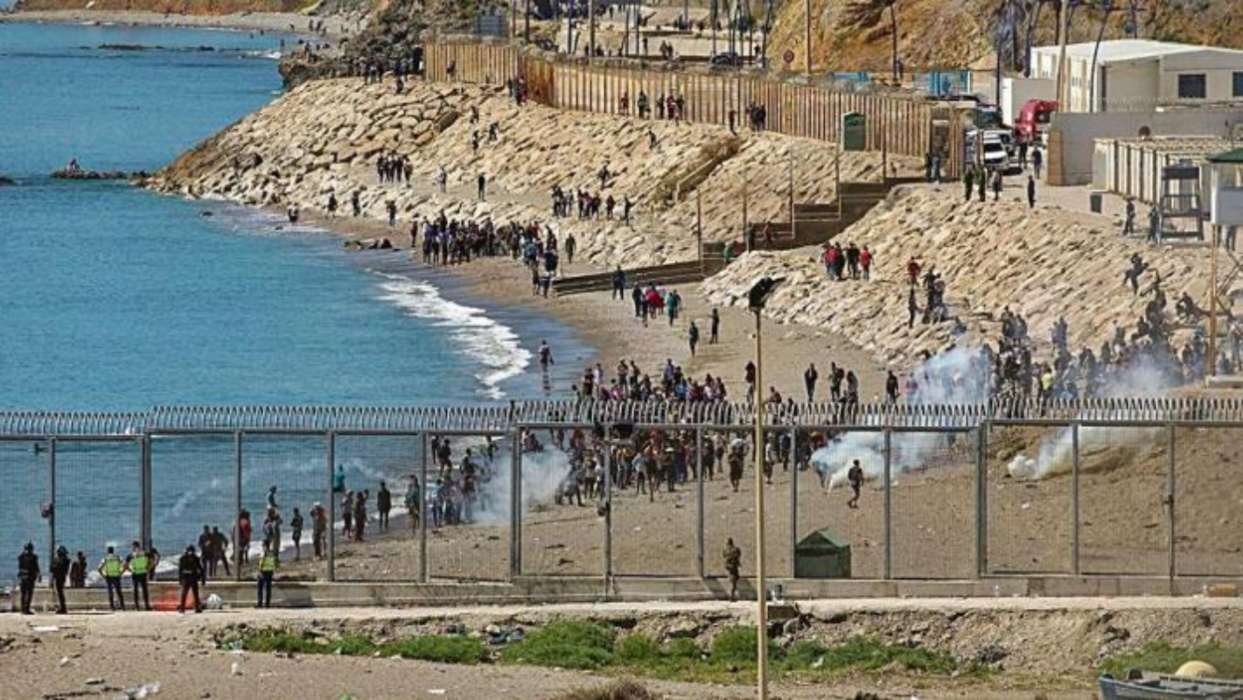
Ceuta becomes Europe’s latest migration stress test
The dramatic scenes unfolding in Ceuta—with tens of thousands of irregular migrants attempting to cross by land and sea, dozens of reported fatalities, and hundreds of unaccompanied minors—have become more than a Spanish emergency.
For many European observers, the crisis represents one of the European Union’s most serious migration challenges since 2015, exposing the limited operational readiness of EU institutions when confronted with a large-scale and sudden influx at one of the Union’s external borders.
Brussels had frameworks—but not operational readiness
The crisis placed renewed scrutiny on the European Commission’s migration leadership, particularly:
- Magnus Brunner, Commissioner for Internal Affairs and Migration;
- Dubravka Šuica, Commissioner for the Mediterranean.
Although the EU has spent years negotiating the New Pact on Migration and Asylum, strengthening cooperation with neighboring countries, and allocating significant financial resources for border management, Ceuta demonstrated that many of these initiatives remain largely institutional rather than operational.
When the crisis erupted:
- no fully operational EU emergency mechanism was activated;
- member states largely responded independently;
- Frontex support remained complementary rather than decisive.
The episode has intensified criticism that European migration policy continues to rely more on political declarations than on rapid-response capabilities.


Spain shifts from openness to emergency border control
Prime Minister Pedro Sánchez’s government, previously associated with a more liberal migration approach—including large-scale regularization initiatives—was forced to adopt far tougher measures.
Madrid responded by:
- deploying military forces to Ceuta;
- accelerating returns of irregular migrants to Morocco;
- describing the mass crossings as a violation of Spain’s territorial sovereignty;
- increasing cooperation with Moroccan authorities to restore border control.
For many analysts, the crisis illustrates how governments advocating more open migration policies may ultimately resort to stricter enforcement once migration pressures reach critical levels.
Europe divided once again
Rather than producing a unified European response, the Ceuta crisis exposed growing divisions among EU member states.
Italy, led by Prime Minister Giorgia Meloni, openly discussed suspending Schengen arrangements with Spain, while several conservative governments argued that insufficient border protection had encouraged the crisis.
Spain, in turn, urged European leaders to avoid political fragmentation and called for greater solidarity in addressing external border challenges.
The political debate once again highlighted the absence of a common European consensus on migration management.
The Greek approach gains renewed attention
The developments in Ceuta have inevitably drawn comparisons with Greece’s management of the Evros border crisis in 2020.
Successive Greek governments—particularly under Prime Minister Kyriakos Mitsotakis—have consistently argued that effective protection of the EU’s external borders is a prerequisite for any sustainable migration policy.
Greek authorities point to several measures that have significantly reduced irregular migration flows:
- strengthened land border infrastructure along Evros;
- enhanced maritime surveillance in the Aegean;
- expanded cooperation with Frontex;
- faster return procedures for irregular migrants.
Within this policy framework, the events in Ceuta are viewed as further evidence that border security has become an indispensable pillar of European migration governance.


Europe’s strategic dilemma
Ceuta underscores the increasingly difficult balance facing the European Union.
On one side stands the obligation to uphold international humanitarian law and asylum protections.
On the other lies the political imperative to maintain secure external borders, preserve public confidence, and prevent irregular migration from overwhelming national systems.
The latest crisis demonstrates that without stronger operational coordination, faster implementation of EU migration instruments, and greater consensus among member states, Europe’s migration governance will remain vulnerable to future shocks.
The Ceuta crisis is no longer simply a Spanish issue—it has become a European governance challenge.
It raises fundamental questions about the effectiveness of the EU’s migration architecture, the implementation of the New Pact on Migration and Asylum, and the Union’s ability to respond collectively under pressure.
As migration increasingly becomes intertwined with security, geopolitics, and domestic political stability, the debate is shifting toward stronger external border management, enhanced return mechanisms, and closer cooperation with neighboring countries.
For frontline member states such as Greece, recent developments reinforce the argument that robust border protection, deterrence of irregular crossings, and coordinated European action are essential components of a credible and sustainable migration policy for the European Union.
Source: pagenews.gr