Opinion Poll: ND 31%, ELAS 15.9%, PASOK 12.1%-Cost of Living the “None” Vote Reshape the Political Landscape
 ΧΡΟΝΟΣ ΑΝΑΓΝΩΣΗΣ 9 '
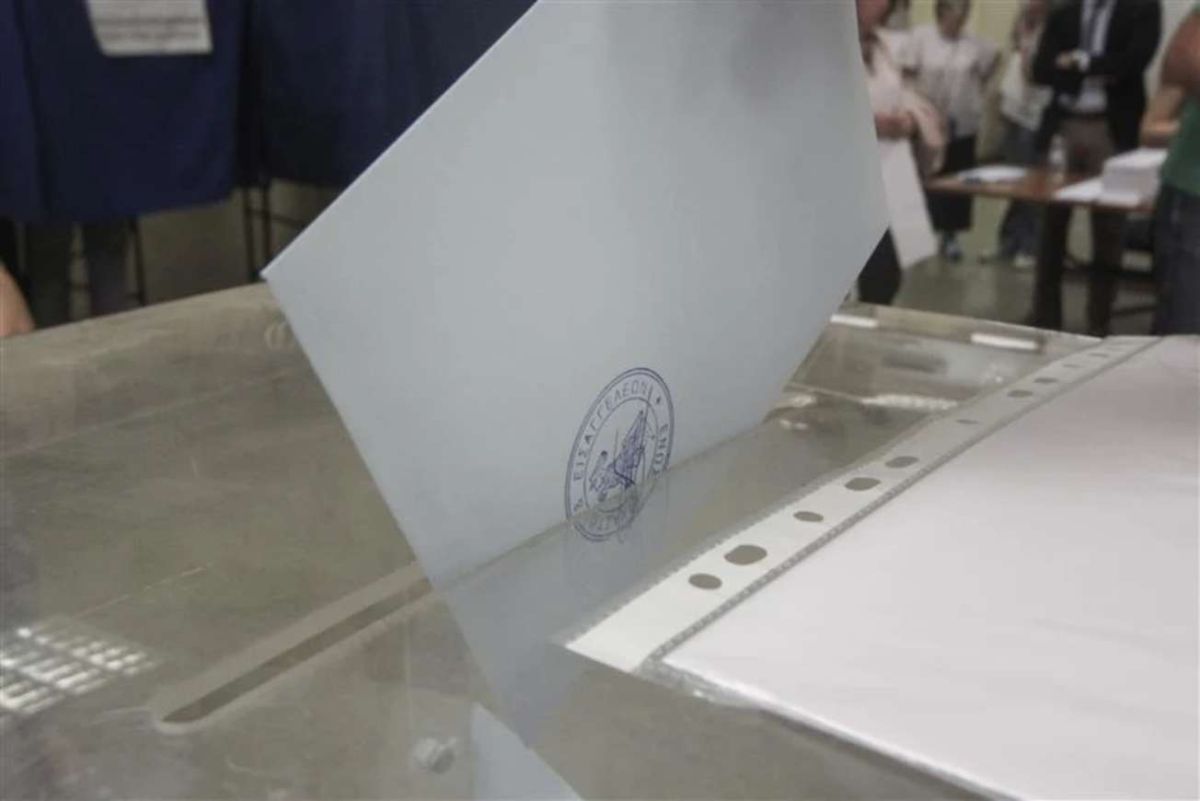
Πηγή Φωτογραφίας: eurokinissi//Opinion Poll: ND at 31%, ELAS 15.9%, PASOK 12.1% — Cost of Living and the “None” Vote Reshape the Political Landscape



The new Opinion Poll survey for ACTION 24, conducted roughly three and a half months after the June poll and following the political leaders’ appearances at the Thessaloniki International Fair, portrays a political landscape with no upheaval at the top but notable movement beneath it.
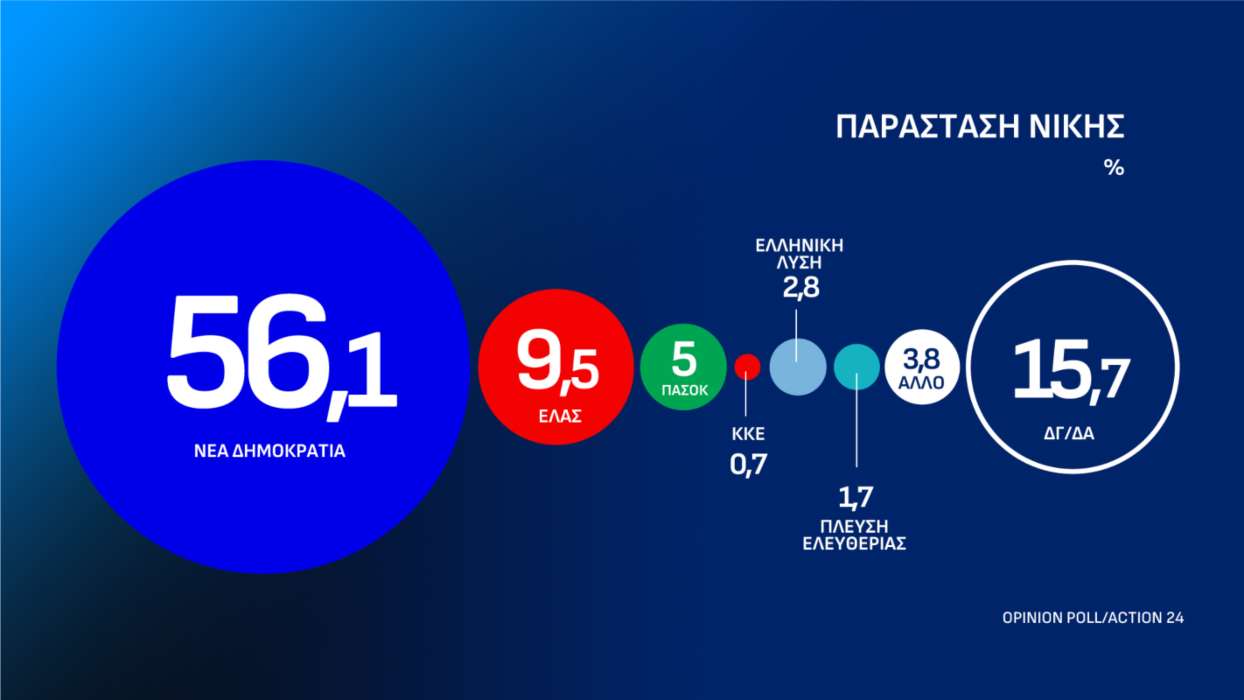
According to the survey data provided for publication, New Democracy stands at 31% in the vote estimate, up from 30.5% in June.
ELAS is second at 15.9%, compared with 15.5%, while PASOK rises to 12.1% from 10.5%.
That leaves New Democracy 15.1 percentage points ahead of ELAS, while the gap between ELAS and PASOK has narrowed to 3.8 points.
ND Maintains Its Lead — Without a Surge
New Democracy’s 31% does not indicate an electoral wave.
It does, however, show that the governing party retains a substantial advantage despite persistent pressure over household finances.
That is one of the clearest political messages in the survey.
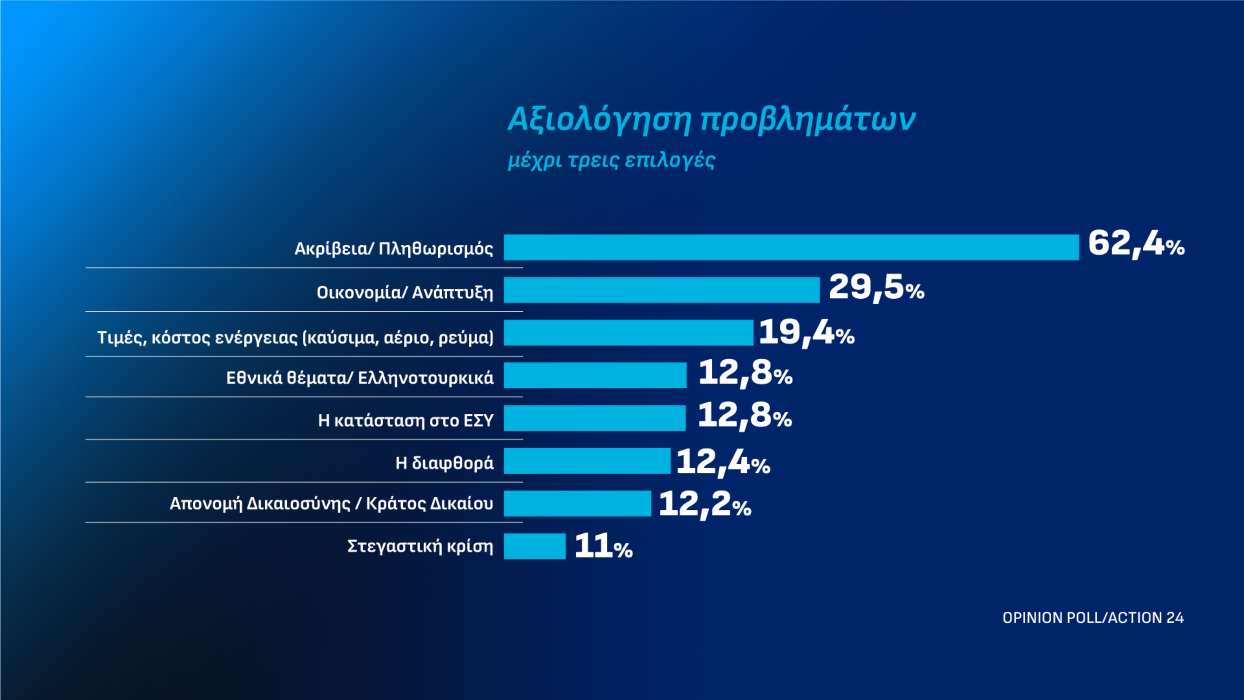
ND remains comfortably ahead even though 62.4% of respondents identify inflation and the cost of living as the country’s most serious problem.
At the same time, 59.6% say the government is either “probably not” or “not” succeeding in improving incomes and living standards within the available fiscal space.
The discontent is therefore visible.
What the poll does not show is that this dissatisfaction has yet consolidated behind one specific challenger.
ELAS Holds Second Place — But PASOK Is Closing the Gap
ELAS edges higher from 15.5% to 15.9%.
That suggests consolidation rather than acceleration.
The more notable movement is behind it.
PASOK rises by 1.6 percentage points to 12.1%, bringing the gap with ELAS down to 3.8 points.
This creates a second political contest within the broader picture: not simply who challenges New Democracy, but which opposition force can establish itself most firmly as the second pole of the system.
The survey does not determine how that contest will evolve, but it shows a narrower gap after the Thessaloniki International Fair.
The Biggest Drop: Hope for Democracy Falls From 12.6% to 4.8%
The sharpest movement in the poll comes further down the table.
“Hope for Democracy” falls from 12.6% in June to 4.8%, a decline of 7.8 percentage points.
Politically, the shift points to the volatility of protest-oriented and newly mobilized voters.
A strong initial showing for a new political formation does not necessarily translate into a stable electoral base.
In this poll, support for the party has fallen sharply within a matter of months.
Greek Solution and Voice of Reason Gain Ground
Movement is also visible to the right of New Democracy.
Greek Solution rises to 7.3%, from 5.9%.
Voice of Reason reaches 3.3%, from 1.7%.
The Communist Party stands at 6.8%, Course of Freedom at 5.4% and MeRA25 at 2.5%.
SYRIZA is recorded at 1.8%.
The broader picture suggests continued fragmentation outside the three leading parties and significant mobility among smaller formations.
An Eight-Party Parliament in the Pollster’s Seat Projection
Using Opinion Poll’s vote-estimate model, the seat projection presented in the survey is:
New Democracy 126 seats, ELAS 49, PASOK 38, Greek Solution 24, KKE 21, Course of Freedom 17, Hope for Democracy 15 and Voice of Reason 10.
This is a poll-based seat projection using current survey assumptions, not an election forecast.
Under that model, eight parties would enter Parliament.
The 16.9% Undecided Vote May Be the Most Important Number
In voting intention among valid responses, New Democracy stands at 25.7%, ELAS at 13.2% and PASOK at 10.1%.
But the standout number is the undecided vote.
It reaches 16.9%.
That is large enough to underline how fluid the current landscape remains.
And it comes at a time when economic pressure has again become the dominant political issue.
Inflation at 62.4%: The Real Contest Is Over Household Finances
The poll sends perhaps its strongest message when respondents are asked about the country’s most important problems.
Inflation and the cost of living rank first at 62.4%, up from 55% in June.
They are followed by:
the economy and growth at 29.5%,
energy prices and costs at 19.4%,
national issues and Greek-Turkish relations at 12.8%,
the condition of the National Health System at 12.8%,
corruption at 12.4%,
justice and the rule of law at 12.2%,
and housing and rents at 11%.
Despite the heavy geopolitical agenda, household economics remains the dominant domestic concern.
39% Say Living Standards Will Be Their Top Voting Criterion
The same message emerges when voters are asked what will ultimately shape their choice.
The leading criterion, at 39%, is a guarantee of improving living standards.
The need for change follows at 29.2%.
The need for stability amid international upheaval stands at 27.5%.
Reform of the political system and the rule of law reaches 22.2%.
The personality of the party leader or prime ministerial candidate ranks lower, at 14.5%.
According to the survey, economic performance and everyday living conditions therefore carry more weight for many respondents than leadership image alone.
Thessaloniki Did Not Transform the Political Landscape
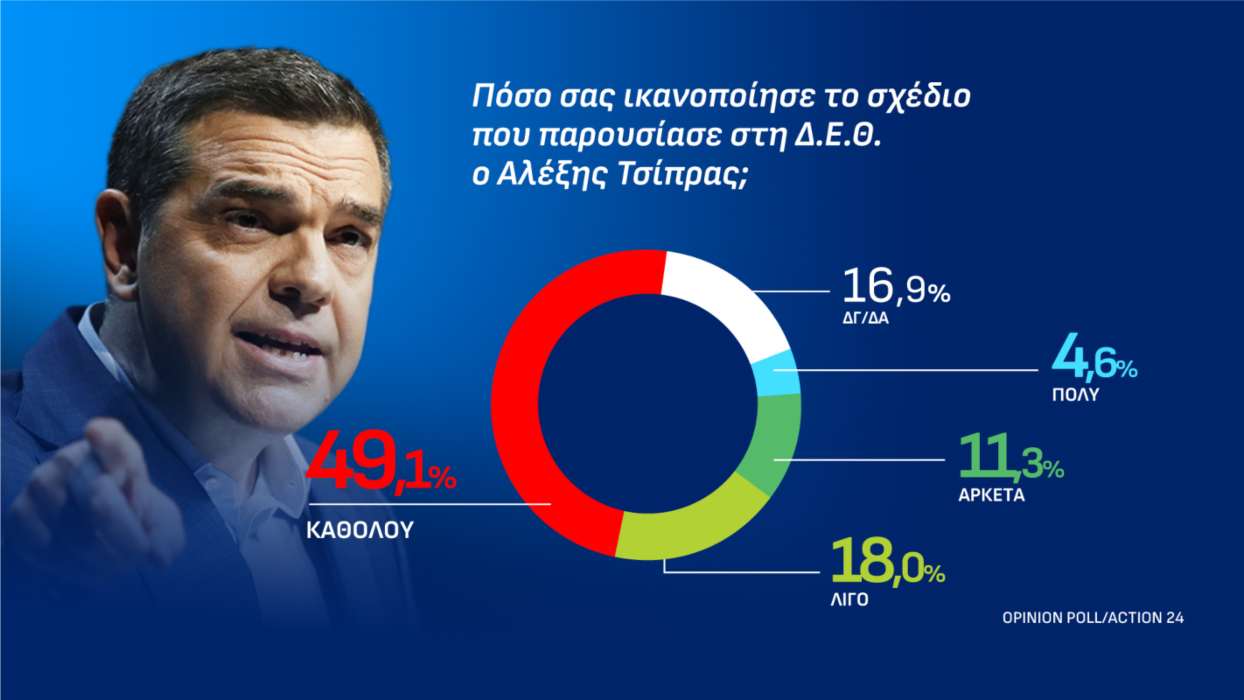
Opinion Poll also measures reactions to the economic programmes presented at the Thessaloniki International Fair.
For Kyriakos Mitsotakis’s plan, 29.6% say they were “very” or “fairly” satisfied.
Another 19% say “a little,” while 45.6% say “not at all.”
For Nikos Androulakis, the combined “very” and “fairly” satisfied figure is 16.4%.
For Alexis Tsipras, it is 15.9%.
The findings suggest that the Thessaloniki presentations did not produce a dramatic reshuffling of political loyalties.
They appear instead to have generated more limited shifts.
Mitsotakis at 31.5% on Economic Credibility — But “None” Comes First
One of the survey’s most revealing findings concerns trust in who can deliver on economic promises and benefits.
Kyriakos Mitsotakis receives 31.5%.
Alexis Tsipras stands at 15%.
Nikos Androulakis at 10%.
But the largest response is:
“None” — 35.1%.
The same pattern appears elsewhere.
On the economy and growth, 35.6% answer “none.”
On strengthening the welfare state, 34.5% do the same.
This may be one of the most important political findings after the cost-of-living numbers.
The poll reflects not only dissatisfaction, but a broader deficit of trust across the available political alternatives.
Preferred Prime Minister: Mitsotakis 27.9% — “None” at 24.9%
In the spontaneous question on the most suitable prime minister:
Kyriakos Mitsotakis stands at 27.9%,
Alexis Tsipras at 13.9%,
Nikos Androulakis at 7.4%.
Another 24.9% answer “none of them.”
Compared with June, Mitsotakis edges down from 29%.
Tsipras rises from 13.2% to 13.9%.
Androulakis rises from 4.8% to 7.4%.
The “none” response increases from 21.6% to 24.9%.
That increase again points to a sizeable electorate that remains politically available without having moved decisively toward a particular leader.
Samaras: Potential Vote Stable at 11.5%
The survey also tests potential support for a possible new party led by Antonis Samaras.
A total of 3.6% say they would be “very likely” to vote for it, while 7.9% say “fairly likely.”
The combined figure is 11.5%, almost unchanged from 11.7% in June.
Potential vote is not the same as voting intention or an estimate of actual electoral performance.
It does, however, indicate a relatively stable group of respondents who say they would consider such an option.
The Political Picture After Thessaloniki: Stability at the Top, Fluidity Below
The overall message of the Opinion Poll survey is not simply about who ranks first, second or third.
It is a political system moving at two different speeds.
At the top, New Democracy retains a clear lead.
ELAS remains second.
PASOK improves its position.
Below them, however, the landscape is considerably more unstable:
a sharp fall for Hope for Democracy,
gains for smaller parties,
16.9% undecided voters,
and high “none” responses in questions of political trust.
Above all sits one issue that continues to dominate the political agenda:
the cost of living.
The survey does not point to an immediate political realignment.
It does show, however, that the largest pool of politically available voters is concentrated among people who feel pressure from everyday costs, remain undecided and express limited trust in the existing political alternatives.
That is the electorate over which the next phase of Greek politics will be fought.
Source: pagenews.gr
Διαβάστε όλες τις τελευταίες Ειδήσεις από την Ελλάδα και τον Κόσμο