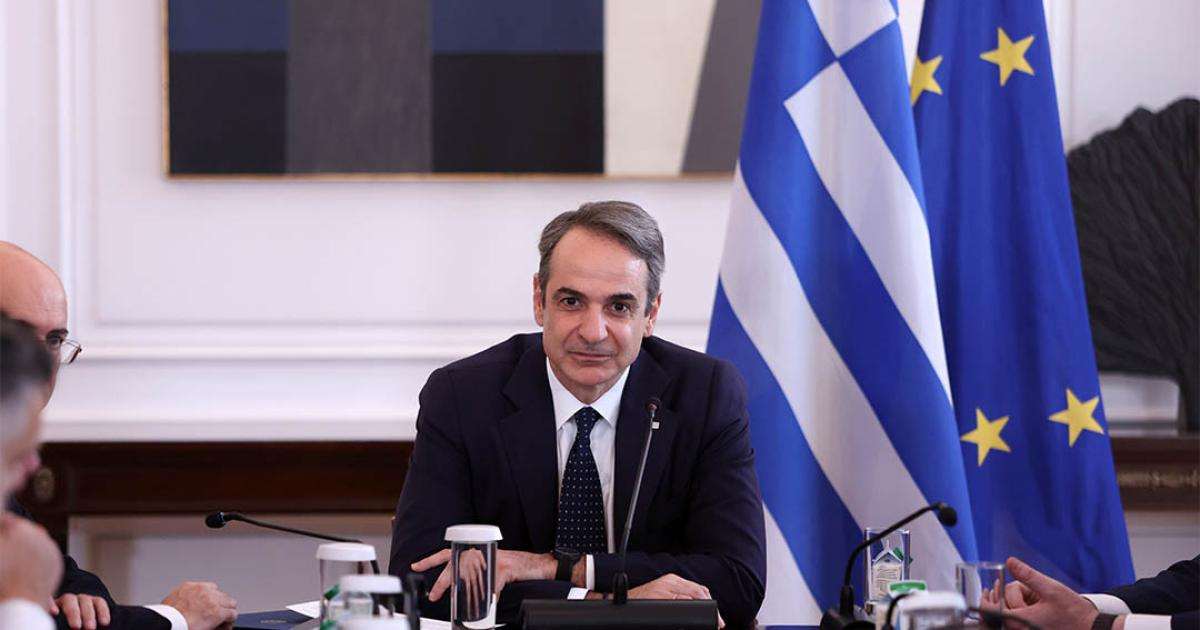
Greek Prime Minister Kyriakos Mitsotakis has called on the European Union to adopt a new emergency mechanism to respond to the weaponization of migration, arguing that Europe faces a growing hybrid threat that existing asylum and migration rules are no longer equipped to handle.
Writing in Politico, Mitsotakis argues that migration has increasingly become a geopolitical instrument used by state and non-state actors to pressure European governments, undermine political cohesion and exploit weaknesses at the Union’s external borders.
From Evros to Ceuta: A New Hybrid Threat
The Prime Minister points to a series of crises that have reshaped Europe’s understanding of border security.
He recalls the 2020 Evros crisis, when thousands of migrants were directed toward Greece’s land border with Turkey, followed by the Belarus-engineered migrant crisis affecting Poland, Lithuania and Latvia in 2021, and most recently the unprecedented pressure on Spain’s enclave of Ceuta.
According to Mitsotakis, these incidents were not ordinary migration surges but coordinated events capable of overwhelming national authorities and testing the resilience of the European Union itself.
Proposal for an EU Emergency Migration Framework
Mitsotakis argues that while the EU Pact on Migration and Asylum represents significant progress, it was designed for manageable migration pressures—not for situations in which migration is deliberately used as a geopolitical weapon.
He therefore proposes a dedicated EU emergency framework triggered by objective criteria, including:
- the scale and speed of arrivals,
- each country’s operational capacity,
- evidence of organized coordination,
- involvement of third countries or criminal networks.
Such a mechanism, he argues, would allow temporary and strictly supervised adjustments to normal migration procedures during exceptional crises.


Temporary Suspension of Asylum Applications
One of the article’s most significant proposals is allowing member states, under clearly defined emergency conditions, to temporarily suspend the submission of new asylum applications while accelerating the return of migrants who have no legal right to remain.
“This is not a departure from Europe’s values, but a necessary adaptation to new geopolitical realities,” Mitsotakis argues.
He stresses that any emergency measures must remain time-limited, proportionate and fully compliant with EU law, the EU Charter of Fundamental Rights and the principle of non-refoulement.
European Solidarity Must Become Automatic
The Greek Prime Minister also insists that frontline countries should never face such crises alone.
He calls for the automatic activation of:
- operational support from EU agencies such as Frontex,
- coordinated return operations,
- financial assistance,
- technical and logistical support whenever the emergency mechanism is triggered.
A Broader Political Message
Beyond migration policy, Mitsotakis frames the debate as one of European security and strategic resilience.
He argues that failing to equip the Union with new legal and operational tools will leave frontline states exposed, encourage hostile actors to continue exploiting migration for geopolitical leverage, and erode public confidence in Europe’s ability to protect its external borders.
With migration once again at the center of the European political agenda following developments in Ceuta, Mitsotakis positions Greece’s experience at Evros as a model for a broader European response—one that treats border protection not merely as a national responsibility, but as a cornerstone of the EU’s collective security.
Source: pagenews.gr