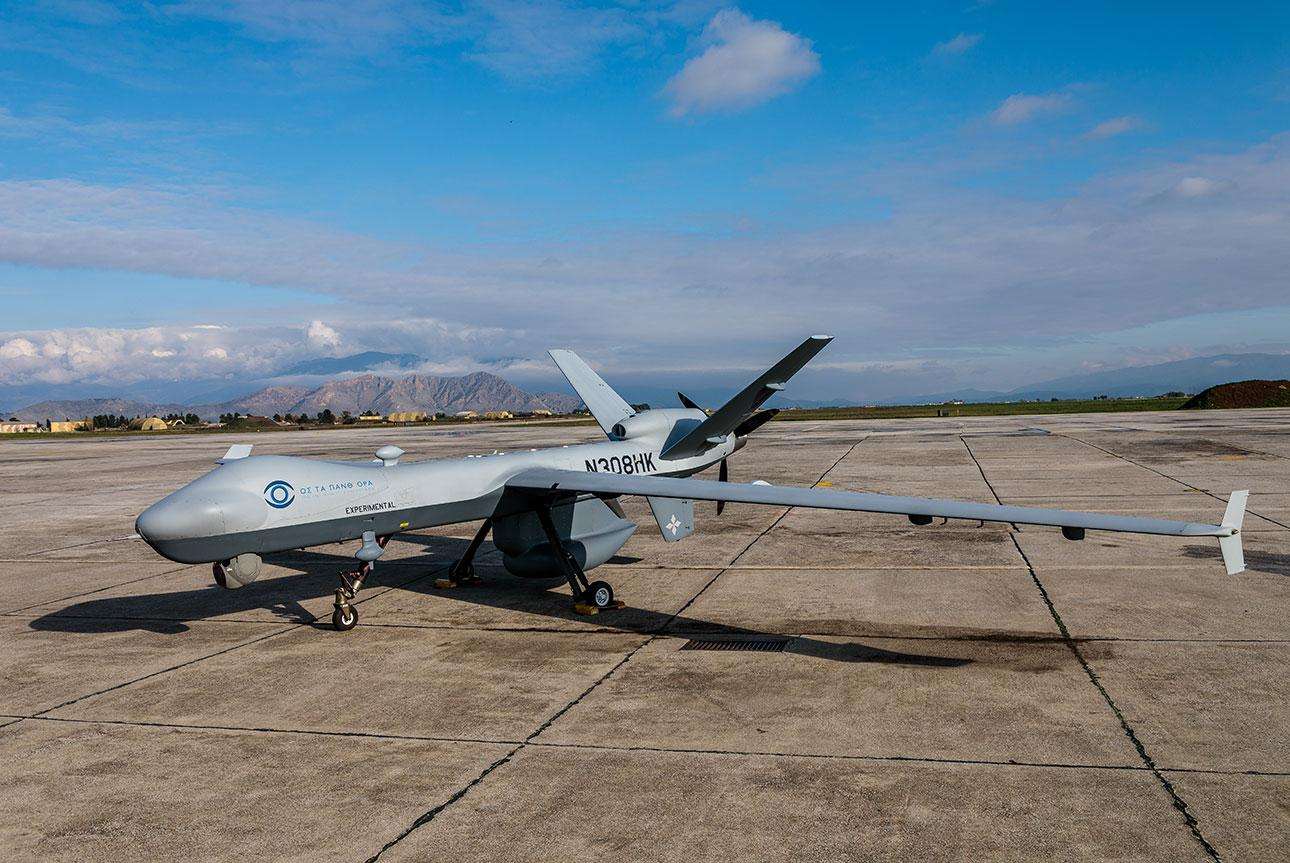
Ankara is once again raising tensions in the Aegean, this time over the possible establishment of a UAV base on Rhodes.
The Turkish Ministry of Defense is framing the issue through its long-standing argument over the “demilitarized status” of Greek islands, warning that such a move would undermine stability in the region.
Its message was explicit:
“A possible step toward establishing a UAV base on Rhodes would constitute a violation of the island’s demilitarized status and would harm peace and stability in the Aegean, as well as good-neighborly relations.”
The Turkish Defense Ministry added:
“Turkey will continue to resolutely protect the rights and interests deriving from international treaties and will take the necessary measures accordingly.”
The dispute, however, goes far beyond drones.
At its core is the question of whether Turkey can claim a say over the defense posture of sovereign Greek territory.


Rhodes Is Greek Territory Under Full Sovereignty
Athens’ position begins with a fundamental point.
Rhodes and the Dodecanese are Greek territory under full sovereignty.
Greece has consistently argued that the legal status of the islands does not grant Turkey the right to supervise or dictate Greek defense planning.
This is where the central legal and political clash lies.
Athens rejects any suggestion that Ankara can act as an arbiter of Greece’s military posture in the islands.
A UAV Base Is More Than a Military Installation
A potential UAV base on Rhodes would have significance far beyond the platform itself.
Drones have become central to modern defense operations.
They are used for:
- surveillance,
- reconnaissance,
- early warning,
- targeting,
- maritime monitoring,
- and maintaining continuous situational awareness.
Rhodes occupies a strategically important position in the southeastern Aegean and the broader Eastern Mediterranean.
A stronger UAV presence there could significantly improve Greece’s surveillance and reaction capability.
That helps explain Ankara’s sharp response.
Ankara Revives the “Demilitarization” Argument
The Turkish Defense Ministry insists that Rhodes’ status is legally binding and that further military enhancement would violate Greece’s obligations.
It stated:
“The demilitarized status of Rhodes is clearly and bindingly regulated by international treaties.”
It added:
“Any attempt to violate this status is incompatible with Greece’s obligations under international law.”
Athens rejects this interpretation.
Its position is that the defense of sovereign Greek territory cannot be subject to a Turkish veto.


Self-Defense Is Central to the Greek Position
The Greek argument is not based solely on sovereignty.
It also rests on the right of self-defense.
Athens maintains that its defense posture must be viewed in the wider security context of the Aegean, where Turkish military capabilities, recurring tensions and the long-standing casus belli continue to shape strategic planning.
From the Greek perspective, this creates an obvious contradiction.
Turkey cannot demand reduced Greek defensive capabilities while simultaneously maintaining military pressure in the region.
The Casus Belli Remains a Core Greek Argument
For Athens, the continued existence of a threat of force is incompatible with Turkish demands that Greece reduce its military presence on the islands.
The Greek side therefore argues that its defense posture is based on deterrence rather than offensive intent.
That distinction is critical.
Deploying defensive capabilities on sovereign territory is not the same as pursuing territorial claims or preparing offensive action.
Turkey’s Reaction Also Reveals Strategic Concern
The intensity of the Turkish statement also reflects concern over the evolution of Greece’s defense architecture.
In recent years, Greece has invested in:
airpower,
air defense,
UAV and counter-UAV technologies,
networked surveillance,
and early-warning systems.
Rhodes is a key point in that broader architecture.
That is why even a discussion of a new drone base attracts immediate Turkish scrutiny.


The Obvious Drone Paradox
There is also a wider strategic contradiction.
Turkey has invested heavily in unmanned systems and has built one of the most advanced drone ecosystems in Europe.
Bayraktar TB2.
Akıncı.
Anka.
Kızılelma.
UAVs are central to Turkish military doctrine.
Against that backdrop, portraying a Greek UAV base as inherently destabilizing creates an obvious asymmetry.
One side cannot claim freedom to expand its own unmanned capabilities while demanding restraint from the other.
The Karpathos Patriot Issue
The Turkish Defense Ministry also referred to the transfer of Patriot systems from Karpathos to Crete.
It described the move as:
“A positive step toward reversing the current incorrect practice.”
It added:
“As Turkey, we will continue to support all constructive steps that contribute to strengthening peace and stability in our region and that comply with international law and treaty obligations.”
Athens, however, does not accept that moving a military system automatically validates Turkey’s legal interpretation.
A Patriot redeployment may be driven by operational, technical or strategic considerations.
It does not in itself amount to recognition of Turkish claims regarding demilitarization.
Ankara Is Trying to Build a Political Precedent
This is one of the most important aspects of the dispute.
Turkey seeks to portray every Greek redeployment away from an island as a “positive” move.
At the same time, every new defensive capability is described as a “violation.”
That creates a political framework in which Ankara would effectively claim a role in determining what military systems Greece may deploy on its own territory.
Athens rejects exactly that premise.
The Real Question Is Who Decides How Rhodes Is Defended
The real issue is not drones.
It is who decides how Rhodes is defended.
Athens’ answer is unequivocal:
Greece does.
Rhodes is sovereign Greek territory.
The Greek government considers the defense posture of its territory a sovereign prerogative that cannot be conditioned on approval from a neighboring state.
Turkey, on the other hand, is trying to reinsert the demilitarization issue into the bilateral agenda as a permanent pressure point.
That is why the Rhodes controversy is larger than a potential UAV base.
It is another test of whether Ankara can link Greek sovereignty to restrictions on Greek defense.
Athens says it cannot.
And as long as the threat-of-force issue remains part of the Greek-Turkish strategic environment, Greece’s deterrence argument will remain central.
Source: pagenews.gr