There are moments in major infrastructure projects that carry far more significance than a ribbon-cutting ceremony.
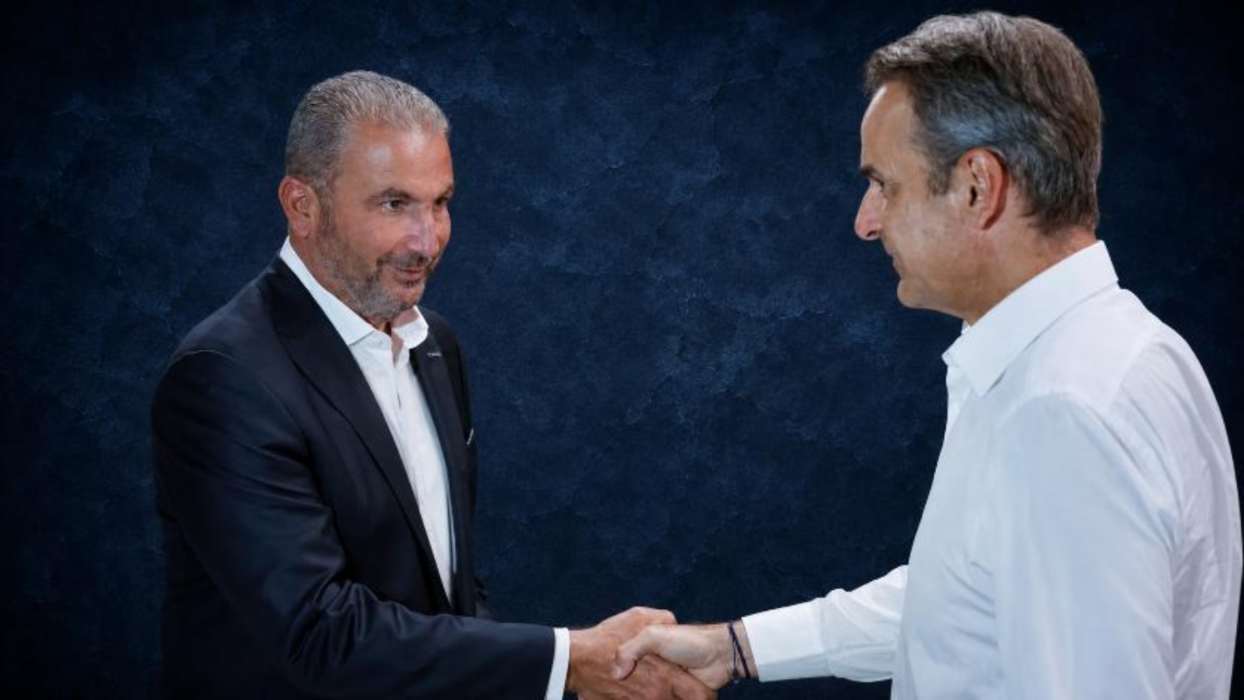
The image of Greek Prime Minister Kyriakos Mitsotakis boarding the first train of the Thessaloniki Metro extension to Kalamaria alongside Alexandros Exarchou, Chairman and CEO of AKTOR Group, is one of them.
Exarchou welcomed the Prime Minister at the new “Nomarchia” station before the two, together with the political leadership of the Infrastructure and Transport Ministry, travelled to “Mikra,” where the official inauguration took place.
The project has now moved from construction into daily operation.
And for AKTOR, that matters.
The group is not merely handing over five stations.
It is delivering a project that for years had become synonymous in the Greek public debate with delays, doubts and the perception that major infrastructure projects were difficult to complete.
That narrative is now being reversed.


The Symbolism of the First Ticket
At Nomarchia station, Mitsotakis, Exarchou and the political leadership of the Infrastructure and Transport Ministry validated the first ticket of the new line toward Kalamaria.
They then boarded one of the 15 new automated, driverless trains and travelled toward Mikra.
The symbolism is powerful.


On one side is the state, responsible for infrastructure policy, financing and delivery.
On the other is AKTOR, which must prove that it can turn technically complex projects into fully operational infrastructure.
That is precisely where Exarchou is now trying to position the company.
Not simply as a contractor.
But as one of the groups capable of carrying the next generation of large-scale Greek infrastructure projects.


Exarchou: “We Are Delivering the Most Advanced Metro in Europe”
Exarchou placed particular emphasis on both the technical dimension of the project and the political determination required to bring it to completion.
“We are proud to deliver to the people of Thessaloniki the most advanced metro in Europe. The Thessaloniki Metro is a characteristic example of how decisive political will can be in completing a major project.”
He added:
“I want to thank the people of AKTOR Group who gave everything they had to complete the project, as well as Hitachi, without which it would have been impossible to finish the metro. The Kalamaria Metro extension will change the lives of thousands of citizens.”
The reference to AKTOR’s workforce and Hitachi is significant.
Infrastructure of this scale is not judged only at the construction site.
It is judged by the integration of multiple technologies, safety certification, testing and the ability to move from engineering completion to reliable daily operation.
A First for Greek Automated Metro Engineering
The Kalamaria extension represents the first branch connection in an automated metro system in Greek technical history.
That means the project was not simply about building five additional stations.
It had to be fully integrated with the existing network.
The Kalamaria line meets the main line at “25th Martiou” station, after which trains continue toward the city center on the same tracks.
Passengers do not need to change trains.
This level of system integration is precisely what increases the project’s technical complexity.
Five New Stations and Nearly 4.8 Kilometers of New Line
The extension runs for roughly 4.8 kilometers and includes five stations:
Nomarchia,
Kalamaria,
Aretsou,
Nea Krini,
Mikra.
With the extension, the total Thessaloniki Metro network reaches 14.4 kilometers and 18 stations.
AKTOR says the new branch is expected to serve more than 60,000 passengers per day, while the journey from Mikra to Thessaloniki’s New Railway Station will take around 25 minutes.


Fifteen New Trains Increase Network Capacity
The extension also brings 15 new trains into service.
The system has been designed to handle at least 18,000 passengers per hour in each direction, with headways of as little as 90 seconds.
That is a crucial point.
A metro network is not judged only by tunnel length and station count.
It is judged by frequency.
Capacity.
Reliability.
And the ability to absorb future passenger growth.
More Than 60,000 Daily Passengers and Fewer Cars
The impact on the city is expected to be substantial.
The extension is projected to add more than 60,000 daily passengers to the network, while government estimates suggest it could remove thousands of cars from daily traffic into central Thessaloniki.
That gives the project a wider economic dimension.
It affects commuting time.
Property values.
Retail flows.
Congestion.
Urban accessibility.
And the overall functioning of the metropolitan economy.
Mitsotakis’ Public Message to Exarchou Matters
One of the most revealing moments of the ceremony came when Mitsotakis addressed Exarchou directly.
“You think you are finished, Mr. Exarchou? No. We still have Pontou to build. Shall we set a public date now and say April 1, 2027, so we can meet here again and inaugurate that as well? So you do not think you will get away that easily.”
The remark was light-hearted.
But politically, it was meaningful.
It showed that the relationship between the state and the contractor has moved into a different phase.
The question is no longer simply whether a project will be delivered.
It is what comes next, and when.
For a construction group, that is one of the clearest forms of credibility.
Not a presentation.
Not a corporate promise.
But a public expectation that the next deadline will also be met.
From the Metro to AKTOR’s New Corporate Story
Exarchou did not limit his remarks to Thessaloniki.
He connected the project directly to the transformation of AKTOR Group.
“The history of the Thessaloniki Metro is not different from the recent history of AKTOR.”
He continued:
“Today we are delivering the most advanced metro in Europe with a renewed AKTOR, which has just completed a €1 billion capital raise in order to implement investments worth €3 billion, in which international investment funds have already expressed interest.”
This is where the real corporate message emerges.
AKTOR is using the delivery of a landmark project as evidence of execution capacity at the same moment that it is entering a much larger investment cycle.

€1 Billion Raised, €3 Billion Investment Plan
Exarchou’s reference to the €1 billion capital raise and the €3 billion investment program is central to the group’s strategy.
AKTOR wants to move beyond the traditional model of a pure construction company and develop into a diversified infrastructure group with exposure to construction, energy, concessions, real estate and facility management.
Exarchou tied that shift directly to the broader Greek economy.
“This confidence of the international investment community in AKTOR reflects the results of the effort and hard work that has taken place in the Greek economy over the past seven years.”
He added:
“If we continue like this, with companies such as AKTOR — the largest and most strongly capitalized technical company in Southeastern Europe — nothing will prevent the further growth of the Greek economy.”
That characterization reflects the company’s own strategic positioning and should be read as part of the narrative management is presenting to investors and stakeholders.
Exarchou’s Real Capital Is Delivery
In construction, financial capital is essential.
But it is not the only currency.
There is another one:
execution credibility.
That is exactly what Exarchou wants to turn into AKTOR’s defining corporate signature.
The group wants to demonstrate that it can:
take on highly complex projects,
complete them,
integrate advanced technology,
meet operational deadlines,
and hand over infrastructure that actually works.
Kalamaria provides a very strong proof point.
From a Symbol of Delay to a Showcase Project
For years, the Thessaloniki Metro was almost synonymous with the inability of the Greek state to complete technically complex infrastructure.
That image is now being reversed.
For AKTOR, this gives the group something that cannot easily be bought:
a flagship project.
A piece of infrastructure that can be shown to investors, governments and future partners as evidence of actual delivery.
The Next Chapter Is Already Forming
The Kalamaria extension is not the end of Thessaloniki Metro expansion.
The government has already reiterated that planning for extensions toward the city’s northwestern districts will continue.
That means the next major infrastructure pipeline is already beginning to take shape.
And for Greece’s construction market, that matters greatly.
Companies with balance-sheet strength, engineering capacity and a track record of execution will be better placed to compete for that next cycle.

The Mitsotakis–Exarchou Image Says More Than the Ceremony
The deeper meaning of the day is not the protocol of the inauguration.
It is the changing relationship between state capacity and corporate execution.
The government needs construction groups with enough capital, technical capability and organizational depth to carry major, complex projects.


Companies, in turn, need a state that can decide, finance, unblock and deliver.
The Thessaloniki Metro showed that relationship in one of its clearest forms.
Alexandros Exarchou is now appearing not simply as the chief executive of the company that completed a difficult project.
He is appearing as the head of a group trying to convert project delivery into a much larger corporate platform.
€1 billion in new capital.
€3 billion in planned investment.
International investor interest.
A new project pipeline.
And a flagship metro as evidence that the company can move from promise to completion.
That is the real political and corporate message of Kalamaria.
For AKTOR and Exarchou, the Thessaloniki Metro is not the end of a project.
It is the showcase for the group’s next era.
Πηγή: pagenews.gr