One word was enough to significantly change the scale of one of Washington’s most serious recent cyber allegations against China.
And the timing is impossible to ignore.
On August 26, the U.S. Department of Justice announced an FBI operation to seize internet infrastructure used by QTFY, a hacking group that American authorities link to China.
The original announcement described NASA, the Federal Reserve, the Department of Energy, the Department of Justice, the Department of Health and Human Services, the National Institutes of Health and the U.S. Senate as “victims” of the group’s cyber activity.
Two days later, that language changed.
The “victims” became “targets.”
And the Justice Department itself had to explain why.
“The Aug. 26 release characterized all the agencies as victims, while the government’s affidavit made clear all were targeted but only some were compromised,” the DOJ explained.
That is not a minor semantic distinction.
Attempting to penetrate the Federal Reserve, NASA or the U.S. Senate is one thing.
Successfully breaking into their systems is another.
NASA, the Fed and the Senate: The Word That Changed the Case
The revised Justice Department announcement now describes the federal institutions as “targets” of QTFY.
They include:
- NASA
- the Federal Reserve
- the Department of Energy
- the Department of Justice
- the Department of Health and Human Services
- the National Institutes of Health
- the U.S. Senate
The revised announcement also contains an unusually revealing note.
“Changes have been made to ensure this release accurately reflects the government’s allegations in the affidavit supporting the domain seizures.”
In other words, the original politically explosive announcement went further than the underlying court documents supported.
Washington then had to correct itself.
NASA Stopped the Hackers at the Door
The FBI affidavit makes the distinction even clearer.
According to U.S. investigators, QTFY has targeted American federal networks since at least 2018.
But in NASA’s case, the attempted intrusion failed.
Investigators determined that the space agency had installed the necessary security updates before the attackers could exploit the relevant vulnerability.
Attempts to penetrate networks belonging to the U.S. Senate and a hospital in March 2026 were also unsuccessful.
There were, however, confirmed compromises elsewhere.
According to the court documents, successful intrusions occurred in September 2024 against three Department of Energy national laboratories, the National Institutes of Health, an agency within the Department of Health and Human Services and a U.S. security-device manufacturer.
A joint warning from the FBI, NSA and U.S. Cyber National Mission Force has also documented successful data theft involving unnamed defense contractors, financial institutions and universities.
So the Chinese cyber threat does not disappear because the DOJ corrected its language.
Far from it.
What changes is the scale of Washington’s original claim.


Who Is QTFY?
U.S. security agencies identify QTFY — also known as QT and QTCYBER — as a significant China-linked cyber threat.
American authorities say the group has operated since at least 2018 and developed infrastructure allowing hackers to disguise the real origin of malicious activity.
Two tools are central to the operation: QScan and QTRouter.
QTRouter can use compromised routers and other internet-connected devices to create infrastructure through which cyber operations can be routed while concealing their actual origin.
U.S. authorities have linked the network to Nanjing Xinjiuwei Network Technology Company and allege that the broader ecosystem has supported operations associated with Chinese state interests.
The FBI and NSA therefore remain clear about the underlying threat.
The correction does not exonerate QTFY.
It corrects Washington’s description of what the group actually succeeded in doing.
The FBI Is Not Backing Away From the Chinese Threat
This distinction is important.
The Justice Department’s revision does not mean U.S. security agencies are abandoning allegations of Chinese cyber espionage.
FBI Cyber Division Assistant Director Brett Leatherman described the operation in unequivocal terms.
“The FBI and Department of Justice are announcing the disruption of a global botnet used by a Chinese state-sponsored group, known as QTFY, to target U.S. critical infrastructure.”
Again, the crucial word is “target.”
Not successfully compromise every institution named in the original announcement.
Washington still accuses China-linked actors of conducting a sophisticated and sustained cyber campaign.
What it can no longer claim on the basis of these documents is that every institution on the original list was actually breached.
And All This Happens Just Before Xi Heads to the United States
This is where a cybersecurity story becomes a geopolitical one.
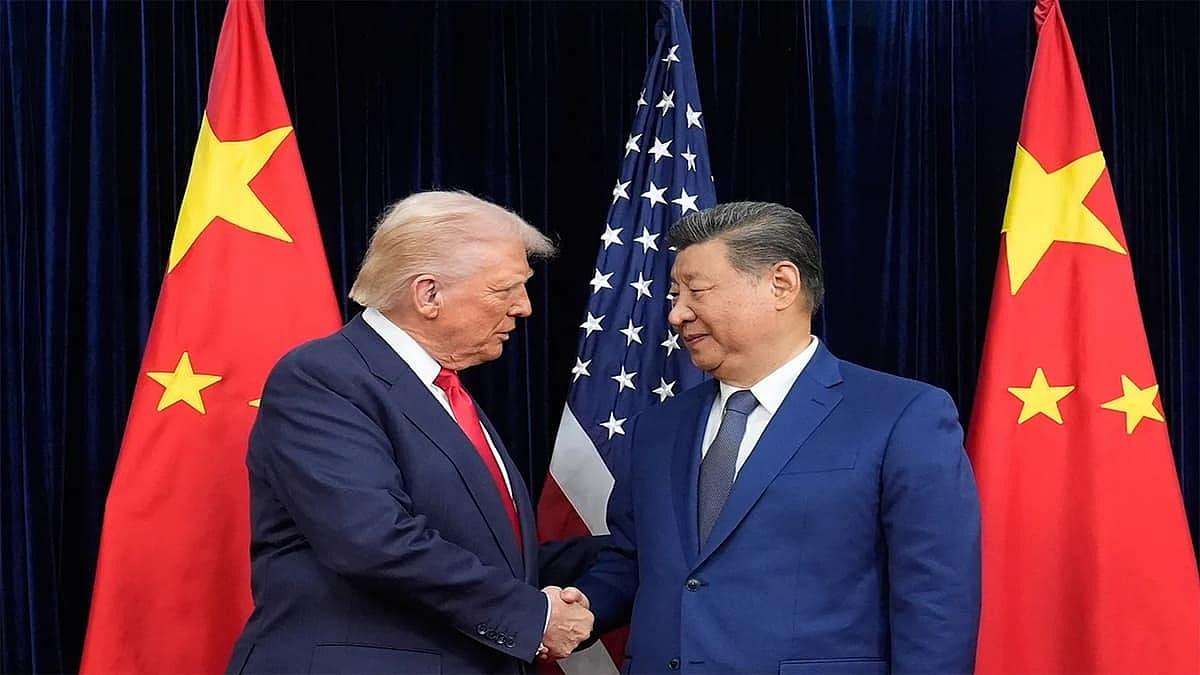
Trump has publicly said that he expects Chinese President Xi Jinping to visit the United States around September 24.
“I think on September 24, or thereabouts, President Xi is coming to the United States,” Trump has said.
The precise timing of the summit has not been formally finalized publicly, but preparations for another high-level encounter are underway.
Beijing is sending its own signals.
Chinese Foreign Minister Wang Yi has urged Washington and Beijing to remove obstacles from their relationship and manage their differences as the two sides seek to stabilize ties.
The objective is increasingly clear.
Neither capital wants the fragile U.S.–China détente to collapse before Trump and Xi get into the same room.
Beijing Gets a Political Gift
China has consistently rejected Washington’s accusations over state-sponsored hacking and argues that the United States uses cybersecurity as a political weapon against Beijing.
Chinese officials have repeatedly accused Washington of “overstretching the concept of national security” and using cyber allegations to justify restrictions against Chinese companies and technology.
The DOJ correction now gives Beijing an obvious communications opportunity.
Chinese officials can point out that Washington itself was forced to narrow the scope of its original allegations.
That does not invalidate documented QTFY operations.
But it does weaken the credibility of the initial American presentation of the case.
And in the information war between Washington and Beijing, credibility matters almost as much as technical evidence.
Trump’s China Dilemma
The episode exposes a broader contradiction in the Trump administration’s China strategy.
Trump wants to demonstrate that the United States will confront Beijing over cybersecurity, technology, trade and national security.
But he also wants a deal.
The two countries are trying to preserve a fragile commercial truce while managing disputes involving tariffs, semiconductors, artificial intelligence, critical minerals, Taiwan and access to strategic technologies.
A formal U.S. allegation that Chinese state-backed hackers had successfully penetrated the Federal Reserve, NASA and the U.S. Senate would dramatically complicate that agenda.
The revised version is still serious.
But it is significantly less explosive.
China-linked hackers targeted critical American institutions.
Some were successfully compromised.
Others were not.
That is a very different proposition from suggesting that the entire list of America’s most sensitive institutions had fallen victim to successful Chinese intrusions.
Was It a U-Turn — or a Necessary Correction?
There are two plausible interpretations.
The first is damaging for Washington.
The Justice Department initially used overly broad language and presented attempted intrusions in a way that created the impression of successful compromises.
The second is considerably less dramatic.
Officials discovered that the public announcement overstated what the underlying affidavit actually demonstrated and corrected the record.
What has not been established is equally important.
There is currently no public evidence that Trump personally ordered the revision, that Xi demanded it, or that the Justice Department changed its language as part of a diplomatic concession to Beijing.
But the timing inevitably gives the correction geopolitical significance.
It comes as Trump and Xi prepare for a meeting carrying enormous strategic stakes.
Trump Needs to Be Tough on China — and He Needs Xi
That is the real story behind Washington’s awkward retreat.
The Trump administration needs two contradictory things from China.
It needs Beijing to remain America’s principal strategic competitor — a threat powerful enough to justify restrictions on Chinese technology, tougher cyber defenses and an aggressive U.S. industrial strategy.
At the same time, Trump needs Xi Jinping at the negotiating table.
He needs room for agreements on trade, critical minerals and potentially broader geopolitical issues without every confrontation escalating into an irreversible crisis.
The QTFY episode captures that dilemma almost perfectly.
On August 26, Washington’s language created the impression that some of the most sensitive institutions at the heart of the American state were among the victims of a sweeping Chinese cyber operation.
By August 28, the United States was acknowledging that all had been targeted — but only some were actually compromised.
That is a substantial retreat from the original wording.
It is not proof that Washington is covering up Chinese aggression to please Xi.
But it is a reminder that in the increasingly delicate U.S.–China relationship, language itself has become an instrument of power.
Trump wants to confront China without closing the door to Xi.
Beijing wants negotiations without accepting Washington’s portrayal of China as an existential security threat.
And just weeks before the two leaders are expected to meet, one carefully corrected word has already lowered the temperature.
From “victims” to “targets.”
In the geopolitical contest between the United States and China, sometimes one word can be worth more than a thousand diplomatic statements.
Source: pagenews.gr