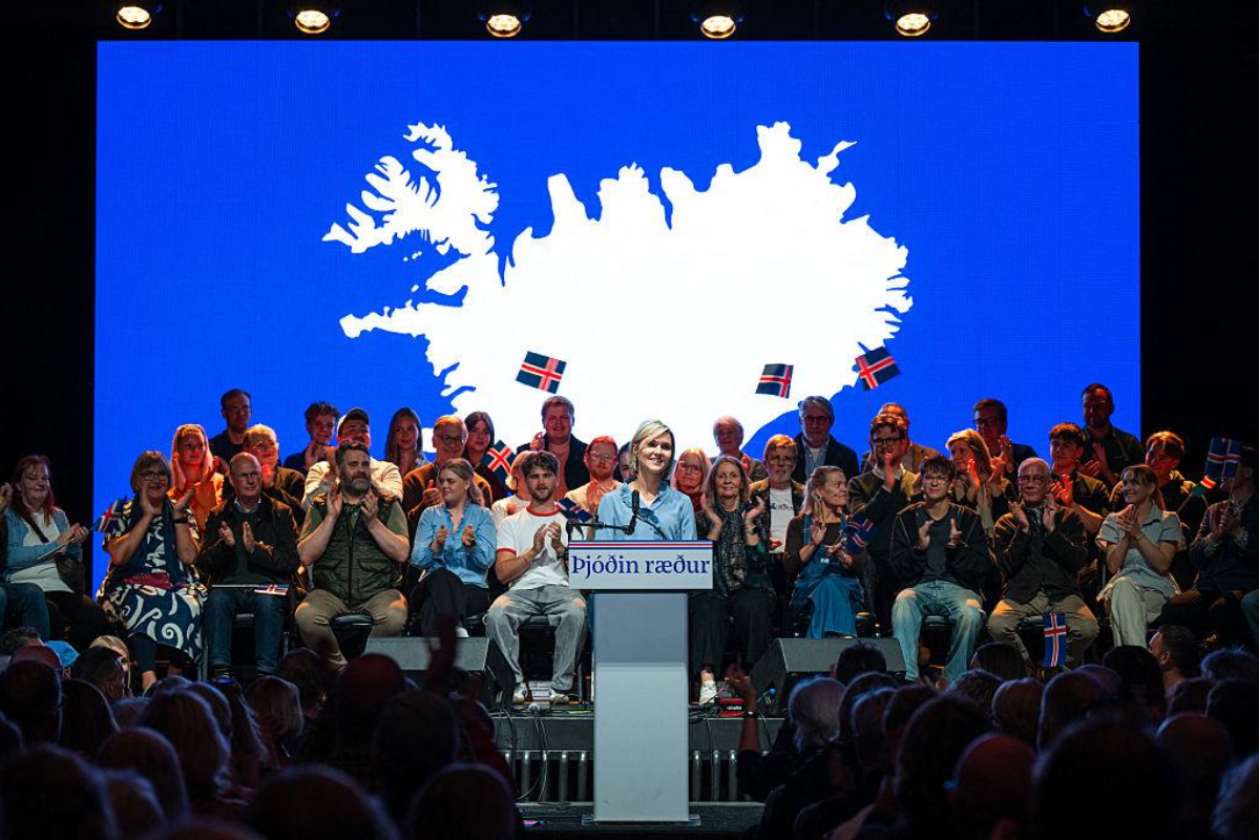
Iceland has said “no” to reopening negotiations to join the European Union.
In a closely fought referendum, 52.8% of Icelanders rejected the government’s proposal to resume EU accession talks, against 47.2% who voted in favour, preserving the country’s distinctive position: deeply integrated into Europe economically and institutionally, but outside the EU.
Turnout reached an exceptionally high 82.5%, underlining the political significance of a vote that ultimately became a choice between deeper European integration and retaining national control over strategic resources.
One distinction is crucial: Icelanders did not vote directly on EU membership. They voted on whether accession negotiations should restart. Even if the “Yes” side had prevailed and talks eventually produced an agreement, a final accession treaty would still have required another referendum.
Reykjavik Said “Yes” — Much of the Rest of Iceland Said “No”
The electoral map exposed a significant geographical divide.
The two Reykjavik constituencies backed reopening negotiations, while the other four constituencies rejected the proposal.
The divide helps explain what drove the result.
Support for closer EU integration was strongest in the capital, while opposition intensified in areas where fisheries, coastal communities and control over natural resources carry greater economic and political weight.
The referendum was therefore not simply a debate over Brussels.
It was also a debate between different visions of Iceland’s economic future.
Fishing Became the Red Line
At the heart of the campaign was an issue that carries almost existential importance for Iceland: control of its fishing waters.
Fishing remains one of the pillars of the Icelandic economy and accounts for roughly 40% of merchandise export revenues.
For opponents of accession, EU membership raised a fundamental question: whether Iceland could retain sufficient control over its fishing grounds and quotas under the EU’s Common Fisheries Policy.
That concern proved decisive.
For many Icelanders, fishing is not merely another sector to be negotiated during an accession process. It represents employment, export income, regional survival and control over one of the country’s most valuable natural resources.
The “No” campaign successfully turned the referendum into a question of sovereignty:
Why surrender negotiating power over Icelandic waters when the country already enjoys extensive access to the European economy?


Iceland Wants Europe — Without Necessarily Wanting the EU
That is what makes Iceland’s decision particularly important.
The country is hardly isolated from Europe.
Iceland participates in the European Economic Area (EEA), giving it extensive access to the EU single market, and it is part of the Schengen Area.
It has consequently adopted a substantial body of EU legislation without becoming a full member.
But key areas, including fisheries, remain outside the EEA framework.
This gives Reykjavik something close to a hybrid model: deep economic integration with Europe while preserving greater national autonomy in politically sensitive sectors.
A majority of voters has now decided not to put that balance at risk.
Frostadóttir Loses Her European Gamble
The result is a political setback for Prime Minister Kristrún Frostadóttir, whose government had supported reopening negotiations.
Her government argued that the geopolitical environment surrounding Iceland had changed significantly and that the country should reassess whether remaining outside the EU continued to serve its long-term interests.
Frostadóttir had nevertheless made clear that the government would respect either outcome.
She said ahead of the result:
“We will be fine even if it is a ‘No’.”
The prime minister had also indicated that a rejection would probably close the EU membership question for the duration of the current government’s term.
The European question is therefore likely to return to the political freezer — at least for now.
From the 2008 Crash to the 2026 Referendum
Iceland’s relationship with EU membership has repeatedly been shaped by economic shocks.
The country applied to join the EU in 2009, following the devastating financial crisis that brought down its banking system and severely damaged the Icelandic economy.
Accession negotiations began, but the political momentum subsequently disappeared and talks were suspended in 2013.
More than a decade later, some of the economic arguments returned.
Supporters of membership pointed to inflation, high interest rates, currency volatility and Iceland’s vulnerability as a small open economy.
Opponents countered that these were domestic economic problems requiring domestic solutions — not reasons to transfer additional powers to Brussels.
The latter argument prevailed.


A Setback for Brussels
For the European Union, the result carries significance far beyond Iceland’s population of around 400,000.
Iceland would have been an unusually straightforward candidate compared with many countries currently seeking membership.
It is a wealthy European democracy, a NATO ally, a member of the EEA and Schengen, and already aligned with much of the EU regulatory architecture.
A decision to resume accession negotiations could therefore have provided Brussels with a powerful political symbol at a time when enlargement has again become part of Europe’s geopolitical strategy.
Instead, the referendum delivers a more uncomfortable message:
economic integration with the EU does not automatically generate political demand for full membership.
The Arctic Is the Bigger Geopolitical Story
There is another reason Brussels cared about the Icelandic vote.
Geography.
Iceland occupies a strategically critical position in the North Atlantic at a time when the Arctic and High North are rapidly becoming more important to European and transatlantic security.
Russia’s military posture in the Arctic, emerging northern shipping routes, Chinese interest in the region and growing competition over resources are transforming the geopolitical significance of Europe’s northern frontier.
Iceland sits directly inside that strategic theatre.
Bringing Reykjavik into the EU would therefore have meant more than adding another small European economy.
It would have strengthened the Union’s political footprint in the High North.
The referendum has closed that route for the foreseeable future.
NATO Yes, EU No
Yet the result should not be interpreted as an Icelandic retreat from the West.
Iceland remains a NATO member, part of Schengen and closely integrated into the European single market through the EEA.
The country is firmly embedded in the Western security architecture.
What voters rejected was another layer of political integration.
That distinction matters.
The model endorsed by the referendum can broadly be described as:
European economic integration + Atlantic security + national control over strategic resources.
For a small state surrounded by some of the world’s richest fishing grounds, that formula remains politically attractive.
What the Iceland Vote Tells Europe
The deeper lesson for Brussels concerns the limits of the EU’s new geopolitical enlargement strategy.
The European Union increasingly presents enlargement not simply as an economic project but as an instrument of power: a larger Union should theoretically have greater strategic weight in an era of competition with Russia, China and other global powers.
Iceland presented almost the ideal case for that argument.
It is democratic, prosperous, Western, institutionally compatible with the EU and strategically located.
And yet a majority still said no to even reopening negotiations.
Why?
Because when European integration collided with control over fisheries, economic sovereignty and national decision-making, domestic interests proved more powerful than the geopolitical case for membership.
This was not an Icelandic Brexit.
Iceland is not leaving Europe, abandoning the single market or turning away from NATO.
Its voters made a more nuanced choice:
close to Europe, inside the Western alliance — but with Reykjavik retaining the final say over Iceland’s waters and resources.
And that may be the most consequential message of the referendum for Brussels.
At a moment when the EU wants enlargement to become an instrument of geopolitical power, Iceland has demonstrated that national sovereignty remains one of the hardest political currencies for Brussels to negotiate.
Source: pagenews.gr