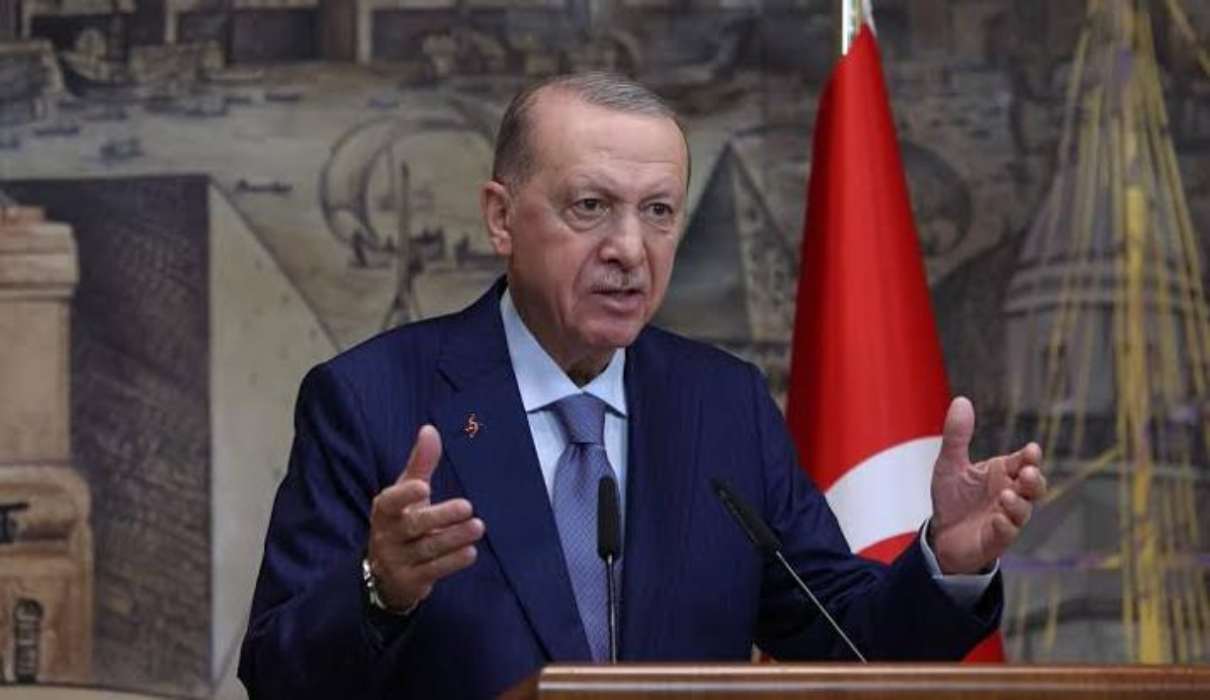
Turkish President Recep Tayyip Erdogan has sharply raised the temperature in Greek-Turkish relations, once again challenging Greece over the military status of islands in the Aegean and calling on Athens to reverse course.
Speaking to journalists on his return from Kyrgyzstan following the Shanghai Cooperation Organisation summit, Erdogan revived one of Ankara’s most contentious positions regarding the Aegean.
“Greece must abandon the wrong path it has taken and stop arming the islands that have demilitarised status,” Erdogan said.
The intervention comes at a particularly sensitive moment, as Athens and Ankara attempt to preserve diplomatic channels while fundamental disagreements over the Aegean, the Eastern Mediterranean and maritime jurisdiction are returning to the foreground.
“Türkiye Does Not Covet Anyone’s Territory”
Erdogan sought to combine his warning with an insistence that Ankara remains committed to good-neighbourly relations.
“We say that we want to move forward with Greece on the basis of good neighbourliness,” he said.
But the Turkish president immediately coupled that message with a warning.
“Greece must now understand something: Türkiye does not covet anyone’s territory, but it will not allow anyone to violate its rights.”
Erdogan also accused Athens of failing to reciprocate what he described as Ankara’s constructive approach.
“We have been sincere on every issue. We were the side that acted constructively. However, on many occasions we did not see the other side respond to our goodwill.”
It is a familiar dual-track strategy from Ankara: dialogue and good neighbourliness on one side, deterrence and pressure on the other.
Erdogan: Do Not Mistake Restraint for Weakness
One of the strongest passages in Erdogan’s remarks was his warning against interpreting Türkiye’s posture as weakness.
“Anyone who interprets Türkiye’s calm and prudent approach as weakness is making a serious mistake. I say this very clearly.”
He then returned directly to the Aegean:
“Greece must abandon the wrong path it has taken and stop arming the islands that have demilitarised status.”
Erdogan concluded his remarks on Greece by invoking history.
“History is a very good guide for those who need to learn from it. We will continue working for peace, security and stability in our region.”
The combination of references to history, military restraint and alleged violations of Türkiye’s rights gives the intervention significance beyond another rhetorical exchange between Athens and Ankara.
The Battle Over the Aegean Islands
Türkiye has long argued that the military status of certain eastern Aegean islands is governed by international treaties imposing demilitarisation obligations.
Greece rejects Ankara’s broader interpretation of those treaties and invokes, among other legal arguments, its inherent right of self-defence under Article 51 of the UN Charter.
For Athens, the security environment cannot be separated from Türkiye’s substantial military capabilities across the Aegean, including the presence of the Turkish Fourth Army, commonly known as the Aegean Army, on the western Turkish mainland.
The disagreement is therefore not simply about competing interpretations of treaty provisions.
It goes directly to the heart of the security architecture of the Aegean.
Athens’ Fundamental Question: Why Should Greece Disarm?
There is also a strategic contradiction at the centre of Ankara’s argument from the Greek perspective.
Türkiye is asking Greece to reduce the military presence on islands close to the Turkish coast while simultaneously pursuing an ambitious expansion of its own military capabilities.
Ankara is developing the KAAN fifth-generation fighter programme, expanding its drone and missile capabilities, investing heavily in indigenous air defence and seeking to restore access to the US-led F-35 programme.
That creates an obvious security question for Athens:
why should Greece accept unilateral military constraints while Türkiye is expanding the range, sophistication and autonomy of its own armed forces?
It is precisely this strategic asymmetry that makes the demilitarisation debate far more consequential than the terminology surrounding individual treaties.
F-35, KAAN and the Road to a “Strong Türkiye”
Erdogan’s comments on Greece were accompanied by remarks outlining his broader vision for Turkish military power.
Asked about Türkiye’s possible return to the F-35 programme and speculation surrounding the Russian-made S-400 system, Erdogan stressed that negotiations with Washington remain alive.
“As you know, Türkiye was one of the partner countries in the F-35 programme and made significant contributions to it. Our discussions on Türkiye’s return to the programme are continuing.”
But he made clear that Ankara does not intend to place all its strategic bets on the American fighter.
“While conducting all these diplomatic efforts, we are not abandoning KAAN. We are not abandoning the development of our own air-defence systems. On the contrary, we are expanding Türkiye’s options.”
His conclusion encapsulated the strategic doctrine:
“This means a strong Türkiye. This is the roadmap for a strong Türkiye.”
A More Autonomous Türkiye Changes the Aegean Equation
Those remarks matter for Greece.
Türkiye is increasingly seeking to operate simultaneously inside and outside traditional Western strategic structures.
It remains a crucial NATO member while deepening relationships with Russia, China, Central Asian states and Middle Eastern powers.
The Shanghai Cooperation Organisation is part of that multidirectional foreign policy.
Erdogan’s objective is not necessarily to replace Türkiye’s Western alliances but to reduce dependence on any single strategic centre.
For Athens, that evolution has direct consequences.
A Türkiye possessing stronger indigenous defence capabilities and a broader network of geopolitical partnerships potentially enjoys greater freedom of action in the Eastern Mediterranean and the Aegean.
Syria Is Part of the Same Strategic Picture
Erdogan also used his remarks to reinforce Türkiye’s ambitions in Syria.
He warned that actors seeking to undermine Syria’s internal stability should not be given room to operate and called on neighbouring and friendly countries to support reconstruction.
“The path to stability in Syria passes through eliminating the seeds of discord,” he said.
The Syrian dimension matters because Ankara increasingly views the Aegean, Eastern Mediterranean, Syria, the Black Sea and the wider Middle East not as separate strategic theatres but as components of a broader regional security environment.
Türkiye wants to be a decisive actor across all of them.
The Timing Matters
Erdogan’s intervention comes as Athens itself is adopting a firmer public tone.
The Greek government has stressed that the policy of “calm waters” with Türkiye is not the defining doctrine of Greek foreign policy.
Government spokesperson Pavlos Marinakis has said that Athens remains committed to dialogue but will accept “no retreat from established national positions.”
Foreign Minister Giorgos Gerapetritis has similarly emphasised that Greece will act according to international law and will not seek Türkiye’s permission to advance projects Athens considers lawful.
That makes Erdogan’s latest intervention an important test of the bilateral relationship.
From “Calm Waters” to Armed Deterrence
The central question is no longer whether Greece and Türkiye will continue talking.
They almost certainly will.
The harder question is whether dialogue can survive when disputes directly touching sovereignty, defence and maritime jurisdiction return to the centre of the relationship.
Ankara wants to present itself as peaceful but powerful: a state seeking dialogue while warning its neighbours not to mistake restraint for weakness.
Athens is advancing a different proposition: peace cannot require Greece to accept unilateral limitations on its defence or concede rights it believes are guaranteed under international law.
And this is where Erdogan’s latest intervention becomes geopolitically significant.
Türkiye says it does not covet Greek territory. Yet at the same time, it is demanding that Greece restrict its military posture on strategically exposed Aegean islands while Ankara itself rapidly expands its military capabilities.
That contradiction will remain one of the hardest obstacles to any lasting Greek-Turkish détente — and one that “calm waters” alone cannot resolve.
Source: pagenews.gr