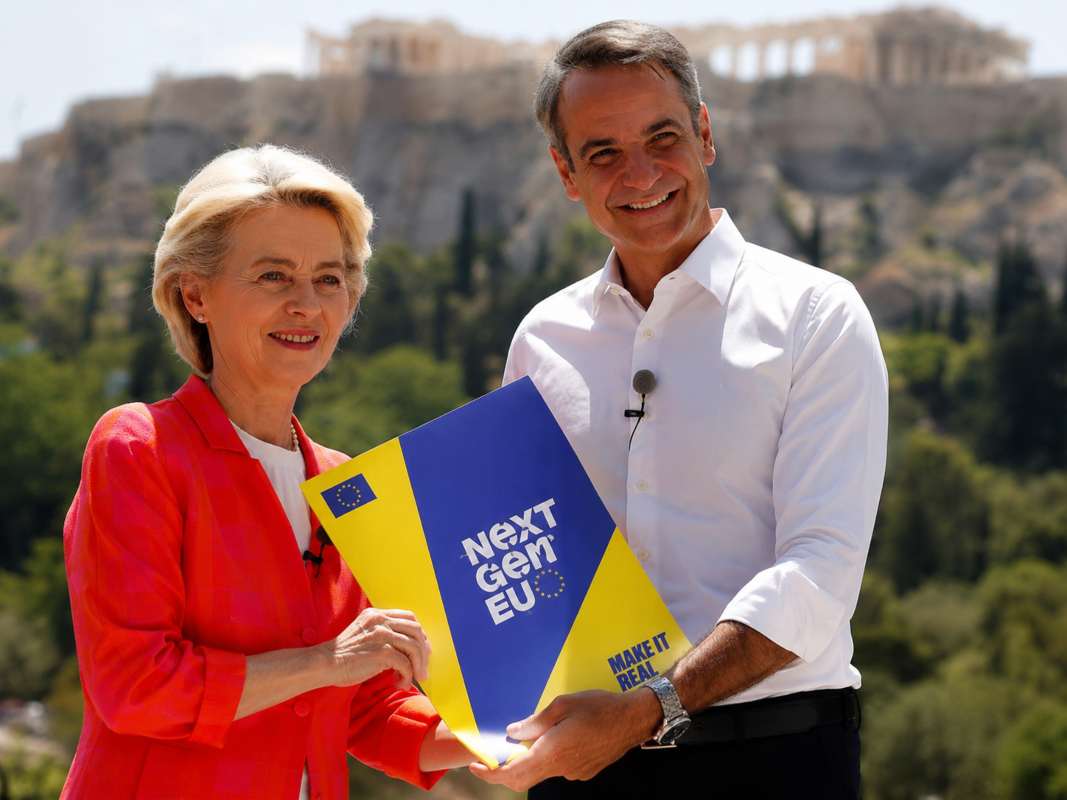
This year’s Thessaloniki International Fair will not only be about tax cuts, benefits and the economic measures Kyriakos Mitsotakis is expected to unveil.
It is also becoming a major political reckoning for one of the largest investment programmes in modern Greek history:
the Recovery and Resilience Facility and Greece 2.0.
Five years after the programme began, Greece is approaching the end of a funding cycle worth almost €36 billion under the RRF alone.
The government must now demonstrate that behind the billions, milestones and disbursement requests there is something citizens can actually see in their everyday lives.


TIF Becomes the Showcase for Greece 2.0
That is precisely the message behind a special event organised by Greece’s Recovery Fund Coordination Agency at the 90th Thessaloniki International Fair, under the title:
“Everyday Life and Investments at the Forefront: The Impact of the Recovery and Resilience Fund.”
The central question is straightforward but politically difficult:
How have European funds translated into better public services, more investment and measurable improvements for citizens?
For the Mitsotakis government, the answer matters enormously.
The RRF is moving from the era of announcements and project approvals into the era of accountability.
The Recovery Fund Reaches the Finish Line
A critical deadline has just passed.
By August 31, 2026, Greece had to complete the implementation of the investments and reforms linked to the milestones and targets underpinning its final payment request.
Greece’s Recovery and Resilience Plan has access to approximately €35.95 billion — €18.22 billion in grants and €17.73 billion in loans.
The broader investment mobilisation is substantially larger once private capital associated with the loan programme is included.
Around €11.3 billion in remaining RRF resources are expected to be disbursed by the end of the year.
The political battle, therefore, is no longer simply about securing the money.
It is about demonstrating the result.


From Billions to Hospitals, Schools and Smartphones
That is the transformation the government will attempt to showcase in Thessaloniki.
The Recovery Fund has financed or supported projects ranging from:
hospital and health-centre renovations,
digital public services,
education and skills,
energy upgrades,
civil protection,
infrastructure,
the green transition,
business investment,
and the digital transformation of the economy.
But this is precisely where the political challenge begins.
Citizens do not vote according to the number of RRF “milestones” successfully completed in Brussels.
They judge economic policy according to what changes in their own lives.
That is why “everyday life” is increasingly becoming the key political word surrounding Greece 2.0.


Mitsotakis’ Biggest Challenge: Make the Billions Visible
At the macroeconomic level, Greece has undergone a substantial transformation.
Investment has recovered sharply from the extraordinarily low levels reached during the sovereign debt crisis, while growth has outpaced much of the euro area in recent years.
The government can therefore argue that European resources have helped accelerate a broader investment recovery.
But there is a political problem.
Macroeconomic success does not automatically translate into a feeling of prosperity.
The cost of living, housing affordability, wages and household purchasing power remain decisive issues for voters.
The government therefore needs to connect the Recovery Fund story with something much more tangible:
income, jobs and public services.
Another €2bn Could Be Heading Toward SMEs
There is also another potentially important announcement taking shape around TIF.
A new financing instrument worth approximately €2 billion for small and medium-sized enterprises is being prepared through the Hellenic Development Bank.
The initiative is particularly important because one of the recurring political criticisms surrounding Greece’s Recovery Fund has been whether smaller companies have enjoyed sufficient access to the investment opportunities created by the programme.
Large corporate groups have had the scale, balance sheets and financing capacity to participate aggressively.
For thousands of smaller Greek businesses, access has been more complicated.
A new €2 billion vehicle would therefore carry both economic and political significance.
It would allow the government to argue that the next phase of the investment cycle is becoming broader and more accessible.


The €36bn Question: Who Actually Benefited?
This is where the opposition’s argument begins.
The political debate is no longer about whether Greece absorbed European money.
The harder question is:
Who benefited from it?
The government will point to new infrastructure, hospital upgrades, digitalisation, private investment, employment and stronger economic growth.
Its opponents will focus on purchasing power, housing costs, inequality and the ability of smaller businesses and ordinary households to feel the benefits of that investment boom.
That clash could become one of the central economic narratives heading toward Greece’s next national election.
Because once the RRF closes, the government will no longer be able to promise what the programme will deliver.
It will increasingly have to defend what it did deliver.


The Bigger Question: What Happens After the RRF?
This may ultimately be the most important economic issue.
What happens when the Recovery Fund ends?
The government wants to prevent an investment cliff from emerging after 2026.
RRF-backed loans already contracted can continue supporting investment beyond the formal programme deadline.
But Athens is also assembling a broader post-RRF financing architecture.
The 2026–2030 National Development Programme provides another €23 billion.
Additional European instruments — including the Social Climate Fund, Modernisation Fund and mechanisms supporting the decarbonisation of Greek islands — could mobilise billions more through the early 2030s.
Significant resources also remain available under the 2021–2027 EU cohesion-policy framework.
The government’s strategic message is therefore simple:
The Recovery Fund may be ending. Greece’s investment cycle must not end with it.


From Brussels to Thessaloniki — and Then to the Ballot Box
This is why this year’s TIF carries unusual political weight.
Mitsotakis will not simply present another package of tax and social-policy measures.
He will try to establish a broader narrative of continuity:
RRF → investment → growth → higher incomes → the next phase of Greece’s economy.
The opposition will attempt to break precisely that chain.
Its argument will be that Greece received a historically large injection of European resources without the improvement in macroeconomic indicators being felt equally strongly across society.
That is where the real battle lies.
Not simply in how many billions Greece received.
But in who ultimately saw the benefit.
The Recovery Fund’s Political Bill Is Coming Due
Greece 2.0 has been one of the biggest financial advantages available to any Greek government since the debt crisis.
The first challenge was securing the resources.
The second was designing the projects.
The third was meeting Brussels’ milestones.
Now comes the hardest part:
proving that almost €36 billion actually changed Greece.
That is why the 90th Thessaloniki International Fair is becoming more than an economic-policy showcase.
For Mitsotakis, the era of telling voters how much money Greece secured from Brussels is coming to an end.
Now he has to show them what the money left behind.
Source: pagenews.gr