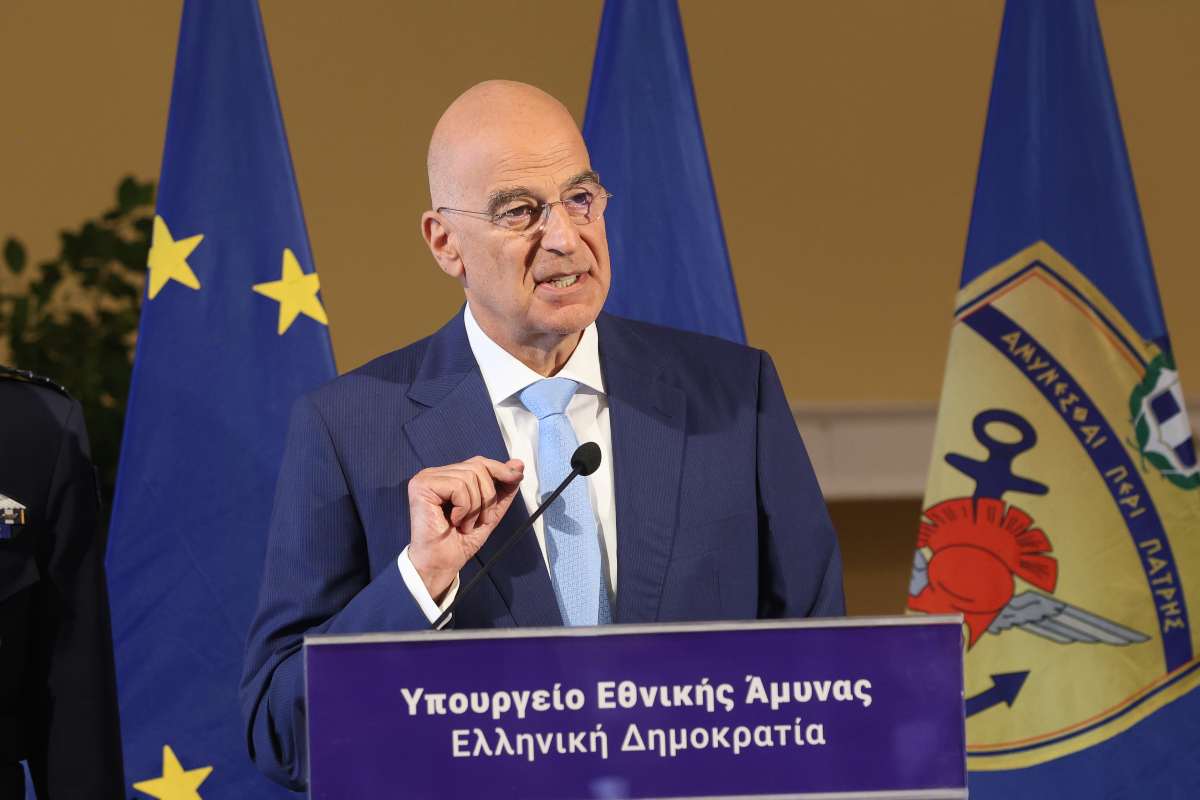
Greece wants to transform itself from a major buyer of foreign weapons systems into a country that produces defence technology, participates in co-production programmes and ultimately exports military systems to Europe.
That was the central message delivered by Defence Minister Nikos Dendias at the 90th Thessaloniki International Fair (TIF), where he presented “Agenda 2030” not simply as a military modernisation programme, but as a new economic and industrial model for Greek defence.
“Winds of change — and major change — are blowing,” Dendias said, arguing that Greece must move quickly to acquire the capabilities needed to confront any potential threat, regardless of where it originates.
The minister later left TIF following the fatal crash of a Hellenic Air Force aircraft at Tanagra.
The new doctrine: From “defence spending” to “defence investment”
At the heart of Dendias’ argument is a seemingly simple change in terminology that carries much broader implications.
“At the Ministry of National Defence, and this is how it is written in the budget as well, we used to speak of defence expenditure. From now on, we are seeking to speak of defence investment,” he said.
The objective is to change Greece’s position within the international defence market.
“It is a new philosophy that seeks to transform our country from a simple customer purchasing systems into a co-producer,” Dendias added.
This is the industrial pillar of Agenda 2030: Greece will continue to spend heavily on defence because of its security environment, but Athens wants a substantially larger share of that money to remain inside the country through production, research, technology, skilled jobs and exports.
“We want companies producing in Greece, not agents”
Dendias was unusually explicit about the kind of defence industry he wants to build.
“We want companies that produce in Greece. We do not want agents and representatives of foreign companies,” he said.
The distinction signals a break with a model in which Greece largely imported complete weapons platforms while capturing comparatively little of their industrial value.
Under the new approach, major procurement contracts are expected to generate greater Greek participation through co-production, subcontracting, software, maintenance, research and technological know-how.


Nearly €7bn in programmes — €1.5bn for Greek industry
Dendias also put figures behind the strategy.
According to the defence minister, Greece has contracted approximately €6.8-7 billion in armament programmes since 2023.
Of that amount, around €1.5 billion is being channelled into the domestic defence industry.
Dendias also announced the creation of a dedicated office within the armaments structure to monitor these investments.
The underlying message is important: domestic industrial participation should no longer remain a broad commitment attached to procurement contracts. Athens wants it translated into measurable work for companies operating and producing in Greece.
The new air-defence shield becomes an industrial project
One of the clearest examples is Greece’s new integrated air-defence and counter-drone shield.
According to Dendias, 19 Greek companies are already participating, with domestic production connected to the programme worth approximately €753 million.
The defence minister presented the project as both a security capability and a potential export opportunity.
“What we produce, we can export. The first shield in Europe, the first shield to have production in Europe. You understand the possibilities this opens up,” he said.
The ambition therefore goes beyond protecting Greek territory.
Athens wants to use Europe’s rapidly expanding demand for air and drone defence to establish Greek companies inside the continent’s emerging defence supply chains.
FDI frigates: Greece pushes for a larger industrial share
Dendias also highlighted Greece’s participation in the FDI frigate programme, commonly known in Greece as the Belharra programme.
According to the minister, following changes to the agreement, Greek industrial participation in the latest frigate reaches 25%.
The significance extends beyond a single naval procurement.
The government wants large defence contracts to become anchors around which a more sophisticated domestic supply chain can develop — particularly in shipbuilding, electronics, communications, sensors and support systems.
The headline target: 15,000 drones a year
Perhaps the most striking industrial target presented in Thessaloniki concerned unmanned systems.
“By December 31, 2026, the Greek factories of the Ministry of National Defence — without even including the private sector — will be producing 15,000 drones annually. And this is only the beginning,” Dendias said.
That target reflects one of the biggest lessons emerging from modern warfare.
Military power is no longer measured only by fighter jets, warships, submarines and armoured vehicles.
Drones, counter-drone systems, electronic warfare, sensors, software and artificial intelligence are becoming increasingly decisive — and they can often be produced at a fraction of the cost of traditional platforms.
For Greece, that technological shift creates an opportunity to enter segments of the defence market where industrial barriers are potentially lower and innovation cycles much faster.
Kentavros, Hyperion, Telemachus and Teucros: Greece’s counter-drone family
Dendias pointed to four domestically developed counter-drone systems as evidence that this shift is already under way: Kentavros, Hyperion, Telemachus and Teucros.
He said the systems are designed to address different operational requirements, creating what he described as a broader family of counter-UAS capabilities.
The minister also cited the Teucros system, saying an earlier version had been used at Larissa prison to bring down a drone carrying contraband, while Teucros 3 is being presented to the public at TIF.
His message on Kentavros was particularly emphatic.
“You know about Kentavros. Kentavros has been tested in combat; it needs no further advertising,” Dendias said.
The uncomfortable number: Just 0.7% domestic defence production
Behind the new industrial strategy lies what Dendias described as a major structural failure.
According to figures he presented, domestic defence production currently accounts for around 0.7% of Greece’s GDP.
“The figure borders on the ridiculous,” he said.
Dendias contrasted that figure with the enormous sums Greece has historically spent on national defence, citing approximately €270 billion in today’s prices up to 2004.
His argument raises the central economic question behind Agenda 2030:
How can a country that spends so much on defence retain so little of the resulting industrial value?
Long-term procurement planning changes the rules
Dendias linked industrial development directly to long-term procurement planning.
“There must be visibility about where we are going and what we are doing,” he said.
For decades, one of the weaknesses of domestic defence production has been uncertainty over future procurement.
A company cannot easily invest in production lines, engineers, research or new technologies if it does not know what the Armed Forces will require five, eight or twelve years ahead.
Long-term procurement planning therefore serves a second purpose beyond military readiness: it becomes a market signal for investment.
Greek companies can prepare for future demand, seek international partnerships and decide where to deploy capital.
A red line on spending: “We do not spend money we do not have”
Despite the scale of Greece’s military modernisation, Dendias also placed fiscal discipline at the centre of the strategy.
“We do not spend money we do not have. Our expenditure remains within what we have available,” he said.
He explicitly connected that principle with the lessons of Greece’s sovereign debt crisis.
“You know very well that precisely because we spent what we did not have, we went bankrupt. That cannot happen again,” Dendias said.
The challenge is therefore formidable: Greece wants a major military modernisation cycle without undermining the fiscal credibility rebuilt after the debt crisis.
Defence policy becomes industrial policy
This is where Dendias’ TIF intervention moved well beyond the traditional boundaries of a defence speech.
“In defence, we must produce products — exportable products — so that we achieve, first, exports and, second, a reduction in imports. Otherwise, we cannot move forward,” he said.
That places defence industry directly inside Greece’s broader economic debate.
If more of the systems purchased by the Armed Forces are produced domestically — and if some of that production can then be exported — defence spending could contribute to reducing imports, increasing exports and improving Greece’s productive base.
Defence policy, in other words, becomes industrial policy.
Dendias puts military personnel inside Agenda 2030
The transformation is not confined to weapons and technology.
Dendias also addressed the living standards of Armed Forces personnel, arguing that the military community suffered significant losses during Greece’s long economic crisis.
“It is not nationally acceptable for Greek military personnel to be pushed among those who have little. It is the duty of the state to help raise their standard of living,” he said.
He then broadened the argument beyond the Armed Forces:
“It is the overall responsibility of the state to rebuild the middle class in Greece.”
Agenda 2030 is therefore being presented as a model in which savings and efficiencies inside the defence system can also help improve conditions for military personnel.
Agenda 2030 is becoming Greece’s defence-industrial doctrine
The deeper shift outlined in Thessaloniki can be summed up in one sentence:
From purchasing weapons to producing defence power.
Greece has traditionally been one of Europe’s heavier defence spenders because of its particular security requirements.
Agenda 2030 aims to change what happens to that money after it is spent.
Athens wants Greek companies developing technology rather than merely representing foreign suppliers; factories producing components and systems; research centres working with the Armed Forces; and domestic businesses entering European defence supply chains.
That would mark a profound shift in Greece’s defence model.
Can Greece become a serious European defence producer?
The timing may offer Athens a rare opportunity.
Europe is rearming. Demand for drones, counter-drone technologies, ammunition, air defence and advanced electronic systems is rising. At the same time, European governments are seeking greater strategic autonomy and more production capacity on European soil.
Greece therefore has a window to transform its high defence burden into an industrial advantage.
But success will not ultimately be measured by the value of contracts signed.
It will be measured by how much of those billions becomes Greek intellectual property, factories, exports, engineering capacity, high-skilled jobs and domestically produced technology.
Dendias set an exceptionally ambitious benchmark for 2030.
“If Agenda 2030 is followed, if this planning is followed through to 2030, then our country will have not only the strongest Armed Forces in the history of Hellenism, but probably one of the strongest Armed Forces — if not the strongest — in the European Union,” he said.
That is the real political and strategic message from Dendias’ TIF intervention: Athens no longer wants simply to buy its security abroad. It wants to produce an increasing share of that security at home — and eventually sell it abroad.
Source: pagenews.gr