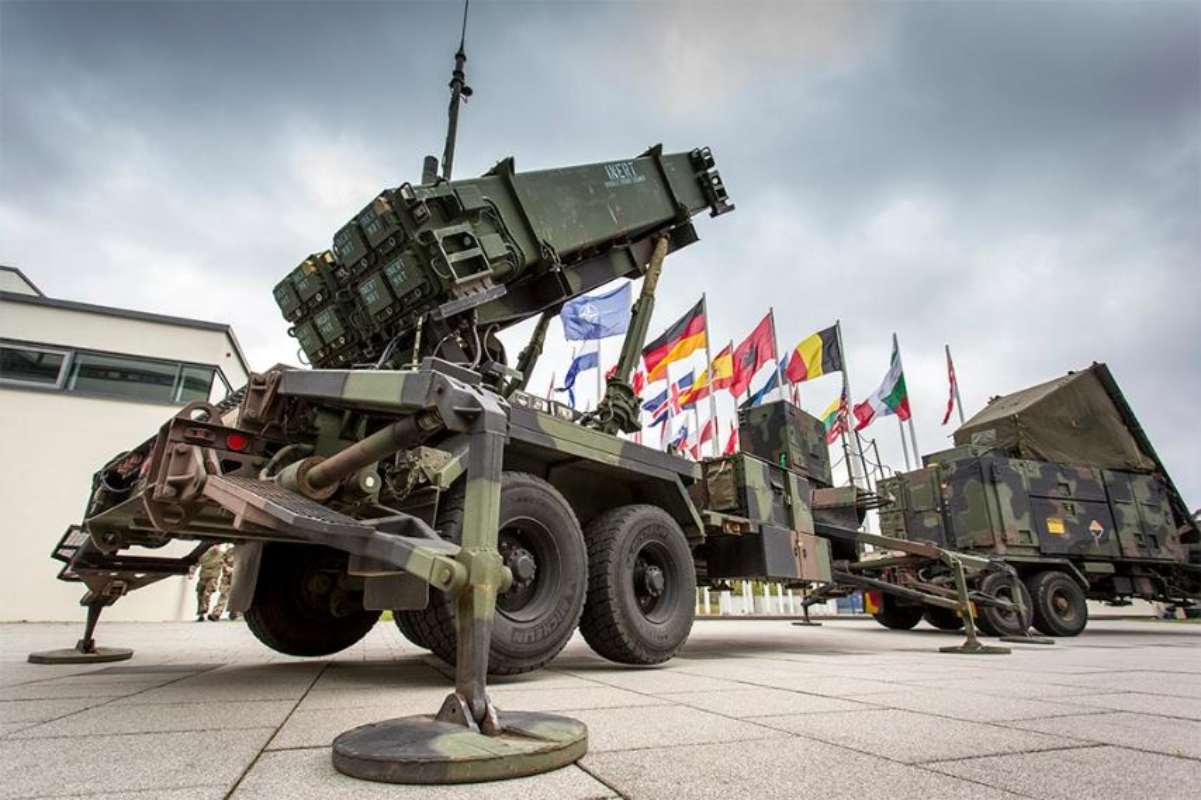
Two defence agreements heading to the Hellenic Parliament shed light on a much broader transformation of Greece’s strategic role within NATO.
The Ministry of National Defence has submitted for ratification an agreement between Greece and NATO’s Communications and Information Agency concerning the Greek national contribution to the development and integration of NATO’s Ballistic Missile Defence capability, as well as a separate technical arrangement with Germany covering multinational air-defence training at NATO’s missile-firing facility in Crete.
The two agreements are different in scope. But taken together, they point in the same strategic direction: Greece is seeking deeper integration into NATO’s air and missile-defence architecture while strengthening operational interoperability with major European allies.
The bills are expected to reach the plenary session of Parliament for debate and a vote within the next two weeks.


Greece moves deeper into NATO’s missile-defence architecture
The first agreement is between the Greek Ministry of National Defence and the NATO Communications and Information Agency, or NCI Agency.
It concerns Greece’s national contribution to supporting the development and integration of NATO’s Ballistic Missile Defence capability.
That may sound highly technical, but its strategic significance is considerable.
Modern air defence increasingly depends not simply on individual interceptor systems but on an integrated network of sensors, command-and-control infrastructure, communications and information-sharing mechanisms capable of detecting and responding to threats across national borders.
Greece’s participation therefore places the country more firmly within NATO’s collective architecture for responding to ballistic missile threats.
Missile defence is moving to the centre of European security
The timing is particularly important.
Recent conflicts have demonstrated how dramatically the threat environment has changed. Ballistic missiles, cruise missiles, drones and saturation attacks have made integrated air and missile defence one of the most urgent priorities for European governments.
For Greece, geography adds another dimension.
The country sits at the intersection of NATO’s southeastern flank, the Eastern Mediterranean and the wider Middle East security environment.
Its air-defence capabilities therefore have significance that extends beyond the protection of Greek territory alone.
The second agreement brings Germany and Greece together in Crete
The second bill concerns a technical arrangement between the Greek and German defence ministries.
It covers the participation of Greece’s 350 Guided Missile Wing and 180 HAWK Guided Missile Squadron in the German Air Defence Missile Wing 1 multinational tactical firing exercise at the NATO Missile Firing Installation (NAMFI) in Crete.
There is an important distinction.
The arrangement concerns a multinational tactical firing activity held in 2021. It should therefore not be presented as a newly announced Greek-German exercise for 2026.
What is now moving through Parliament is the ratification of the relevant technical arrangement.


Why Crete matters
NAMFI gives the second agreement significance beyond the exercise itself.
Crete hosts an important NATO facility where allied air-defence units can conduct live-fire training and test their ability to operate in a multinational environment.
For Greece, the strategic benefit is twofold.
Greek forces gain experience alongside allied units, while the country provides infrastructure that strengthens NATO’s operational footprint in the Eastern Mediterranean.
The key word is interoperability.
In a real crisis, allied forces need to be able to exchange information, operate under compatible command structures and coordinate different air-defence systems quickly.
Training of this kind is designed precisely for that environment.
From Patriot and HAWK to a new air-defence era
There is also a much wider Greek defence story behind the parliamentary legislation.
Air defence can no longer be designed primarily around the traditional threat of hostile aircraft.
The modern battlefield includes ballistic and cruise missiles, low-cost drones, loitering munitions and coordinated attacks intended to overwhelm defensive systems through sheer volume.
That requires several layers of protection, from early warning and electronic warfare to short-, medium- and long-range interception.
For Greece, the challenge is therefore not simply to modernise individual systems. It is to create an increasingly networked air-defence architecture capable of connecting national capabilities with allied command-and-control structures.


Greece wants to become more than a buyer of weapons
This is where the two agreements acquire broader political significance.
For years, discussion of Greek defence policy has often focused on procurement: fighter jets, frigates, missiles and other weapons platforms.
The emerging model is more complex.
Greece is also seeking to become an operational hub within the security architecture of NATO’s southeastern flank.
Its geography, military infrastructure and position in the Eastern Mediterranean give it an opportunity to play a role extending beyond its own national defence requirements.
Crete is particularly important in that equation.
A new strategic value for the southeastern flank
The broader European security environment is also increasing the value of Greece’s location.
NATO is strengthening its deterrence and defence posture, while European governments are investing heavily in capabilities that were neglected during the post-Cold War period.
Integrated air and missile defence sits near the top of that list.
In such an environment, countries able to provide military infrastructure, training facilities, surveillance capabilities and operational connectivity acquire greater strategic weight.
Greece increasingly wants to be one of those countries.

Parliament will now have its say
Both Defence Ministry bills are expected to be debated and voted on in the plenary session of the Hellenic Parliament within the coming fortnight.
The parliamentary process will also reveal how Greece’s political parties position themselves on deeper participation in NATO’s evolving defence architecture.
The ballistic missile defence agreement is particularly significant in this respect because it touches on a broader strategic question: how closely Greece should integrate its national defence infrastructure with NATO’s collective systems.
The bigger picture: Air defence becomes the first line of deterrence
The significance of the two agreements ultimately goes well beyond their technical provisions.
The wars of the past few years have demonstrated that protecting airspace, military installations, ports, energy infrastructure and population centres is becoming one of the defining challenges of national security.
For Greece, the next generation of deterrence will therefore not be measured only in fighter aircraft, frigates or long-range weapons.
It will also depend on how quickly the country can detect a threat, process the information, share it across allied networks and intercept the incoming weapon before it reaches its target.
That is why the NATO agreement now heading to Parliament matters.
It reflects a larger transition in Greek defence policy: from individual weapons platforms toward an integrated shield — and from national air defence toward a broader allied architecture extending across NATO’s southeastern flank.
Source: pagenews.gr