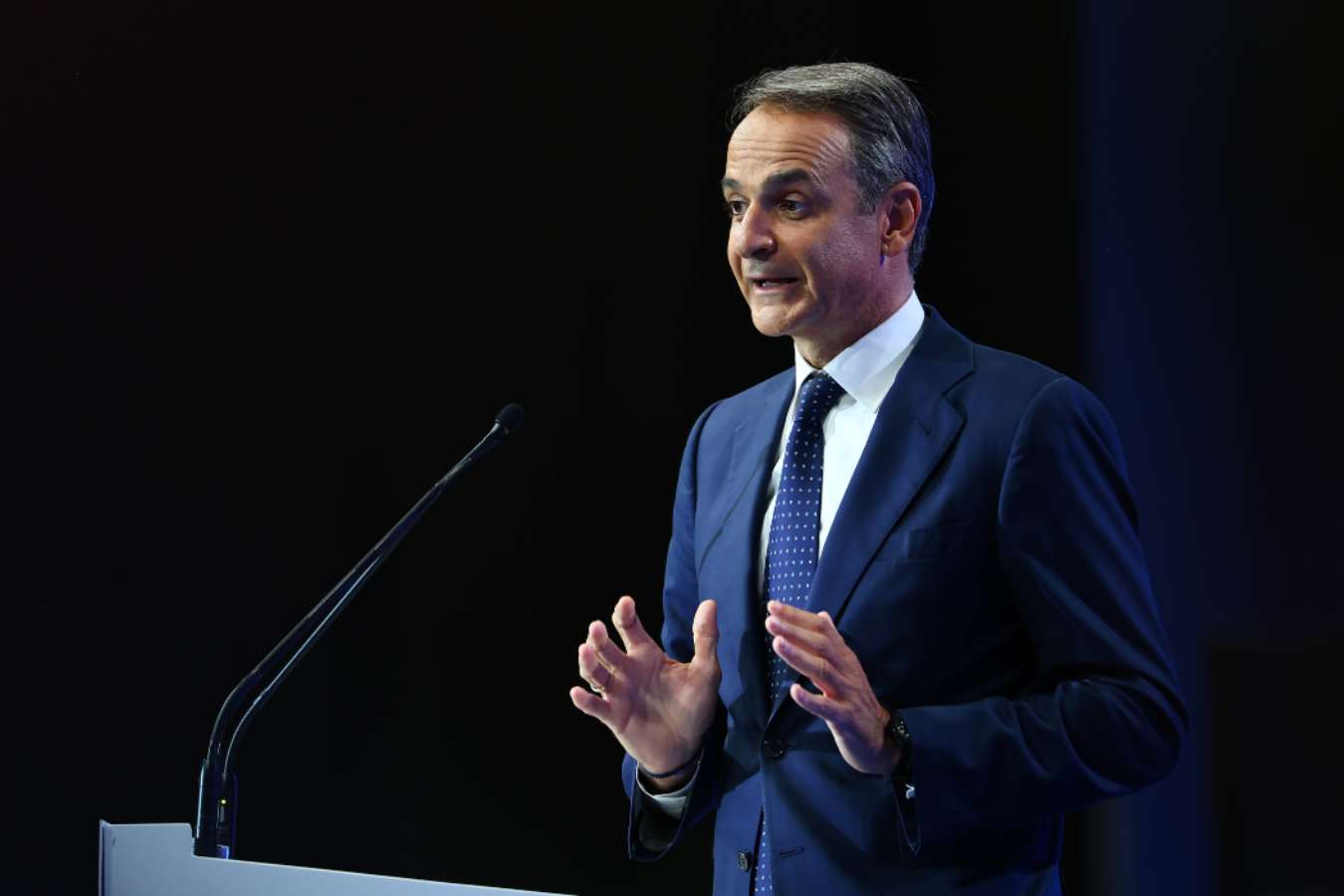
Prime Minister Kyriakos Mitsotakis’ package at the 90th Thessaloniki International Fair has one feature that sets it apart from the usual headline-grabbing announcements: there is no single big winner.
Instead, the government is spreading the economic benefit across much of Greece’s social and economic map — private-sector workers, civil servants, pensioners, self-employed professionals, SMEs, farmers, families with three or more children, young parents and people trying to buy a home.
Mitsotakis himself made that political strategy explicit.
“This year we are turning to the most dynamic parts of society and, at the same time, to society as a whole: the self-employed, small and medium-sized businesses, pensioners, public-sector employees, farmers, private-sector workers, families, parents with three children, larger families and renters.”
The political objective is equally clear: the government wants stronger fiscal numbers to stop being an abstract macroeconomic story and become something voters can identify in their salary, pension, tax bill, electricity costs or ability to buy a home.
As Mitsotakis put it:
“Growth must benefit everyone and it must be fair.”


Private-sector workers: The road to a €1,000 minimum wage
For private-sector employees, the most visible commitment is the minimum wage.
The government’s roadmap takes it to €1,000 by January 2028, with pay reaching €1,300 for employees entitled to three seniority increments.
Employee social-security contributions are also set to fall by another 0.5 percentage points from April 2027.
According to the examples accompanying the package:
- A young worker on the minimum wage is projected to gain €414 in 2027 and €1,040 in 2028.
- An employee with three seniority increments and current net monthly earnings of €959 is projected to gain €1,055 annually in 2028.
The real test, however, will not simply be the nominal wage increase. It will be whether those gains translate into higher purchasing power after inflation.
Civil servants: €500 at Christmas and further pay rises
Public-sector employees are set to receive a €500 gross Christmas payment from December 2027.
This is not the restoration of a full 13th salary. It is a more limited measure with a substantially smaller permanent fiscal cost.
Further wage increases of up to €80 gross per month are also envisaged by January 2028, reflecting the link between public-sector pay and increases in the statutory minimum wage.
In the government’s example, a 40-year-old public employee with two children and a current net salary of €1,447 would receive:
- €562 in additional net income in 2027,
- another €402 in 2028,
- for a combined €964 over the two years.
Pensioners: Annual support rises to €400
For pensioners, the permanent annual payment rises by €100 to €400 net from November 2026.
The government also says eligibility will be widened to include all pensioners over the age of 65.
Politically, this is an important intervention because older households are particularly exposed to increases in food, energy and essential-service costs.
The government is effectively seeking to turn the annual payment into a permanent component of its pensioner income policy.


Self-employed: Relief from presumptive taxation
The taxation of self-employed professionals has been one of the government’s most politically sensitive reforms.
The new package introduces relief for compliant taxpayers, removing increases to presumed taxable income linked to turnover and employee payroll costs from the 2026 tax year.
Presumptive taxation will also be reduced by 50% in settlements with fewer than 2,000 residents, with the threshold rising to 2,200 in Western Macedonia.
In the government’s example, a 15-year-old restaurant business employing five people with an annual payroll of €105,000 would gain €2,534 a year.
The advance income-tax payment for self-employed professionals is also set to fall from 55% to 50% from the 2027 tax year.
Farmers: From a €1,183 tax bill to zero
One of the package’s biggest tax interventions targets professional farmers.
Income tax will be eliminated on income up to €20,000 from the 2026 tax year, while the minimum tax-free threshold rises to €22,204 under the announced framework.
The government provides two striking examples:
- A farmer earning €20,000 who previously paid €1,183 in income tax would pay zero.
- At €30,000 in income, the tax bill would fall from €5,083 to €2,183.
The second example represents an annual saving of €2,900.
For the government, the measure has a double objective: increasing disposable income while rebuilding its political relationship with rural communities under pressure from high production costs.
Businesses: Lower advance tax and €1.5bn for SMEs
Businesses receive a combination of tax relief and new financing.
The corporate advance-tax rate is set to decline by five percentage points annually from the 2028 tax year until it reaches 50%, down from 80%.
Meanwhile, €1.5 billion is to be channelled from Recovery and Resilience Facility resources through the Hellenic Development Bank to small and medium-sized enterprises:
- €1.1 billion through lending instruments,
- €400 million through guarantee schemes.
The business levy will be abolished in the regions from the 2026 tax year. In Attica, it is scheduled to be cut by 50% in 2028 and eliminated in 2029.
A retail business in Thessaloniki currently paying €1,600 would therefore see that charge fall to zero from 2027, according to the examples presented.
Families with three children: A major tax-free threshold increase
Demographic policy is becoming increasingly embedded in Greece’s tax system.
Families with three children will pay no income tax on earnings up to €20,000 from the 2027 tax year.
The tax-free threshold rises by €11,000 to €25,364.
Under the example accompanying the measure, a parent of three earning €20,000 who previously paid €620 in tax would pay nothing.

Larger families: More money for every additional child
For larger families, the childbirth allowance will increase by €1,000 for every additional child, covering births after January 2026.
That means:
- €4,500 for a fourth child, up from €3,500,
- €5,500 for a fifth child,
- with the amount continuing to rise for each additional child.
The principle is straightforward: state support increases as the financial demands on a family grow.
The children’s “piggy bank”: Government matches parents’ savings
One of the package’s most distinctive policies is the new “Savings Pot for the New Generation.”
For children up to the age of two, parents will be able to establish an investment account into which the state will match parental contributions up to €1,200 per year.
That ceiling is expected to increase by 10% every five years.
According to the example presented by the government, the account could exceed €60,000 by the time the child turns 18.
That figure should not, however, be treated as a guaranteed payout: the final value would depend on the scheme’s detailed rules and investment returns.
Disability benefits: Automatic protection against inflation
From 2027, disability benefits are set to be indexed to inflation.
The measure covers around 218,000 people, with the government estimating an average annual gain of approximately €220.
The significance lies in the mechanism itself: the real value of the benefit would adjust to price movements rather than depend entirely on a new political decision each time inflation rises.
“My Home 3”: €2bn for Greece’s housing battle
Housing is becoming one of the biggest political battlegrounds in Greece.
The new “My Home 3” programme will have €2 billion in financing through the Hellenic Development Bank, targeting access to home ownership.
At the same time, the government plans to raise the property transfer tax from 3% to 15% for home purchases by non-EU nationals.
The policy is particularly significant because it attempts to address both sides of the housing equation: helping domestic buyers while seeking to curb part of the external investment demand competing for a limited housing stock.
Rural Greece: ENFIA property tax eliminated in small settlements
The package also introduces targeted tax advantages for smaller communities.
From 2027, the ENFIA property tax is set to be abolished in settlements of up to 2,000 residents, with the threshold rising to 2,200 in Western Macedonia.
Combined with presumptive-tax relief and the abolition of the business levy outside Attica, the measures create a distinct package of preferential tax treatment for the regions.
The objective goes beyond taxation. It is also an attempt to address demographic decline and economic depopulation outside Greece’s major urban centres.


Electricity: The big 30% gamble
Then comes the measure that potentially affects almost everyone: energy.
The government is targeting a gradual 30% reduction in wholesale electricity prices between 2027 and 2029.
From January 2027, Public Service Obligation charges on residential electricity bills are also set to be cut by 50%.
There is an important distinction: the 30% figure is a target for wholesale electricity prices, not a guarantee that every household electricity bill will automatically fall by 30%.
Politically, however, it may be one of the package’s most consequential commitments.
Energy costs flow from households to factories, from production to food prices and ultimately across almost the entire economy.
Mitsotakis’ TIF strategy: Not one big winner, but millions of smaller ones
This is where the political architecture of the package becomes clearer.
Mitsotakis has not placed all his political capital behind one spectacular announcement.
He has spread it across multiple constituencies.
The private-sector worker gets the minimum-wage pledge.
The civil servant sees €500 at Christmas and further salary increases.
The pensioner sees €400.
The farmer sees zero tax at lower income levels.
The self-employed professional gets relief from presumptive taxation.
Businesses get lower taxes and financing.
Families receive tax and demographic incentives.
Young people get “My Home 3.”
Parents get the new savings account.
And almost everyone has a stake in whether electricity prices actually fall.
The real crash test will be the voter’s wallet
That broad reach also creates the government’s biggest political risk.
The more groups Mitsotakis includes in his package, the more benchmarks voters will have against which to judge delivery.
They will not necessarily evaluate TIF by calculating the total fiscal cost of the announcements.
Their questions will be much simpler.
Did my salary actually increase?
Did I pay less tax?
Could I afford a home?
Did my electricity bill fall?
And, crucially, were the gains swallowed again by food prices, rents and services?
That is the real political wager behind Mitsotakis’ 90th TIF package: proving that the “growth dividend” exists not only in Greece’s fiscal accounts but in household budgets.
Because from now until the next election, the economy will not be judged only by GDP, debt or surpluses.
Source: pagenews.gr