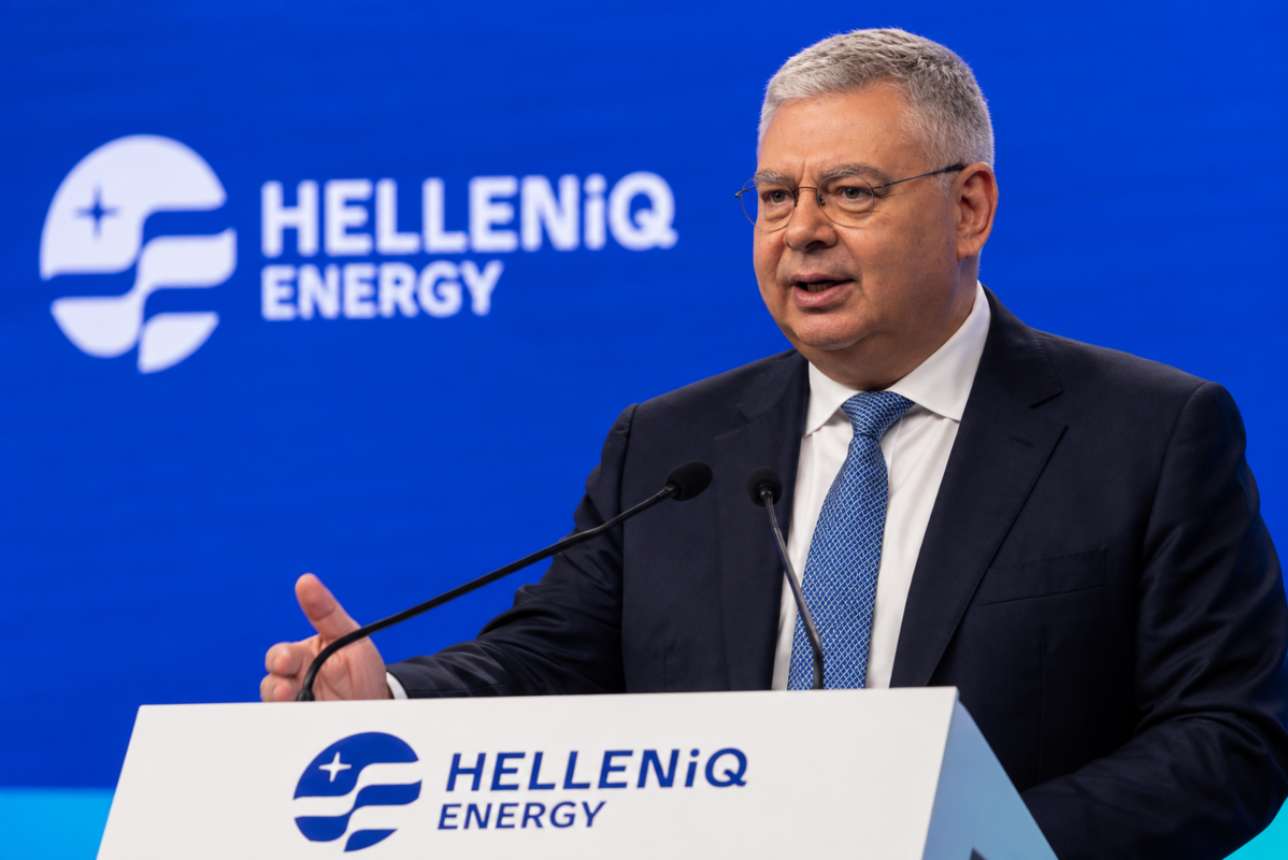
HELLENiQ Energy is preparing to turn one of Europe’s biggest industrial vulnerabilities into a strategic advantage for Greece.
As Russian energy companies retreat from parts of Southeastern Europe and Europe’s refining capacity remains constrained, the Greek energy group sees an increasingly attractive opening across the Balkans and Central Europe, where demand for diesel and other refined products is creating new opportunities for efficient Mediterranean producers.
The strategy is already showing up in the numbers. In the first half of 2026, HELLENiQ Energy reported a 35% increase in diesel and jet-fuel exports, driven primarily by deficit European markets.
What is emerging, therefore, is considerably bigger than another corporate investment programme.
HELLENiQ Energy is positioning Greek refining inside the supply gap created by Europe’s new energy geography.
A Potential €3–5 Billion Industrial Bet
At the heart of the strategy is a potentially massive investment programme.
HELLENiQ Energy is examining investments estimated at €3–5 billion across its three Greek refineries, aimed at increasing production of higher-value products, particularly diesel and gasoline, by approximately 10–15%.
If implemented at full scale, this would rank among Greece’s most significant industrial investment programmes of the coming decade.
The strategic logic is compelling.
At a time when parts of Europe are losing refining capacity, Greece retains a sophisticated and export-oriented refining base capable of producing more fuel than its domestic market requires.
HELLENiQ Energy’s three refineries have combined nominal capacity of around 16 million tonnes annually and account for more than 60% of Greece’s domestic fuels market.
In 2025, exports already represented 54% of total refining sales.
The next phase is about pushing that advantage further north.
From Greece Deep Into the Balkans
The biggest opportunity lies beyond Greece’s borders.
The restructuring of Russian energy flows has altered the competitive landscape across Southeastern Europe, while Central European markets continue to require significant volumes of diesel.
HELLENiQ Energy enters that market with advantages that would be difficult to replicate quickly: sophisticated refineries, port infrastructure, access to Mediterranean crude flows, regional retail operations and an increasingly international trading platform.
Its Geneva trading operation provides another piece of that architecture, connecting crude procurement and refined-product sales with international markets.
The objective is no longer simply to export surplus Greek production.
It is to turn Greek refining into a strategically important supply platform for Southeastern Europe.
Acquisitions: The Next Move Could Be Across the Border
There is another potentially transformative opportunity.
Europe’s geopolitical realignment is changing ownership structures across the Balkan energy sector. Assets linked to departing or constrained players can become available, sometimes at depressed valuations.
That makes acquisitions increasingly relevant.
HELLENiQ Energy has the balance sheet, regional knowledge and existing commercial footprint required to evaluate opportunities if strategically attractive assets come onto the market.
There is an important distinction: no specific acquisition should yet be treated as a completed or announced transaction.
But the optionality matters.
Instead of building every element of its regional expansion from scratch, the group could potentially acquire infrastructure, market share or production capacity as the Balkan energy map is redrawn.


Thessaloniki Could Become the Northern Energy Gateway
Northern Greece occupies a particularly important place in this strategy.
The Thessaloniki refinery already provides a natural gateway to Balkan markets, while the Thessaloniki–Skopje product pipeline strengthens the northbound corridor.
HELLENiQ Energy has itself highlighted the pipeline’s importance for supplying neighbouring markets more efficiently.
But the emerging picture is potentially much larger.
Refining, fuel pipelines, power generation, electricity storage and potentially LNG could gradually turn Thessaloniki into an integrated energy platform connecting Greece with the Western Balkans and Central Europe.
That changes the significance of the company’s proposed FSRU.
FSRU: More Than Another LNG Terminal
HELLENiQ Energy continues to assess an FSRU project in Thessaloniki.
The final investment decision will depend heavily on commercial viability, sufficient demand, long-term commitments and the group’s wider capital-allocation priorities.
If it proceeds, however, its significance extends beyond LNG imports.
An FSRU in Northern Greece could provide gas for the group’s own power-generation activities while simultaneously serving regional markets through Greece’s expanding northbound energy corridors.
That would give HELLENiQ Energy something strategically valuable: internal demand combined with access to external Balkan markets.
And it would reinforce Greece’s role as an entry point for non-Russian energy into Southeastern Europe.
Then Comes the Wild Card: The Ionian Sea
There is, however, one variable capable of reshuffling the entire investment equation.
Block 2 in the northwestern Ionian Sea.
The ExxonMobil–Energean–HELLENiQ Energy consortium has formally entered the second exploration phase, which includes an exploration well.
HELLENiQ Energy has indicated that the offshore drilling campaign is expected during 2027.
If drilling confirms a commercially significant hydrocarbon discovery, capital-allocation priorities could change dramatically.
The group would suddenly have to weigh potential upstream development against refinery upgrades, LNG infrastructure, power investments and possible acquisitions.
That is why the Ionian well is more than an exploration story.
A single drilling result could influence where billions of euros in Greek energy investment are deployed over the following decade.
Batteries: The Quiet Part of the Transformation
At the same time, HELLENiQ Energy is building another pillar around electricity.
Renewables, storage, power generation, trading and retail through Enerwave are increasingly being integrated into a single commercial platform.
The group is advancing battery-storage projects in Thessaloniki with 100 MW of power and 200 MWh of storage capacity.
That distinction matters: the project is 100 MW/200 MWh, rather than 200 MW.
Storage allows HELLENiQ Energy to capture excess renewable production, deploy electricity when demand and prices rise and reduce reliance on more expensive thermal generation during certain periods.
This makes batteries more than a decarbonisation investment.
They are becoming an instrument for margin optimisation, energy trading and portfolio flexibility.
Not an Exit From Oil — An Expansion Into Energy
This is perhaps the most important element of the strategy.
HELLENiQ Energy is not simply abandoning refining to become a renewable-energy company.
Nor is it retreating from the energy transition to double down on hydrocarbons.
It is pursuing something more sophisticated.
Refining, international trading, natural gas, electricity, renewables, storage and potentially upstream production are being assembled into different layers of the same regional energy platform.
That provides optionality in a market defined by geopolitical uncertainty.
When refining margins are attractive, the group has scale.
When electricity becomes more valuable, it has generation and storage.
If LNG demand grows, it has potential infrastructure and internal consumption.
And if the Ionian Sea produces a significant discovery, it gains another strategic asset.
Greece Could Turn Europe’s Refining Weakness Into Industrial Power
The wider story extends well beyond HELLENiQ Energy.
Europe has spent years debating strategic autonomy while simultaneously losing parts of its traditional industrial and energy infrastructure.
Greece finds itself in an unusual position.
It retains a sophisticated refining industry, strong maritime access, growing LNG infrastructure and geographical proximity to Balkan markets seeking alternative energy routes.
HELLENiQ Energy now appears determined to monetise that geography.
The opportunity is to transform an existing Greek industrial strength into a regional strategic asset.
If refinery investments, higher exports and regional expansion proceed as envisaged, the question will no longer be simply how much fuel Greece exports.
It will be how indispensable Greece can become to the energy security of the Balkans and Central Europe.
Source: pagenews.gr