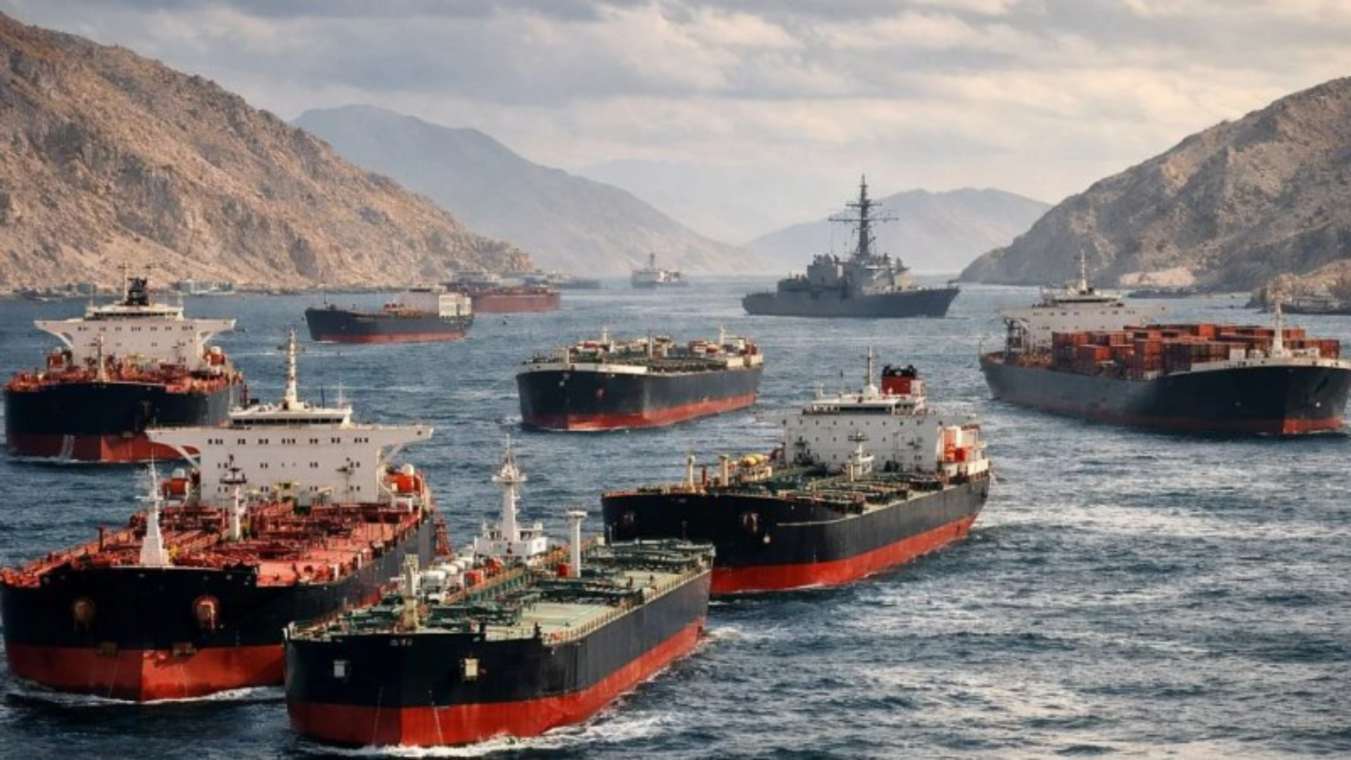
A single map explains why maritime security has returned to the top of the international agenda.
The Red Sea.
The Suez Canal.
The Eastern Mediterranean.
The Aegean.
These are not five isolated geographical areas.
They are links in the same maritime chain carrying oil, LNG, goods, raw materials and containers from Asia and the Middle East toward Europe.
A serious disruption at any one of these points can quickly feed into energy prices, shipping costs, inflation and ultimately the daily lives of millions of Europeans.
That helps explain why Kyriakos Mitsotakis placed maritime security prominently in Greece’s message at the United Nations.
Why Hormuz Matters to Europe
The Strait of Hormuz is one of the world’s most important energy arteries.
When tensions rise there, markets do not wait for physical supplies to be disrupted before reacting.
They begin pricing risk.
Insurance premiums.
Freight rates.
Ship availability.
Longer or alternative routes.
Potential supply disruptions.
All of these can influence the final cost of energy long before oil or LNG flows are actually interrupted.
For Europe, that vulnerability has become especially important after years in which energy security moved from a largely economic issue to a central question of national security.


Then Comes the Red Sea
The second critical gateway is the Red Sea.
Security threats to commercial shipping there have already demonstrated how quickly a regional conflict can affect global supply chains.
When ships face greater danger, operators must consider alternative routes, longer journeys and higher operating costs.
The consequences can then spread through international trade.
The strategic lesson is straightforward: maritime security thousands of kilometers from Europe can have immediate economic consequences inside Europe.
And Then the Eastern Mediterranean
This is where Greek geography acquires additional strategic value.
The Eastern Mediterranean is no longer merely the arena of Greek-Turkish disputes.
It is simultaneously an energy region, a commercial corridor, an area of major military activity, a bridge between Europe and the Middle East and a potential hub for new infrastructure.
Athens wants Greece to become increasingly embedded in this emerging system.
LNG, Hydrocarbons and US Interest
Energy is a crucial part of the equation.
Greece is seeking to strengthen its role as a gateway for LNG and other energy flows toward Southeast and Central Europe through regional infrastructure and the Vertical Corridor.
At the same time, the involvement and interest of major international energy companies in Greek offshore areas has increased the strategic significance of the Ionian Sea and waters around southern Greece and Crete.
The shift is important.
Greek maritime zones are no longer discussed only in terms of sovereign rights.
They are increasingly connected to European energy security.
And Turkey Returns to the Equation
The same waters in which Greece is seeking to expand its energy and geopolitical role are also the waters where Greek-Turkish disagreements remain unresolved.
This gives Mitsotakis’ emphasis on UNCLOS a wider strategic significance.
The greater the economic and energy value of the Eastern Mediterranean becomes, the more consequential maritime delimitation becomes.
And the greater the potential cost of a crisis.
Greece’s New Equation
For Athens, a broader strategic equation is taking shape:
shipping + energy + geography + international law + defense.
Each component reinforces the others.
Greece’s merchant fleet gives Athens a substantial stake in the international debate over freedom of navigation.
Its geography provides access to critical Eastern Mediterranean routes.
Energy infrastructure adds economic and strategic weight.
And Greece’s diplomatic position gives it an additional platform from which to raise maritime security internationally.
The Aegean Is No Longer an Isolated Sea
This is perhaps the most important conceptual change.
For decades, much of the Greek debate viewed the sea primarily through the prism of relations with Turkey.
That is no longer sufficient.
The same maritime space is simultaneously a frontier, an energy zone, a commercial corridor and an arena of international security.
A geopolitical chain now stretches from Hormuz through the Red Sea and Suez to the Eastern Mediterranean and the Aegean.
Greece sits at a strategically important point along that chain.
Geography Can Become Power — or Vulnerability
Geography alone does not create geopolitical power.
It creates opportunity.
For Greece, the challenge is to turn its maritime position, shipping strength, infrastructure and diplomatic alliances into lasting strategic relevance.
That requires more than military deterrence.
It requires ports, energy infrastructure, connectivity, investment, diplomacy and a stable legal environment.
If Athens succeeds, the Eastern Mediterranean could become not merely the place where Greece confronts security risks, but one of the principal sources of its geopolitical leverage.
If regional instability deepens, however, the same geography could expose Greece to greater economic and security risks.
That is why the maritime corridor stretching from Hormuz to the Aegean is becoming one of the most important strategic spaces for Greece — and for Europe.
Source: pagenews.gr