Greece is heading into its second Presidency of the United Nations Security Council with an issue that now sits at the heart of global geopolitics: who can guarantee that the world’s maritime routes remain open when regional conflicts spill into the seas?
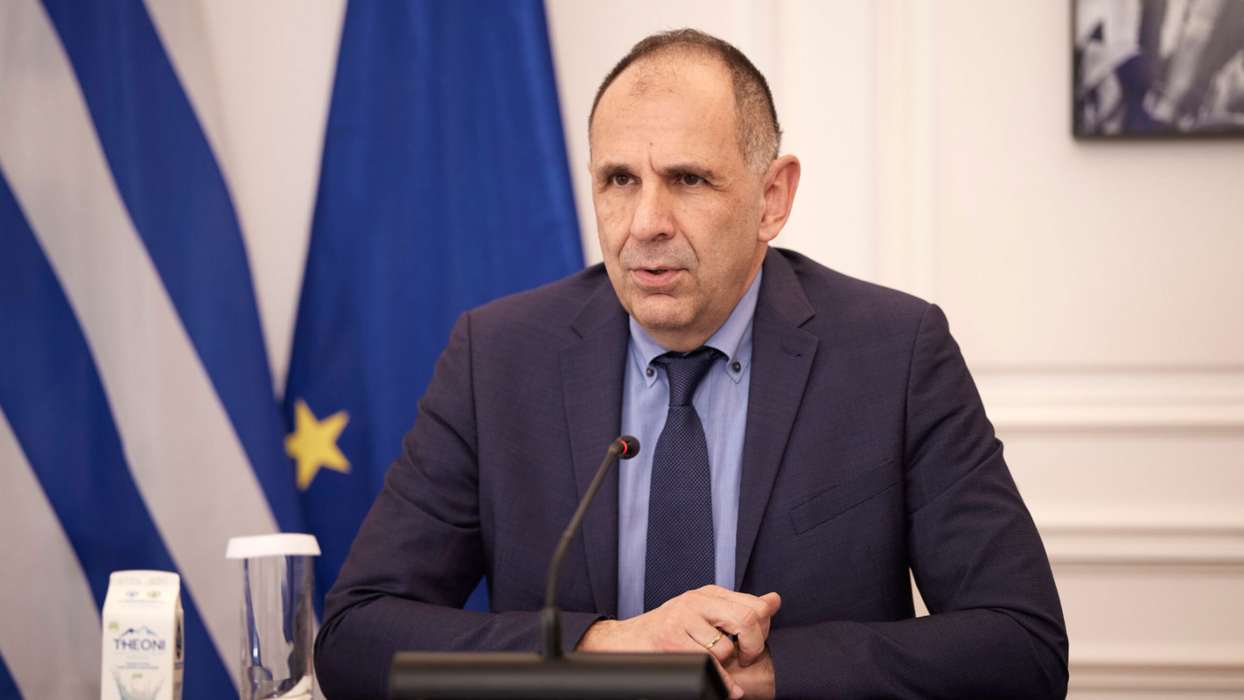
Speaking in New York at the ministerial meeting launching the Group of Friends for Maritime Security and the Safety of Seafarers, Foreign Minister George Gerapetritis placed maritime security at the center of Greece’s diplomatic agenda.
The timing is significant.
Instability in the Red Sea, tensions surrounding the Strait of Hormuz, attacks against commercial vessels, piracy, drones and threats to critical undersea infrastructure have transformed maritime security from a specialist shipping issue into a matter of global economic, food and energy security.
Gerapetritis: Attacks Are Hitting Trade, Food and Energy Security
The Greek Foreign Minister emphasized that attacks against international shipping have consequences far beyond the vessels directly involved.
They have not only endangered human lives and freedom of navigation, he said, but “have disrupted global supply chains and affected food and energy security.”
That connection is becoming increasingly important for the UN Security Council.
Traditional maritime threats such as piracy, armed robbery and trafficking now coexist with drones, sophisticated weapons systems, cyber threats and risks to critical maritime infrastructure.
In other words, the sea is increasingly becoming another arena where geopolitics, warfare and the global economy collide.
From the Red Sea to the Strait of Hormuz
The scale of the risk becomes clearer when looking at the map.
The Red Sea and Bab el-Mandeb connect Asia and the Indian Ocean with the Suez Canal and the Mediterranean.
The Strait of Hormuz is an even more important energy chokepoint.
UN Secretary-General António Guterres has underlined the enormous importance of Hormuz to global energy and commodity markets, warning that disruption of critical maritime routes can have consequences far beyond the region itself.
A military incident thousands of kilometers away from Greece can therefore rapidly feed into energy prices, freight costs, insurance premiums and ultimately European inflation.
The geopolitical equation is straightforward: when maritime chokepoints become conflict zones, the economic shock does not remain at sea.


Seafarers on the Front Line
Gerapetritis also shifted the focus from ships to the people working aboard them.
He described seafarers as “the backbone of international shipping,” stressing that they face an expanding range of risks — from piracy and armed conflict to terrorist attacks and other serious security threats.
“The protection of shipping must go hand in hand with the protection of those who work at sea,” he said.
For Greece, this human dimension carries particular significance because of the scale of Greek shipping and its exposure to global maritime routes.
Greek-owned vessels operate every day in areas where geopolitical tensions can rapidly become direct security threats.
Greece at the UN Security Council: Maritime Security Returns to the Top
Maritime security is not a new addition to Greece’s Security Council agenda.
Athens identified it from the outset as one of the priorities of its 2025–2026 term as an elected member of the UN Security Council, alongside the peaceful settlement of disputes, respect for international law, women and security, climate-related risks and the protection of children in armed conflict.
During Greece’s first Security Council Presidency in May 2025, Athens convened a high-level open debate on strengthening maritime security through international cooperation.
Now the issue is returning.
“Maritime security will once again be at the center of our forthcoming Presidency in October,” Gerapetritis said.
October Comes in a More Dangerous Maritime Environment
The geopolitical environment surrounding Greece’s second Presidency is markedly different.
The international debate on maritime security increasingly covers not only piracy or attacks against individual merchant ships, but also missiles, drones, cyber operations, sabotage and critical infrastructure beneath the seabed.
The consequences can spread rapidly across borders.
Shipping routes carry energy and food. Submarine cables carry electricity and data. Pipelines connect producers with consumer markets.
The distinction between economic infrastructure and strategic infrastructure is therefore becoming increasingly blurred.
Greece Is Not Only Talking About Maritime Security — It Has Forces in the Field
There is also an operational dimension to Athens’ policy.
Greece participates in international and European maritime security operations, including ATALANTA in the wider Indian Ocean, ASPIDES in the Red Sea and IRINI in the Mediterranean.
The EU’s defensive Operation ASPIDES was established in 2024 in response to attacks threatening international navigation in the Red Sea and surrounding waters.
Its mandate has since evolved as the threat environment has changed, reflecting growing European concern not only about commercial vessels but also about maritime situational awareness and critical infrastructure.
For Greece, the combination of diplomacy and operational involvement is important.
Athens is seeking to present maritime security not simply as an abstract principle at the United Nations, but as an area in which it already contributes personnel, naval capabilities and diplomatic resources.
Freedom of Navigation as a Core Greek Position
In New York, Gerapetritis also returned to the legal foundation of Greece’s position.
Freedom of navigation must be safeguarded, while the security of ships and crews must be guaranteed in accordance with international law and, in particular, the United Nations Convention on the Law of the Sea — UNCLOS.
For Greek diplomacy, that reference carries broader significance.
Athens has consistently sought to frame its foreign policy around international law, the law of the sea and rules governing maritime activity.
The argument is particularly relevant when strategic waterways become instruments of geopolitical pressure.
For a major maritime nation, keeping international sea lanes open is not simply a foreign-policy objective.
It is an economic interest.
Hormuz Raises the Stakes
The Strait of Hormuz illustrates why the debate has become so urgent.
It is one of the world’s most important energy arteries. Any prolonged disruption can affect crude oil, petroleum products and LNG flows, with repercussions spreading rapidly into international markets.
For Greece, this has a double dimension.
The country is both a major shipping power and an increasingly important energy gateway for southeastern Europe, with LNG terminals, pipelines, ports and electricity interconnections becoming more important to the region’s energy architecture.
A crisis in Hormuz therefore does not concern Athens only as a diplomatic issue.
It can become a shipping, energy and economic issue almost immediately.
From Ships to Cables: The New Battle Beneath the Sea
There is another element rapidly moving up the international agenda: the seabed itself.
Submarine cables carry vast volumes of international data. Electricity interconnectors are becoming essential to regional energy systems. Pipelines connect producers with markets.
Offshore energy installations are also strategic assets.
As a result, modern maritime security increasingly means protecting not only what sails on the sea but also what lies beneath it.
For Greece, this has direct strategic relevance.
Its geographical position, commercial fleet, ports, LNG infrastructure and planned electricity interconnections mean that maritime security is increasingly intertwined with national economic and energy security.
Gerapetritis: “Without Seafarers, Half the World Would Freeze”
The Foreign Minister concluded his intervention with an old maritime saying intended to underline just how dependent the global economy remains on those working at sea:
“Without seafarers, half the world would freeze and the other half would starve.”
Behind the phrase lies an economic reality that successive international crises have made increasingly visible.
When a shipping route becomes dangerous or inaccessible, the consequences spread quickly.
They move into tankers, freight rates, insurance costs, energy prices, fertilizers, food supplies and ultimately household bills.
Greece’s Maritime Diplomacy Faces Its October Test
Athens is therefore seeking to turn two longstanding Greek assets — shipping and geography — into instruments of international diplomacy.
Greece alone cannot guarantee security in the Red Sea or the Strait of Hormuz.
But as an elected member of the Security Council, a country associated with one of the world’s largest merchant fleets and an active participant in European maritime operations, it can push for stronger international coordination and a more permanent approach to maritime security.
That will be one of the tests of Greece’s Security Council Presidency in October.
Because in a world where maritime trade routes and energy arteries are increasingly becoming instruments of geopolitical pressure, security at sea is no longer only a matter for sailors and navies. It is a matter for the entire global economy.
Source: pagenews.gr