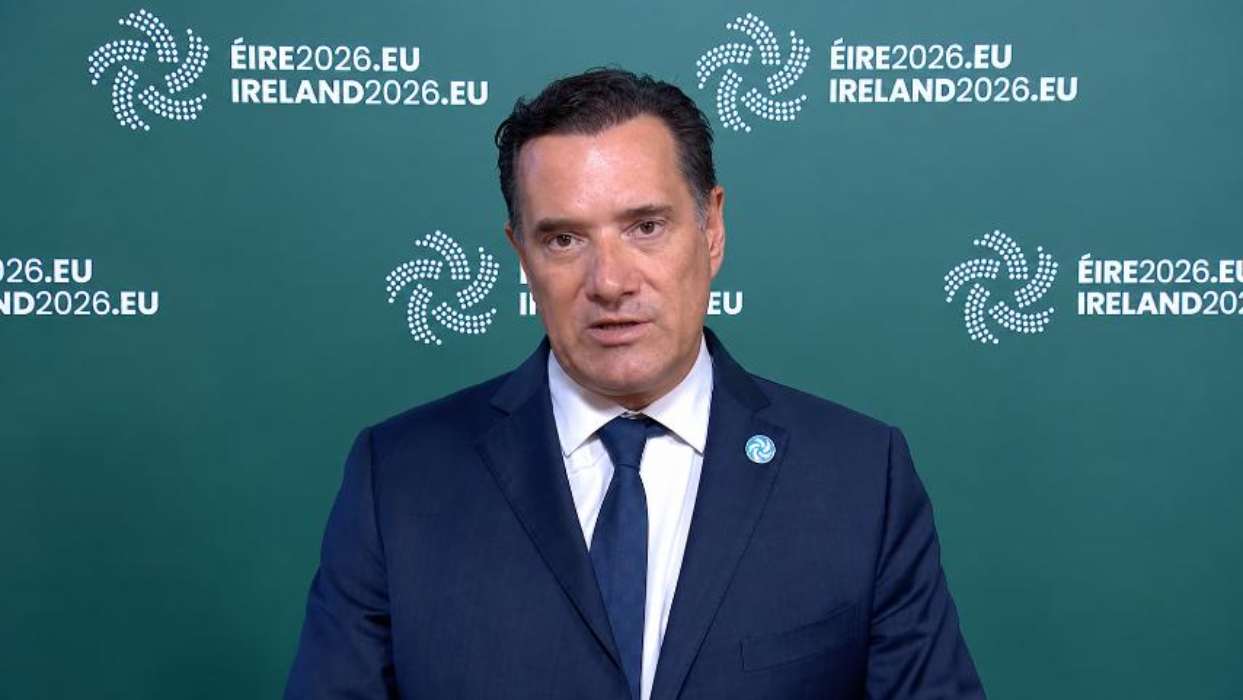
Greece is bringing an agenda focused on health innovation, biotechnology, pharmaceutical production and digital transformation to the Informal Meeting of European Union Health Ministers in Dublin, where Health Minister Adonis Georgiadis is representing the country.
“I have the great honour of representing Greece today at the Informal Meeting of EU Health Ministers in Dublin,”Georgiadis said in a social-media post.
Speaking as he arrived at the meeting, the minister set out Greece’s central message:
“Europe cannot afford to be left behind in innovation, and Greece, following all the reforms carried out by the government, wants to play a leading role in this field.”


Biotechnology: Europe’s Next Major Challenge
The first issue highlighted by Georgiadis was biotechnology and the emerging European regulatory framework for biotech products.
“We have to discuss something extremely important today: the regulation of biotechnology and biotechnology products. This must become a major strategic priority for Europe’s future,” he said.
The issue is already high on the EU agenda.
The European Commission has presented the European Biotech Act, aimed at narrowing Europe’s innovation gap, accelerating the transition from research to production, improving access to finance and simplifying the regulatory environment in areas ranging from clinical trials to advanced cell and gene therapies.
Why Europe Is Moving Now
The Commission’s own figures illustrate the scale of the challenge.
Biotechnology contributes almost €40 billion to the EU economy, with health biotechnology accounting for more than 80% of that added value.
Yet Europe attracts only around 7% of global venture-capital investment in health biotechnology, compared with 63% for the United States and 14% for China.
Europe’s share of commercial clinical trials also declined from 22% in 2013 to 12% in 2023.
The new European framework is designed to help address precisely that competitiveness gap.

Georgiadis: Greece Wants a Leading Role
It is against this backdrop that Georgiadis positioned Greece’s own strategy.
“Greece, following all the reforms carried out by the government, wants to play a leading role in this field,” he said.
The minister linked biotechnology to the strength of the domestic pharmaceutical industry, new productive investments and the wider effort to strengthen Greece’s position on Europe’s pharmaceutical and life-sciences map.
The challenge extends well beyond healthcare itself.
It is also about investment, research, new therapies, manufacturing capacity and Europe’s ability to reduce strategic dependencies in critical health technologies.
From the Laboratory to the Patient
One of the central ambitions of the European Biotech Act is to shorten the path from the laboratory to the market — and ultimately to the patient.
The proposed European framework includes measures aimed at:
- strengthening research and manufacturing capacity;
- improving biotech companies’ access to financing;
- expanding the use of AI and health data;
- accelerating the market entry of innovative products;
- supporting strategic biotech projects and clusters;
- strengthening European expertise in biosimilars;
- and reinforcing biosecurity.
For Brussels, the issue is increasingly one of both healthcare policy and European competitiveness.
Greece’s Second Card: Digital Health
Georgiadis also placed particular emphasis on a second field in which Greece has invested heavily in recent years:
digital health.
“We will also discuss digital tools, which can play a very important role in healthcare and in improving patients’ health,”he said.
He added:
“In this field, Greece has already become a leading player and is regarded as a good example in Europe.”
The description of Greece as a “leading player” reflects the minister’s assessment of the country’s progress.
Digital transformation itself, however, is firmly on the official agenda of the Dublin meeting.


MyHealth Goes to the European Table
Georgiadis said he would present MyHealth to his European counterparts as one of the central examples of Greece’s digital-health transformation.
“We will talk about MyHealth Hub and everything that has been achieved in Greece,” he said.
Digital health is taking on broader strategic importance across Europe as health data, artificial intelligence and interconnected services increasingly become part of patient care, medical research and the development of new treatments.
The direction of travel is clear: healthcare systems are moving toward a model in which digital access, data and prevention become increasingly interconnected.
“PROLAMVANO”: Greece’s Prevention Programme
The second Greek project highlighted by Georgiadis is the nationwide “PROLAMVANO” preventive healthcare programme.
“We will talk about the diagnostic examinations under ‘PROLAMVANO’, which have generated great interest across the European Union,” the minister said.
The assessment of the programme’s impact at EU level is Georgiadis’s own.
The broader significance of the programme lies in Greece’s attempt to move from a healthcare system focused predominantly on treating illness after it occurs toward one that increasingly uses digital notifications, population screening and health data for earlier diagnosis and prevention.
That approach is closely aligned with another priority being discussed at European level: earlier intervention and preventive healthcare.

Dublin: Health Becomes Part of Europe’s Competitiveness Strategy
The Informal Meeting of Health Ministers is taking place in Dublin on September 30 and October 1, under the Irish Presidency of the Council of the EU.
The agenda includes innovation, life sciences, biotechnology, digital transformation, health-system resilience and competitiveness.
The broader shift is significant.
Europe is increasingly treating healthcare not only as a social-policy issue but also as an element of its economic, technological and strategic strength.
From Prevention to Pharmaceutical Production
That gives Greece’s participation an additional dimension.
Digital health, preventive screening, pharmaceutical investment and biotechnology can increasingly be viewed as interconnected parts of a broader European strategy.
Greece’s challenge is to convert the reforms and investments already under way into measurable gains for patients, research, domestic production and the wider economy.
Georgiadis summed up the political message he is taking to Dublin:
“This time, and throughout this period, Greece is among Europe’s leading countries in the field of health.”
Whether Greece qualifies as a European “leader” across individual health indicators is an evaluative claim by the minister rather than a uniform statistical ranking.
What is clear is that the three pillars Georgiadis chose to highlight in Dublin — biotechnology, digital health and prevention — sit at the centre of the EU’s evolving healthcare agenda.
And Athens wants to ensure that Greece is not merely following that transformation, but actively participating in shaping it.
Source: pagenews.gr