The Greek government is deploying an extraordinary €95 million support package to cushion industry from high electricity costs, using two European state-aid frameworks while significantly expanding the number of companies eligible for assistance.
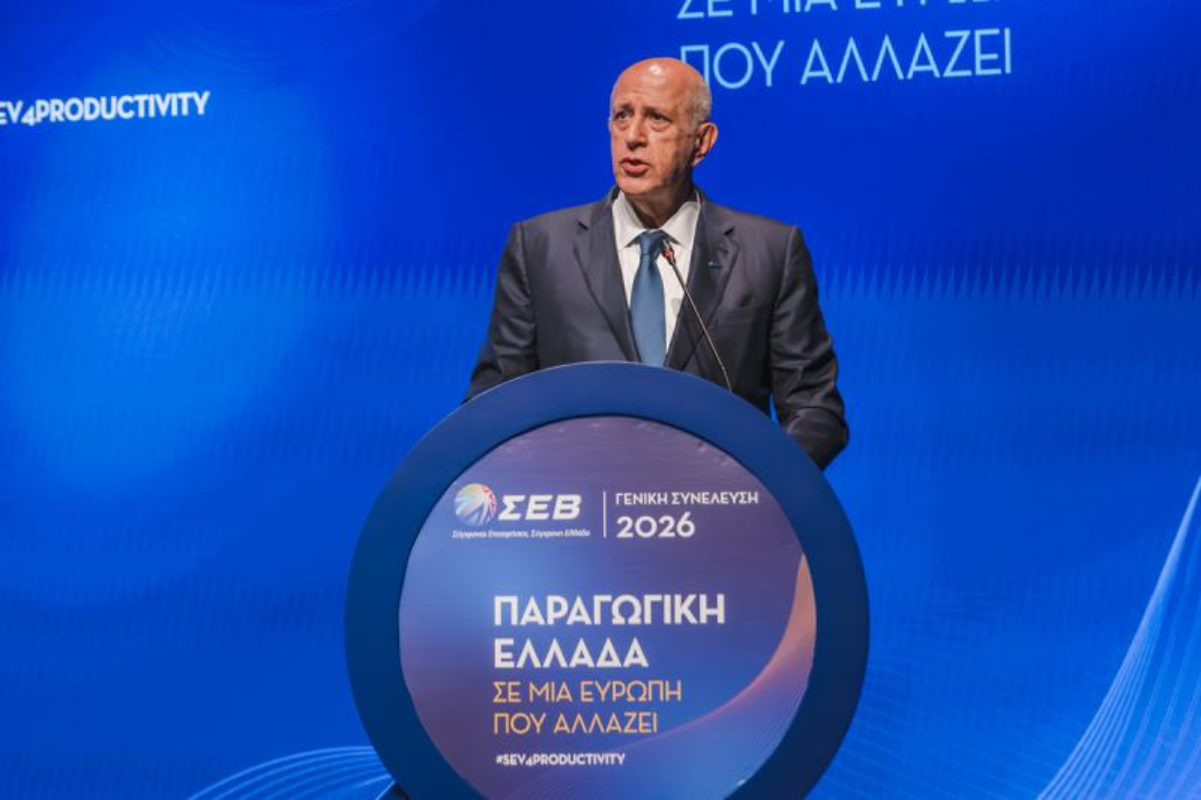
The measure, announced by Prime Minister Kyriakos Mitsotakis at the annual General Assembly of the Hellenic Federation of Enterprises (SEV), is not limited to Greece’s largest energy-intensive industrial groups.
The new scheme will also cover companies that have so far remained outside the mechanism compensating industries for indirect carbon costs.
This is arguably one of the package’s most important features:
the support net is expanding beyond major energy-intensive groups to hundreds of smaller and medium-sized industrial companies.
Cement, paper, plastics and food production are among the sectors potentially benefiting from the broader eligibility criteria.
The €95 Million Is Split Into Two Pools
The basic architecture of the scheme divides beneficiaries into two categories.
Around two-thirds of the €95 million will be directed to large energy-intensive companies that already receive support through the indirect CO₂ cost compensation mechanism.
These companies account for electricity consumption of approximately 7 TWh.
The remaining one-third will be allocated to industrial sectors that fall outside the existing compensation mechanism and have therefore lacked access to comparable support.
Electricity consumption among this second category is estimated at around 1.5 TWh.
The package therefore attempts to address two different problems:
large energy consumers already covered by carbon-cost compensation but facing renewed pressure from electricity prices;
and smaller or medium-sized industrial companies that have so far operated without a comparable safety net.


Estimated Relief of Around €20–25/MWh
The most important question for industrial companies is how much the scheme will actually reduce their electricity costs.
Initial estimates put the effective relief at approximately €20–25 per megawatt-hour.
The final amount will depend on the design of the scheme, each company’s eligible consumption and prevailing electricity prices.
Crucially, this will not be a single, uniform discount applied to every industrial consumer.
The scheme must operate within the limits established by the relevant EU state-aid frameworks.
CISAF: Wholesale Electricity Price Could Be Cut by Up to 50%
The first pillar is the Clean Industrial Deal State Aid Framework (CISAF).
Under the European framework, eligible support can reduce the average annual wholesale electricity price by as much as 50%.
There is, however, a significant restriction.
Support cannot cover more than 50% of an eligible company’s annual electricity consumption.
Therefore, even where the maximum permitted support intensity is applied, a company’s entire electricity consumption is not subsidised.
METSAF: Middle East Crisis Raises the Ceiling to 70%
The second instrument is the Middle East Crisis Temporary State Aid Framework (METSAF).
The temporary European framework was introduced in response to the economic and energy consequences of the Middle East crisis.
It provides greater potential support.
The maximum reduction can reach 70% of the average wholesale electricity price.
However, the eligible volume remains capped at 50% of a company’s electricity consumption.
This distinction is crucial:
“up to 70%” does not mean that an industrial company’s total electricity bill will fall by 70%.
The €50/MWh Floor
The European framework also establishes a clear minimum price.
After state support, the final electricity price cannot fall below €50 per megawatt-hour.
This effectively operates as a floor.
Even if the mathematical calculation of the subsidy would otherwise push the price below that level, the €50/MWh threshold applies.
The key question will therefore be how close the final Greek scheme can bring eligible industrial consumers to that level.


Smaller Industrial Companies Get Support for All of 2026
There is also an important difference in the period covered.
For companies outside the existing indirect carbon-cost compensation mechanism, support is designed to cover the whole of 2026.
This group represents around 1.5 TWh of electricity consumption.
For energy-intensive industries already receiving CO₂ compensation, additional support will instead cover the period from:
August through December 2026.
These companies represent approximately 7 TWh of consumption.
Half the Aid Must Be Reinvested
EU rules do not allow companies to receive the support without conditions.
Beneficiaries will be required to channel 50% of the aid into green-transition investments.
In practical terms, for every €1 million received in support, €500,000 would have to be linked to investment aimed at reducing the company’s future energy or carbon footprint.
Depending on the final scheme and eligibility requirements, such investments could include:
energy efficiency,
renewable energy,
storage,
battery systems,
electrification of industrial processes,
or other decarbonisation projects.
The underlying philosophy is clear:
Europe is helping industry with today’s energy bill, but expects companies to invest in reducing their exposure tomorrow.
Hundreds More Companies Could Become Eligible
The expansion of eligibility is particularly significant.
Until now, Greece’s main protection mechanism through indirect CO₂ cost compensation primarily covered a relatively limited number of major energy-intensive companies.
The new scheme could bring significantly more small and medium-sized industrial companies into the support framework.
Sectors at the centre of the discussions include:
cement,
paper,
plastics,
food production,
and other manufacturing activities with high electricity costs.
For many of these companies, electricity represents a critical component of total production costs and therefore directly affects their ability to compete with European and non-European producers.
Europe’s Bigger Problem: Competing With the US and China
The issue extends far beyond Greece.
European industry faces a structural energy-cost disadvantage compared with several of its major international competitors.
Spyros Theodoropoulos, president of SEV, has repeatedly highlighted the energy-price gap separating European industry from competitors in the United States and China.
From the industrial sector’s perspective, therefore, the problem cannot be solved by temporary subsidies alone.
The central question is whether the European Union can create lasting conditions for competitive and predictable energy prices.
The recommendations contained in the Draghi report, investment in power grids, renewable generation, interconnections and a faster European mechanism for responding to energy crises are increasingly central to that debate.
SEV and EVIKEN Welcome the Measure
The initial response from Greek industry to the government’s announcement has been positive.
Both SEV and EVIKEN, which represents major industrial energy consumers, had repeatedly called for Greece to make use of the available European instruments.
Companies outside the existing CO₂ compensation mechanism had been particularly vocal in calling for wider eligibility, arguing that they faced high electricity costs without access to an equivalent line of support.
However, a positive response to the package does not eliminate the broader concerns.
The €95 million addresses part of the problem.
It does not eliminate the structural energy-cost gap facing Greek and European industry.
€95 Million Is the Ceiling
This is one of the scheme’s most important limitations.
The €95 million represents the maximum fiscal envelope available for the Greek intervention.
The final programme must fit within that ceiling.
Therefore, even though the CISAF and METSAF frameworks may theoretically allow higher support intensities, the Greek programme cannot exceed the available budget.
The actual benefit received by individual companies will therefore be determined by a combination of factors:
the number of eligible companies,
eligible electricity consumption,
the period covered,
wholesale electricity prices,
and the overall €95 million ceiling.
Athens Has Already Started Talks With Brussels
The Greek government has already conducted preparatory discussions with the European Commission over the use of CISAF and METSAF.
This is important because the package constitutes state aid and therefore has to comply with EU competition rules.
A precise timetable for completing the approval process has not yet been established.
Athens nevertheless expects the consultations to move relatively quickly, as the Greek model is being constructed around European frameworks that are already available.
From Subsidies to Industrial Competitiveness
The real challenge ultimately goes beyond the €95 million package.
It is what happens when that money runs out.
Greek industry has consistently called for predictable and internationally competitive energy costs.
The government is now using available European instruments to absorb part of the exceptional pressure.
The European Union, meanwhile, is linking financial support to green-transition investment.
The package therefore operates simultaneously as immediate relief and an obligation to transform.
For individual companies, the first impact will be visible in their electricity costs.
For the wider Greek economy, however, the bigger question is whether this temporary €95 million intervention can become a bridge toward an industrial sector that needs fewer subsidies because it has secured permanently lower and more competitive energy costs.
Source: pagenews.gr