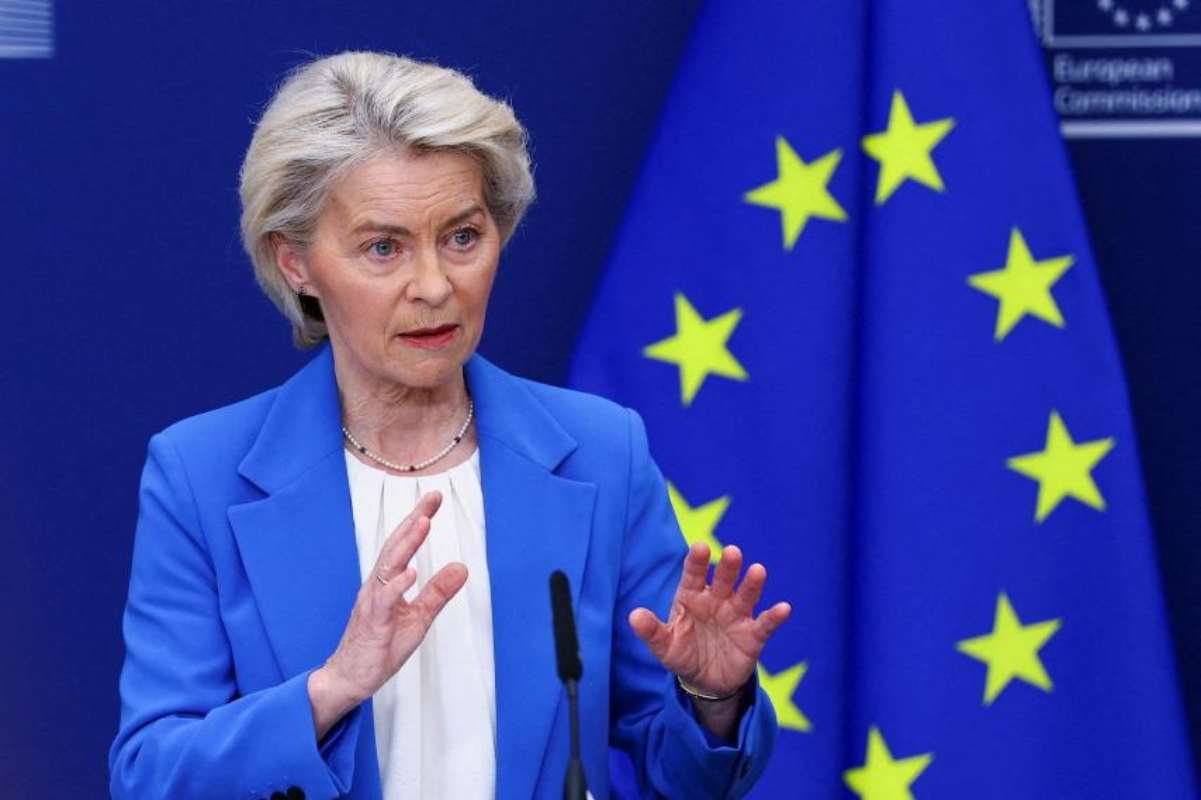
European Commission President Ursula von der Leyen is calling for a tougher European approach to migration, sending a clear message to the leaders of the EU’s 27 member states that protecting the bloc’s external borders must remain a central priority.
In a letter circulated ahead of the European Council summit on October 15–16, von der Leyen calls for additional measures to address irregular migration, strengthen the EU’s border management capabilities and improve the implementation of return decisions.
According to Politico, the letter sets the stage for discussions among European leaders on Friday, October 16, when migration is expected to feature prominently on the summit agenda.
The initiative comes amid growing concern in Brussels over sudden migration pressures, particularly following developments in Ceuta, the Spanish enclave bordering Morocco.
The Commission’s central message is that Europe must be better prepared to respond when migration flows are deliberately used to exert political pressure or destabilise member states.
Von der Leyen’s Warning: Europe Must Defend Its External Borders
The European Commission president places particular emphasis on preventing the instrumentalisation of migration by state and non-state actors.
Her letter stresses that the European Union must be capable of responding to situations in which migration is used as a means of political pressure.
“We will never compromise on the protection of our external borders,” von der Leyen declares.
The statement reflects the Commission’s determination to reinforce border management while preserving the principles underpinning the European legal framework.
The president also argues that no state or non-state actor should be allowed to exploit European rules and values to undermine the Union.
The language highlights how migration policy has increasingly become intertwined with security and geopolitical considerations.
For Brussels, the challenge extends beyond processing asylum applications and managing arrivals.
It also involves combating migrant-smuggling networks, responding to hybrid threats and preventing external actors from exploiting vulnerabilities along Europe’s borders.
The Ceuta Crisis and Europe’s Growing Concerns
Developments in Ceuta have played an important role in shaping the latest European debate.
The Spanish enclave on the northern African coast occupies a particularly sensitive position along the EU’s external frontier.
According to the reporting cited by Politico, approximately 70,000 migrants arrived from Morocco during the summer crisis.
The scale of the reported arrivals raised questions about the ability of European authorities to respond rapidly to exceptional migration pressures.
The situation has become a reference point in discussions about emergency preparedness.
European officials are examining how personnel, equipment and operational support could be mobilised more quickly when a member state faces a sudden surge in arrivals.
The objective is to prevent an immediate border-management challenge from developing into a broader political, administrative or humanitarian crisis.


A New European Emergency Response Mechanism
One of the principal initiatives outlined by von der Leyen involves developing an EU emergency response framework for situations in which large-scale migration movements are used as an instrument of pressure.
Such a mechanism would aim to strengthen coordination between European institutions and national authorities.
The Commission had already presented a five-point plan on September 29 to improve preparedness for sudden mass arrivals.
Its priorities include stronger monitoring, better coordination and faster operational responses.
The proposed framework could be particularly significant for countries located along the EU’s external borders.
These include Greece, Italy, Spain and other member states facing pressure along Mediterranean migration routes.
However, the precise responsibilities, funding arrangements and operational powers of any new mechanism would depend on subsequent political and legislative decisions.
Stronger Frontex and Faster Migrant Returns
Expanding the capabilities of Frontex, the European Border and Coast Guard Agency, is another central element of the Commission’s approach.
Von der Leyen is seeking stronger operational support for member states, particularly in implementing return procedures.
The Commission argues that an effective migration system must be capable of enforcing decisions concerning third-country nationals who do not have a legal right to remain in the EU.
Returns have long been among the most difficult aspects of European migration policy.
Administrative obstacles, identification problems, missing travel documents and insufficient cooperation with countries of origin frequently complicate removal procedures.
Brussels wants closer coordination between national authorities, more consistent procedures and stronger partnerships with third countries.
At the same time, return operations must comply with European and international legal obligations, including safeguards against refoulement and the protection of fundamental rights.
The EU’s New Return System
The latest proposals form part of a wider effort to reform Europe’s return framework.
The Commission has been pursuing measures designed to improve cooperation between member states and establish more consistent procedures.
Among the mechanisms under discussion are a European return order, greater mutual recognition of return decisions and closer cooperation with countries outside the European Union.
Another politically sensitive proposal concerns the possible establishment of return hubs outside EU territory.
Supporters argue that such arrangements could improve the management of cases involving people who have received final return decisions.
Critics question whether adequate legal safeguards, independent monitoring and effective access to protection could be guaranteed.
The debate therefore concerns both operational effectiveness and compliance with fundamental rights.
Von der Leyen Pushes for Full Implementation of the Migration Pact
The Commission president also links the new initiatives to the implementation of the EU Pact on Migration and Asylum.
Her letter calls on member states to maintain cooperation and fulfil their commitments under the agreed framework.
Particular emphasis is placed on the relationship between responsibility and solidarity.
The Commission argues that stronger border management must be accompanied by fairer cooperation among EU governments.
This remains a politically sensitive issue.
Countries along the Union’s external borders have consistently sought more substantial support from their European partners.
Other member states have placed greater emphasis on border controls, returns and preventing irregular arrivals.
The effectiveness of the new framework will depend on whether these different priorities can be reconciled through practical cooperation.
Greece at the Centre of the Mediterranean Challenge
For Greece, the developments in Brussels have particular significance.
The country occupies a strategic position along the southeastern external border of the European Union.
Its migration-management responsibilities extend across both land and maritime frontiers.
Recent attention has focused particularly on Crete and the migration route from North Africa, which presents additional operational challenges.
The maritime corridor connecting Libya to Crete illustrates the difficulties associated with monitoring extensive sea areas and coordinating search-and-rescue operations.
It also highlights the importance of cooperation with countries of origin and transit.
Greek authorities have repeatedly called for stronger European border-management capabilities and more effective return arrangements.
The initiatives outlined by von der Leyen could influence the operational support available to Greece.
However, any specific benefits would depend on the final design of the measures and the resources allocated to their implementation.
Libya, Crete and the External Dimension of EU Migration Policy
The European Union’s migration strategy increasingly depends on cooperation with third countries.
Brussels is seeking stronger partnerships aimed at disrupting smuggling networks, preventing dangerous journeys and improving lawful return procedures.
North Africa is central to this approach.
Libya presents particularly complex challenges because of political fragmentation, competing centres of authority and longstanding concerns about the treatment of migrants.
These conditions complicate efforts to establish reliable and rights-compliant migration-management arrangements.
For Greece, developments in EU relations with Libya are directly relevant to the maritime routes leading towards Crete.
Greater European coordination could improve information-sharing and operational preparedness.
Nevertheless, effective cooperation must also address the humanitarian and legal risks associated with migration management in the region.
Fewer Irregular Crossings, but Continued Political Pressure
The renewed push for tougher migration measures comes against a more complex statistical background.
EU border data have indicated a significant decline in recorded irregular crossings during 2024 and 2025, with the downward trend continuing into 2026.
However, lower overall numbers do not necessarily eliminate pressure on particular routes.
A relatively concentrated increase in arrivals can place substantial demands on local authorities, reception facilities and border-management services.
The Commission’s approach therefore reflects concerns about both the total scale of migration and the ability to respond to sudden regional developments.
Humanitarian organisations have meanwhile emphasised that new restrictions should be assessed against principles of necessity, proportionality and respect for asylum rights.
The challenge for European policymakers is to strengthen operational capacity without weakening legal protections.
Migration Becomes a European Security Priority
The language used by von der Leyen illustrates the growing connection between migration policy and European security.
Border protection, hybrid threats, smuggling networks and relations with neighbouring countries increasingly form part of the same strategic discussion.
This does not mean that all irregular migration constitutes a security threat.
Rather, European institutions are focusing on situations in which migration movements may be deliberately manipulated for political purposes.
The distinction is important.
Migration management involves legitimate questions of border control, international protection and administrative capacity.
Security responses must therefore remain proportionate to the circumstances and consistent with EU law.
The Commission’s proposals will be judged partly on whether they can maintain that balance.
The October Summit: What EU Leaders Must Decide
Von der Leyen’s letter prepares the ground for the European Council discussions on October 16.
European leaders are expected to examine stronger external border protection, emergency preparedness and the implementation of the Migration and Asylum Pact.
The future role of Frontex, return procedures and cooperation with third countries will also feature in the broader debate.
The negotiations are likely to reveal different national priorities.
For frontline countries such as Greece, a central concern is whether European solidarity will translate into meaningful operational and financial assistance.
Other governments are particularly focused on reducing irregular arrivals and increasing the effectiveness of return decisions.
The outcome will depend on the ability of the 27 member states to reach common positions and implement them consistently.


A Defining Test for Europe’s Migration Strategy
Von der Leyen’s intervention signals the Commission’s intention to strengthen the EU’s capacity to respond to migration pressures.
External border protection, faster returns and emergency coordination are the principal elements of the proposed approach.
At the same time, Brussels faces the challenge of ensuring that stronger controls remain compatible with international protection obligations and fundamental rights.
For Greece, the critical question is whether European commitments will translate into stronger operational support, more effective cooperation with third countries and a fairer distribution of responsibilities.
The October summit will provide an important indication of how far EU governments are prepared to move towards a more coordinated migration strategy.
The broader issue extends beyond immediate border-management challenges.
It concerns the European Union’s ability to combine security, solidarity and the rule of law within a coherent and sustainable migration policy.
Source: pagenews.gr