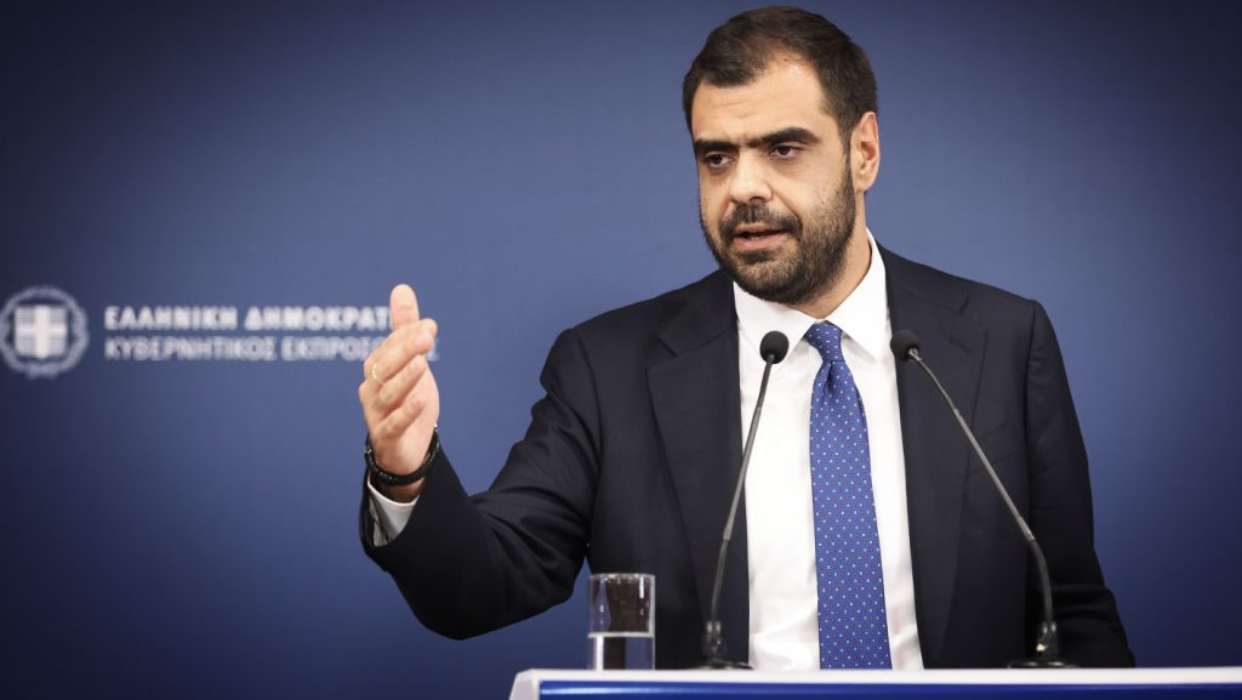
Greece will not seek Turkey’s permission to proceed with the electricity interconnection project between Greece and Cyprus, government spokesperson Pavlos Marinakis insisted in a wide-ranging television interview, delivering a firm message on maritime jurisdiction, international law and the government’s foreign-policy strategy.
Speaking amid renewed controversy over the project and Ankara’s claims in the Eastern Mediterranean, Marinakis rejected suggestions that Athens had retreated from its sovereign positions. He also drew a clear distinction between the interventions of former conservative prime ministers Kostas Karamanlis and Antonis Samaras, describing the latter’s expulsion from New Democracy as an unfortunate but unavoidable development.
The interview extended beyond foreign policy to the escalating energy crisis, household electricity bills, heating subsidies, taxation and the government’s fiscal response. In its final segment, Marinakis responded to newspaper reports concerning allegations in Greek basketball and his brother’s career as a referee, categorically denying any personal or family involvement in the matters under investigation.
“Permission Only From Greece”: Athens Rejects Turkish Authorization
The electricity interconnector linking Greece and Cyprus dominated the foreign-policy discussion, particularly the prospect of renewed maritime operations and the issuance of navigational notices.
Marinakis rejected the premise that Greece had previously backed down during tensions near the island of Kasos.
“There was no question of a retreat at Kasos. We have said this before,” he stated.
He accused some critics of exaggerating developments rather than examining the legal and operational facts.
“Some people seem to prefer dramatizing events to presenting them objectively,” he said.
The spokesperson described the interconnector as a project of European strategic importance, involving Greece, Cyprus and major European industrial interests.
“This is an energy project of European significance. A European project, carrying Europe’s institutional backing,” Marinakis said.
He insisted that the relevant licensing procedures fall under Greek jurisdiction and categorically ruled out any application for authorization from another country.
“There is absolutely no question of a permit, an application for a permit, or a licensing procedure involving any state other than Greece,” he declared.
Pressed on whether an informal arrangement with Turkey could be contemplated, his response was equally explicit.
“Neither formally nor informally.”
According to Marinakis, seeking authorization from Ankara would establish a potentially damaging precedent concerning maritime jurisdiction.
“Applying for permission would indeed create a dangerous precedent. That is precisely why there was never any possibility of following such a procedure,” he argued.


Notification Is Not Authorization: The Legal Distinction at the Heart of the Dispute
A central element of Marinakis’s argument concerned the difference between requesting permission and providing technical notification during maritime operations.
The distinction has become politically sensitive following statements by Greek Foreign Minister George Gerapetritis and renewed Turkish assertions concerning the interconnector.
Marinakis maintained that the technical communication procedures associated with such operations do not constitute recognition of another state’s authority.
“It is a procedure that produces no legal effects. It has been followed in comparable projects in the past and concerns a specific process undertaken by the company,” he explained.
“It is not permission. We are not asking anyone for permission.”
Asked what Athens would do if Ankara continued insisting that Turkish authorization was required, the spokesperson said Greece would not allow Turkish declarations to determine its policy.
“Greece does not allow its strategy or its policy to be dictated by others,” he said.
He also rejected suggestions that Gerapetritis had modified the government’s position.
“We are not changing our position. There is no question of permission, neither informal nor in any other form. This project will proceed,” Marinakis insisted.
The spokesperson framed the dispute as a question of international law rather than a contest between unilateral national interpretations.
“International law, the law of the sea and the rules governing these projects are not written by any single country. They exist, and they must be applied,” he said.
“Everyone is free to say what they want. The project will move forward.”
What Happens if Turkish Warships Appear?
The interviewers also raised the possibility of Turkish naval vessels appearing in the area during the next phase of the project.
Marinakis avoided outlining a hypothetical military response but maintained that Athens would take the necessary steps to allow the works to proceed.
“The project will move forward, and whatever needs to be done to ensure its progress will be done,” he said.
Asked whether previous statements by the foreign minister about responding to developments on the ground remained valid, Marinakis declined to distance himself from Gerapetritis.
“Whatever needs to be done for the project to proceed will be done, without any retreat,” he said.
The remarks reflected the government’s determination to maintain its declared position while avoiding a detailed public discussion of possible military contingencies.
Karamanlis Versus Samaras: A Deliberate Political Distinction
One of the interview’s most politically significant moments came when Marinakis was asked about criticism from two former New Democracy prime ministers, Kostas Karamanlis and Antonis Samaras.
Both have raised concerns over Turkish actions, the Turkish–Libyan maritime memorandum and the implications for Greek sovereign rights.
But Marinakis insisted that their interventions should not be treated as equivalent.
Referring to Karamanlis, he argued that the former prime minister had described an unwelcome development without suggesting that it produced legally binding consequences for Greece.
“Mr. Karamanlis spoke about an unpleasant development which, however, produces no legal effect,” Marinakis said.
He emphasized that Karamanlis had called for national unity and had not described the Turkish–Libyan developments as a national defeat.
“Kostas Karamanlis’s speech had nothing to do with the reactions we saw from a large part of the opposition and from former Prime Minister Antonis Samaras,” he argued.
“Mr. Karamanlis did not speak of a national defeat when referring to the illegal, invalid and legally baseless Turkish–Libyan memorandum.”
The distinction was politically consequential.
While acknowledging Karamanlis’s concerns, the government spokesperson sought to separate them from Samaras’s more confrontational criticism of the administration’s foreign-policy decisions.
Turkey’s Casus Belli, Blue Homeland and the EU’s SAFE Programme
Marinakis also addressed Turkish positions on the Aegean and Eastern Mediterranean, including the longstanding threat of war associated with any Greek extension of territorial waters in the Aegean beyond six nautical miles.
He argued that Turkey’s disputed positions predate the current administration.
“Did the illegal casus belli and everything else we hear from Turkey in violation of international law appear for the first time after 2019? The answer is no,” he said.
He pointed to Prime Minister Kyriakos Mitsotakis’s insistence that Turkey’s threat of war should be lifted in connection with Ankara’s potential participation in the European Union’s SAFE defence financing programme.
“Who was the first Greek prime minister to raise the lifting of the casus belli in connection with requests by third countries, including Turkey, to participate in SAFE? Kyriakos Mitsotakis,” Marinakis argued.
The spokesperson also challenged the suggestion that dialogue with Turkey necessarily implied concessions.
“Previous Greek prime ministers, from different political parties, met their Turkish counterparts. Does that mean they were retreating? The answer is no,” he said.
His argument was that diplomatic engagement and the defence of national positions are not mutually exclusive.
Twelve Nautical Miles, Maritime Agreements and Defence Modernization
Marinakis went on to list decisions taken under the Mitsotakis government that he presented as evidence against allegations of diplomatic weakness.
These included the extension of Greece’s territorial waters to 12 nautical miles in the Ionian Sea, maritime delimitation agreements with Italy and Egypt, and the country’s maritime spatial planning initiatives.
“Who extended territorial waters to 12 nautical miles in the Ionian Sea? Kyriakos Mitsotakis. Who signed maritime agreements with Italy and Egypt? Kyriakos Mitsotakis,” he said.
He challenged those accusing the government of excessive accommodation toward Ankara to identify a concrete concession.
“Let someone who is trying to construct a narrative of submissiveness — and Mr. Karamanlis is clearly not among them — tell me where Greece has retreated,” Marinakis stated.
He also cited defence modernization, including the upgrading of F-16 fighter jets, the acquisition of Rafale aircraft, the planned F-35 programme and Belharra-class frigates.
“The Mitsotakis government, understanding this reality, is taking substantive action, always with respect for international law,” he said.
“We want peaceful coexistence, but we are neither retreating nor being naive.”
Samaras’s Expulsion: “Unpleasant, but Unfortunately Unavoidable”
The government spokesperson was particularly direct when discussing Antonis Samaras’s removal from New Democracy.
He described the decision as painful for the governing party but maintained that it had become unavoidable.
“Mr. Samaras’s expulsion was an unpleasant development for the party, but unfortunately an unavoidable one,” Marinakis said.
“None of us was happy about it. The prime minister has said so himself. It was not something done with pleasure.”
He linked the decision to the nature of Samaras’s criticism of Greek foreign policy and, in particular, the language directed at Foreign Minister George Gerapetritis.
“There are certain red lines concerning the country’s foreign policy that nobody can cross,” Marinakis stated.
He again contrasted the former prime ministers, arguing that Karamanlis had not used comparable language.
The intervention highlighted a central challenge for New Democracy: responding to criticism from influential figures within its political tradition while defending the government’s current diplomatic strategy.
Energy Crisis: “As Long as There Is a Need, There Will Be Support”
The interview then shifted to the economy, with the journalists confronting Marinakis over rising natural gas prices, electricity bills and heating fuel costs.
The government spokesperson acknowledged the pressure on households and businesses and indicated that further announcements would be made by the relevant ministries concerning support measures.
“As long as the factors causing this crisis persist, the government will continue supporting citizens as much as it can and as far as public finances allow,” he said.
“As long as there is a need, there will be support.”
He declined to disclose the precise measures before their official announcement.
“The announcements will be made this afternoon. I do not want to prejudge anything,” he said.
Marinakis also cautioned against what he portrayed as two extremes in the political debate: celebrating government performance while citizens remain under pressure, and dismissing every intervention as inadequate.
“It is as wrong to celebrate during a period of unprecedented pressure and crisis as it is to dismiss everything. And an even greater mistake is to promise money that you cannot find,” he argued.
Heating Allowances: The Government’s Comparison With 2019
Marinakis defended the government’s heating allowance policy by comparing current maximum payments with those available when New Democracy took office.
According to the figures he cited, the previous maximum was €350, while current support can reach €1,200 and, in certain cases involving greater energy needs, €1,500.
“When Kyriakos Mitsotakis took office, do you know what the maximum heating allowance was? €350. Do you know what the maximum is now? More than €1,000. It is €1,200, and in certain cases of increased energy needs, €1,500,” he said.
He also argued that income eligibility thresholds had been broadened to include more beneficiaries, including families with children and single-parent households.
The spokesperson insisted that economic performance should be evaluated against the background of international disruptions.
“You cannot compare a period of crisis with a period of normality,” he said.
The figures were presented as part of the government’s defence of its policy, although the interviewers continued to emphasize the immediate financial burden facing consumers.
Electricity Bills: The Dispute Over Fixed and Variable Tariffs
Electricity prices produced another extended exchange.
Marinakis argued that government intervention and the restructuring of Greece’s dominant electricity provider had helped create conditions for competitively priced fixed-rate contracts.
The interviewers pointed out that a substantial share of consumers remained on variable-rate tariffs and continued to face rising costs.
The spokesperson maintained that the availability of fixed-rate contracts represented a meaningful option.
“The opportunity provided by the major supplier, and by other suppliers, to obtain a fixed tariff at a price considerably below the European average lasts for at least a year,” he said.
“It provided consumers with a degree of certainty.”
When challenged about the number of households that had not switched, he replied:
“Everyone was given the opportunity. Some chose it; others, as is their right, did not.”
He also defended government interventions in the Public Power Corporation and cited the taxation of extraordinary energy-company profits as part of the administration’s record.
“You Will Not Hear ‘There Is Money’ From Us”
The debate over additional relief measures developed into a broader confrontation over public spending, taxation and the legacy of Greece’s debt crisis.
The journalists questioned why the government had not moved further to reduce fuel taxes, impose additional taxes on refinery windfall profits or provide new subsidies for vulnerable households and small businesses.
Marinakis responded by emphasizing fiscal responsibility and the importance of costing policy proposals.
“You will not hear ‘there is money’ from us, nor will you see it as government policy,” he said, invoking a phrase associated with earlier Greek political debates.
“If the opposition proposes something without costing it, then in my view that proposal has no value,” he added.
He argued that the consequences of past fiscal decisions continued to affect younger generations, pensioners and workers.
“Today’s young people, who cannot afford their own homes, are paying for the mistakes of the past. So are pensioners who lost roughly half their pensions,” he said.
Refinery Profits: Why Athens Prefers Monthly Support
Asked specifically about imposing additional taxes on refinery profits, Marinakis said the government had previously used extraordinary taxation when it considered that approach appropriate.
For the current period, however, he argued that monthly support mechanisms were more effective.
“We believe that month-by-month support from the refineries is more effective than such an option,” he stated.
He also referred to competition considerations and other market factors influencing the government’s choice of intervention.
“When this government judged that taxation was the best solution, it implemented it,” he said.
The distinction underscored the administration’s preference for targeted measures in the present circumstances, rather than immediately committing to another extraordinary tax.
Tax Revenues, Employment and the Promise of Further Relief
Marinakis identified three principal sources of additional government tax revenue: increased employment and economic activity, efforts to combat tax evasion, and higher VAT receipts.
“The first is more jobs, and therefore economic growth. The second is tackling tax evasion. And the third is additional VAT revenue,” he explained.
He referred to approximately €850 million in additional VAT revenue, stressing that VAT rates had not been raised.
The spokesperson also outlined measures he said were scheduled for November, including rent-related assistance and financial support for pensioners.
He pointed to reductions in income taxation, changes to advance tax payments for sole proprietors and more favorable tax arrangements for younger taxpayers.
“As the state collects more money while reducing taxes, it will return that money to society in a fair way, primarily through tax reductions,” Marinakis said.
He presented the government’s approach as the opposite of what he characterized as unfunded opposition promises.
“We do not do what others do: promise first and then look for the money. We find the money first, without raising taxes, and then we provide support.”
Basketball Allegations: Marinakis Responds to Newspaper Reports
The interview’s final section focused on reports published by the Greek newspaper Dimokratia concerning allegations in the basketball sector and the career of Marinakis’s brother as a referee.
The government spokesperson rejected any suggestion of personal involvement and disputed the way the reports had been presented.
Addressing the first report, he said that a complainant had approached him with information relating to individuals connected to basketball.
Marinakis maintained that he had no authority to investigate the allegations himself and had advised the individual to contact the competent authorities.
“As a public official, who had no jurisdiction in this particular matter because I am neither the deputy minister nor the alternate minister responsible for sport, I told him to go to the authorities,” he said.
According to his account, the complainant subsequently contacted the authorities, and information was forwarded to the prosecutor.
“We want the truth to come to light. We are not taking a position,” Marinakis stated.
“What happens and what does not happen will be decided by the judiciary.”
He insisted that his own conduct had been limited to directing the complainant toward the proper institutional process.
“I did what my duty required: go to the judiciary. And that is indeed what happened,” he said.
“Absolutely No Involvement”: The Response Concerning His Brother
Marinakis reacted more forcefully to the second newspaper report, which referred to his brother’s work as a basketball referee.
He argued that a family relationship could not reasonably be treated as evidence of involvement in a separate investigation.
“There is no such thing as family responsibility,” he said.
“Because I am the government spokesperson, I find myself having to answer questions about a relative who has absolutely nothing to do with any of these cases,” he added.
According to Marinakis, his brother began refereeing local basketball competitions in 2013 and was selected to officiate at the top national level in 2019.
He argued that presenting those facts alongside the allegations created an unjustified impression of a connection.
“They take two facts that have nothing to do with the case — including a family relationship — and place them together in a headline to create impressions,” he said.
“That is not serious journalism.”
Asked directly whether he or any member of his family had been involved in the alleged wrongdoing, he replied:
“Absolutely no involvement. There is not the slightest involvement.”
These statements constitute Marinakis’s response to the reports, rather than an independent finding concerning the underlying investigation.
“The Judiciary Will Decide”: Marinakis’s Final Position
Marinakis concluded by emphasizing that neither his office nor his family relationships gave him authority to assess the substance of the allegations or determine whether any individual had committed an offense.
He maintained that the proper course was for the information to be examined by the judicial authorities.
“I did not judge the allegations, nor did I discuss the substance of whatever evidence existed. I encouraged the citizen, as is my duty, to approach the authorities,” he said.
And he ended with a clear distinction between his own role and that of the justice system:
“Whether that evidence proves valid, whether it connects one person or another, is not for me to say.”
Source: pagenews.gr