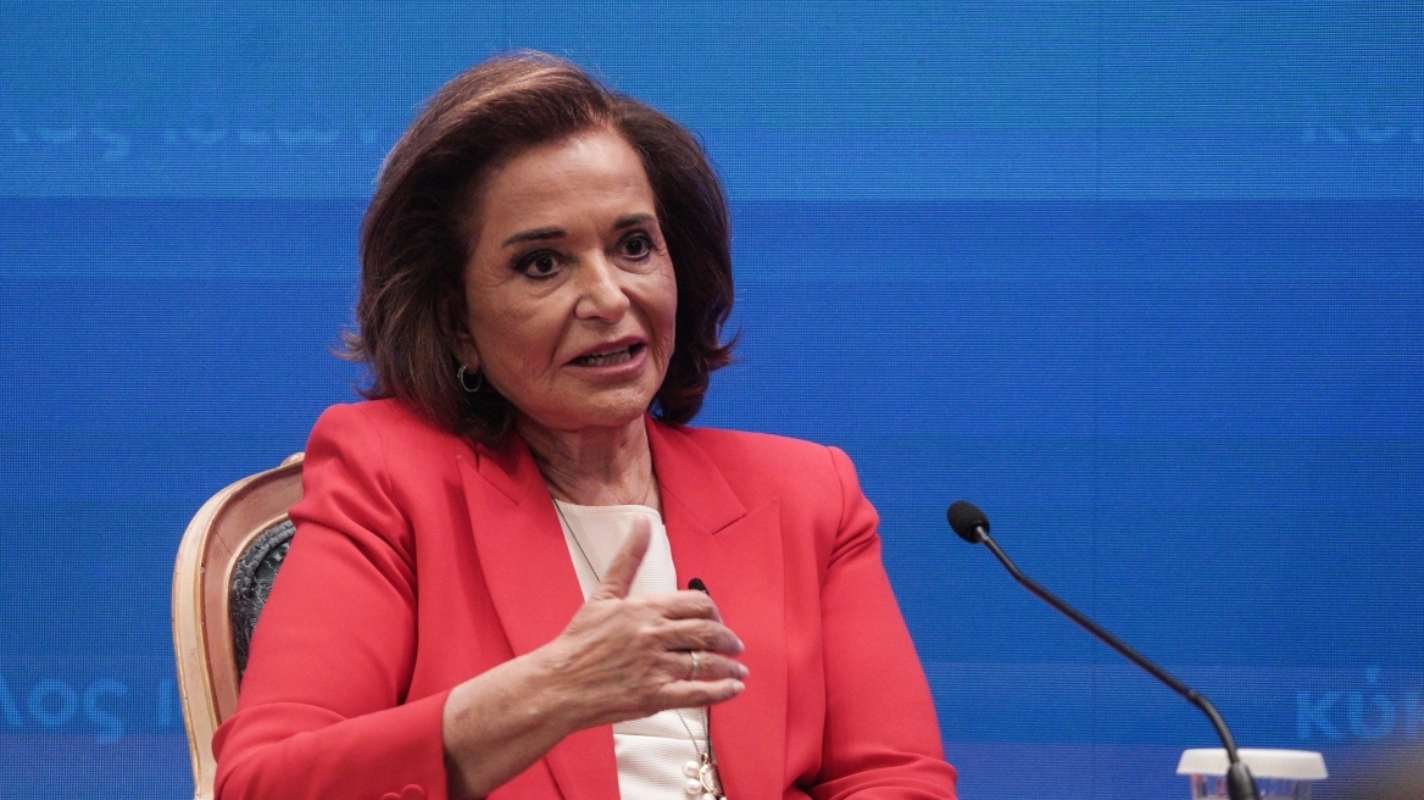
Former Greek Foreign Minister and senior New Democracy politician Dora Bakoyannis has delivered a wide-ranging political intervention, defending the government’s foreign policy while acknowledging growing public frustration over inflation and the pressures facing Prime Minister Kyriakos Mitsotakis ahead of the next general election.
In a television interview, Bakoyannis rejected suggestions that Greece had compromised its sovereign rights through diplomatic communications with Turkey concerning the Great Sea Interconnector (GSI), the strategically important electricity link between Greece and Cyprus.
She also publicly disagreed with former Prime Minister Kostas Karamanlis over the implications of notifying Ankara about the project, arguing that diplomatic notification does not constitute recognition of Turkish jurisdiction.
On domestic politics, Bakoyannis made one of her most striking statements when she attributed much of the current inflationary pressure to international conflicts and US President Donald Trump’s policies.
“There is no Mitsotakis inflation. There is Trump inflation,” she declared.
“There Is Trump Inflation” – Bakoyannis Blames Global Conflicts for Rising Prices
Bakoyannis argued that Greece and the wider European economy are paying a heavy economic price for two major conflicts: Russia’s war in Ukraine and the war involving Iran.
She maintained that the initial disruption caused by the invasion of Ukraine had already severely affected energy markets, food supply chains and household purchasing power.
According to Bakoyannis, the subsequent conflict involving Iran has compounded those pressures.
“Why did Trump decide to start the war? We are the ones paying the price through higher inflation,” she said.
She argued that European governments have limited capacity to offset price increases driven by international energy disruptions.
“We have two wars, and we in Europe are paying the price through inflation,” she stated.
Bakoyannis nevertheless acknowledged that Greece had experienced cost-of-living pressures before the latest geopolitical crises, while insisting that external shocks had significantly worsened the situation.
Her remarks came during a discussion about whether the Greek government has exhausted its policy options for addressing the rising cost of living.


New Democracy Faces a More Difficult Political Climate
In a notable acknowledgement of the government’s political difficulties, Bakoyannis conceded that the combination of inflation, public dissatisfaction and the accumulated effects of years in office has created a more challenging environment for New Democracy.
Asked whether voters increasingly believe that the government has run out of solutions, she responded:
“All these factors together have indeed created a heavier political atmosphere for New Democracy.”
She also recognised that some voters who supported the governing party in the 2019 and 2023 elections have become disappointed.
Bakoyannis said the government must engage with these voters and explain the economic challenges facing Greece, as well as the limits of national policymaking during international crises.
The discussion also touched on the political alternatives represented by Prime Minister Kyriakos Mitsotakis, former Prime Minister Alexis Tsipras and PASOK leader Nikos Androulakis.
Bakoyannis maintained that the election debate should focus on the choices available to voters and the policies each political force proposes.
Why Greece Is Not Cutting VAT Despite Budget Surpluses
The former foreign minister was challenged over the government’s reluctance to reduce value-added tax despite substantial fiscal surpluses.
Asked why Greece could not use part of its budgetary gains to fund targeted VAT reductions, Bakoyannis pointed to European fiscal rules.
She argued that measures reducing government revenue or increasing expenditure are subject to EU fiscal monitoring and spending constraints.
“Every measure that reduces revenue or increases expenditure is monitored by the European Union,” she explained.
According to Bakoyannis, the government has already used approximately €2 billion in available fiscal space to support households.
She also said Mitsotakis had asked the European Commission to allow greater flexibility for additional measures without counting them in the same way against expenditure ceilings.
The former minister suggested that the issue would require further political negotiations at European level.
Bakoyannis Criticises von der Leyen’s Technocratic Commission
Bakoyannis also directed criticism towards European Commission President Ursula von der Leyen, questioning whether the Commission’s technocratic approach adequately reflects the pressures facing European households.
“Von der Leyen chose technocratic commissioners rather than politicians,” she said.
While acknowledging the importance of technical expertise, Bakoyannis argued that policymakers must recognise the immediate financial pressures experienced by citizens.
She suggested that Brussels has become too focused on detailed regulatory questions while households struggle with energy costs and inflation.
The former foreign minister called for greater political sensitivity in European economic decision-making, arguing that governments need additional flexibility to respond to exceptional circumstances.
She said the issue should be addressed at European Council level, where national leaders could press for a more responsive fiscal framework.
A Direct Disagreement with Kostas Karamanlis Over the Greece–Cyprus Cable
The interview’s most significant foreign-policy exchange concerned the Great Sea Interconnector and the diplomatic notification sent by France to Turkey regarding the project’s maritime operations.
Bakoyannis rejected claims that the notification amounted to a concession to Ankara or recognition of Turkish jurisdiction.
She also explicitly disagreed with former Prime Minister Kostas Karamanlis, whose position, as presented during the interview, was that even a simple notification to Turkey could establish a dangerous precedent.
Asked whether that concern was justified, Bakoyannis replied:
“No. That is not the case.”
She emphasised her longstanding political relationship with Karamanlis, under whom she served as foreign minister.
“You know very well how highly I regard Kostas Karamanlis and how closely I worked with him throughout the years when I served as his foreign minister,” she said.
Nevertheless, she insisted that international law draws a clear distinction between diplomatic notification and a request for authorisation.
“A simple notification has absolutely nothing to do with recognising jurisdiction. Ask any professor of international law and you will receive the same answer,” she argued.
The disagreement highlights different interpretations within Greece’s centre-right political establishment concerning how Athens should respond to Turkish claims in the Eastern Mediterranean.
“Turkey Was Informed – It Did Not Grant Permission”
Bakoyannis explained that the French side had communicated with Ankara through a note verbale, a formal diplomatic communication intended, in this case, to provide information rather than request approval.
According to her account, the necessary authorisations for the project were issued by Greece and Cyprus.
“Greece granted the authorisation. Cyprus granted the authorisation. The cable is moving forward, and that is what matters, without further tensions,” she said.
Bakoyannis argued that France’s decision to inform Turkey was designed to minimise the risk of confrontation and protect the vessel carrying out the work.
“Turkey was informed and is satisfied with the notification. It used to demand that we seek permission. Now it is satisfied with a simple note verbale,” she remarked.
She strongly rejected claims that the communication amounted to accepting Turkish co-management or jurisdiction over the relevant maritime area.
“For Greek journalists, analysts and opposition politicians to make such claims is wrong. It goes against our interests because there is no basis for it,” she argued.
Bakoyannis also referred to the European dimension of the project, highlighting the previously announced €600 million in EU financial support.
She maintained that the project’s stronger European backing had changed the diplomatic environment compared with earlier periods of tension near Kasos.
“Greece Is Not a Weak Country”
The former foreign minister also addressed broader concerns about Greece’s geopolitical position and its ability to defend its interests.
She cited the international response to the Turkey–Libya maritime memorandum as an example of diplomatic resistance to Turkish claims.
According to Bakoyannis, the speed and strength of the reactions from European partners and other allies had surprised Ankara.
She urged Greece’s political and media establishment to avoid portraying the country as inherently vulnerable.
“We should stop constantly beating ourselves up and creating the impression that this country is weak,” she said.
“Greece is not weak. It is not a superpower. It is not the United States. But we are a country that remains consistent in its positions. We are a calm and steady power.”
Returning to the electricity interconnector, she stressed that the practical outcome was more important than the political controversy surrounding the diplomatic notification.
“What matters is the result. And what is the result? The cable will go ahead without the slightest permission from Turkey,” she said.
US–Greece Relations: “Strategic Partnerships Are Built on Common Interests”
Bakoyannis also discussed Greece’s relationship with Washington following the latest American electoral developments.
She maintained that Greek-American strategic cooperation remains strong, regardless of the personal relationships between political leaders.
“Strategic relations with America are not based on anyone’s good feelings. They are based on common interests,” she said.
She identified energy corridors, security in the Eastern Mediterranean and the strategic importance of Alexandroupolis and Souda Bay as central pillars of the bilateral relationship.
“America has common interests with Greece. Energy routes, stability in the Eastern Mediterranean, Greece’s strategic position through Alexandroupolis and Souda. These are American interests, but they are also our interests,” she explained.
Bakoyannis referred positively to diplomatic contacts involving US Secretary of State Marco Rubio and the importance of Greece’s relationships within Congress.
However, she expressed uncertainty over Trump’s next foreign-policy decisions.
“What Trump will do next is the big question, and it concerns all of us who follow international affairs,” she said.
Bakoyannis Announces New Book and Promises “Christmas Surprises”
The interview concluded with an announcement about Bakoyannis’ forthcoming book, which she confirmed she had completed.
According to the former foreign minister, the book is scheduled to reach bookstores on December 4, with its official presentation planned for December 10 at 6 p.m. at the Athens Concert Hall (Megaron Mousikis).
Bakoyannis declined to reveal the title or the identities of those who will participate in the presentation.
“As if I would reveal the title now,” she joked.
She also dismissed speculation about the presentation panel.
“I have read some unbelievable nonsense. We have not yet finalised the panel,” she said.
Asked whether the event might feature political figures and generate controversy, she avoided providing details, while making clear that she hoped the book would attract serious attention.
“Wouldn’t you like some Christmas surprises? You will have them,” Bakoyannis concluded.
Source: pagenews.gr