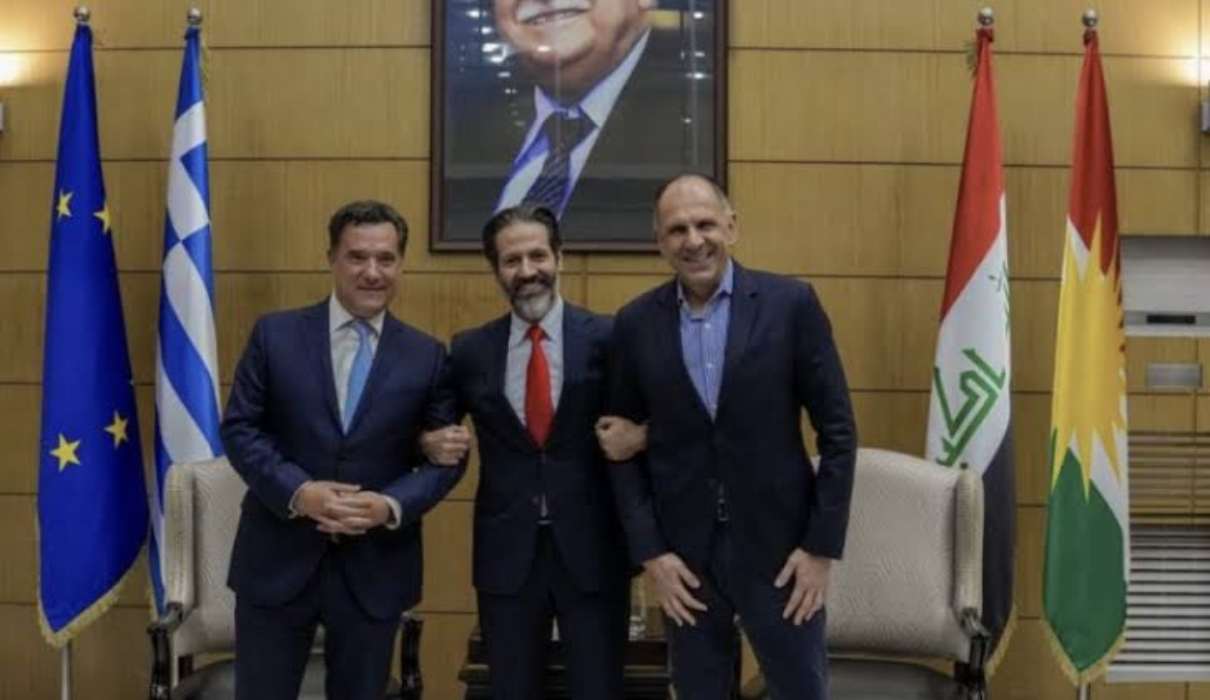
Greece is strengthening its diplomatic footprint in one of the Middle East’s most strategically sensitive regions, with Health Minister Adonis Georgiadis and Foreign Minister Giorgos Gerapetritis leading a high-level Greek presence at the Slemani Strategic Forum in Iraqi Kurdistan.
The two ministers arrived in Sulaymaniyah on Thursday, November 12, 2026, ahead of their participation in the international gathering, which brought together senior political figures, former heads of government, diplomats and security officials from Iraq and around the world.
At the heart of the visit was a meeting with Qubad Talabani, Deputy Prime Minister of the Kurdistan Regional Government and official patron of the forum, who welcomed the Greek delegation and emphasized the importance of strengthening bilateral relations.
For Georgiadis, the visit also marked the continuation of a relationship with Kurdish political leaders developed during his previous tenure as Greece’s Minister of Development and Investments.


Georgiadis: “We Have Every Interest in Strengthening Our Ties with Iraq and the Kurds”
In a public statement posted on X, Georgiadis outlined the significance of the mission and Greece’s strategic interest in the region.
“Together with Foreign Minister Mr. Giorgos Gerapetritis, we travelled to northern Iraq, to the autonomous Kurdistan Region, for a major international conference, where we represented Greece,” he wrote.
He then delivered the central message of the visit:
“We have every interest in strengthening our ties with Iraq in general and with the Kurds in particular.”
The Greek health minister also thanked journalist Matthew Boyle for their discussion at the forum.
“I thank my friend @mboyle1 for the excellent discussion we had in the presence of the Deputy Prime Minister of Kurdistan and the President of Iraq.”
His participation illustrates the international dimension of his political activity, bringing together contacts established through economic diplomacy and potential cooperation in healthcare and other sectors.
Qubad Talabani Welcomes the Greek Ministers: “A Milestone in Our Growing Relations”
According to local media reports, the arrival of the Greek delegation was warmly received by the Kurdish regional leadership.
Qubad Talabani welcomed both ministers, describing their visit as an important step toward strengthening relations between Greece and the Kurdistan Region.
Photographs released following the meeting showed the officials engaging in a cordial atmosphere, reflecting the positive diplomatic tone surrounding the visit.
In a statement issued by Talabani’s press office, the visit was described as:
“A milestone in our growing relations with Greece. It was a pleasure to welcome Foreign Minister Giorgos Gerapetritis and Health Minister Adonis Georgiadis on their first visit to Slemani.”
The statement emphasized that the relationship between the two sides is built on years of cooperation across several important sectors.
These include agriculture, tourism, healthcare and higher education, areas that offer opportunities for both economic development and institutional partnerships.
Talabani’s office also characterized the visit as the beginning of a new chapter in bilateral cooperation, with the stated objective of achieving tangible results.
The emphasis on practical outcomes is particularly significant for Greece, which is seeking to expand its international economic partnerships while reinforcing its diplomatic role in the wider Middle East.


Georgiadis and the Kurdish Leadership: A Relationship Built Over Several Years
The Sulaymaniyah visit did not represent Georgiadis’ first engagement with the Kurdish leadership.
In April 2022, while serving as Greece’s Minister of Development and Investments, he met Qubad Talabani to discuss opportunities for Greek companies in Iraqi Kurdistan.
Those discussions focused particularly on agriculture, food production and tourism.
Contacts continued in April 2026, with healthcare cooperation emerging as another area of mutual interest.
During those discussions, Talabani invited Georgiadis to visit the Kurdistan Region.
The November mission therefore followed a series of earlier political and institutional contacts.
This continuity is relevant because international partnerships frequently depend on sustained engagement rather than isolated diplomatic meetings.
For Georgiadis, the visit provided an opportunity to build on relationships established under a different ministerial portfolio while exploring areas connected to his current responsibilities.
A Global Gathering: 73 Political and International Figures in Sulaymaniyah
The scale of the Slemani Strategic Forum further highlighted the international significance of the Greek delegation’s participation.
Held on November 12–13, 2026, the forum brought together 73 prominent figures from Iraq and other countries, according to local reporting and information attributed to the organizers.
Among the political personalities listed in the forum’s program were:
- Nizar Amedi, President of Iraq, and Bafel Talabani, President of the Patriotic Union of Kurdistan (PUK).
- Ali Babacan, leader of Turkey’s DEVA Party and former Turkish deputy prime minister and foreign minister.
- Frans Timmermans, former Executive Vice-President of the European Commission.
- Kiril Petkov, former Prime Minister of Bulgaria.
- Olusegun Obasanjo, former President of Nigeria, and Macky Sall, former President of Senegal.
- Andrés Pastrana, former President of Colombia.
- James Heappey, former British Minister of State for the Armed Forces, and Lord Grimstone, former UK Investment Minister.
- Nick Carter, former Chief of the UK Defence Staff.
- Yulia Tymoshenko, former Prime Minister of Ukraine.
The presence of figures from Europe, the Middle East, Africa and Latin America reinforced the forum’s role as a platform for international political dialogue.
For the Greek delegation, the gathering provided an opportunity to participate in discussions involving regional security, economic development and the future of international partnerships.
The participation of prominent Turkish, European and international political figures also reflected the complex diplomatic environment surrounding Iraqi Kurdistan.


Healthcare, Tourism and Investment: The Economic Dimension of Greece’s Outreach
Beyond the diplomatic symbolism, the visit placed economic and institutional cooperation at the center of the Greek-Kurdish relationship.
The four sectors highlighted by Talabani’s office — agriculture, tourism, healthcare and higher education — offer several possible avenues for cooperation.
Healthcare is particularly relevant to Georgiadis’ current ministerial responsibilities.
Potential initiatives could involve medical education, hospital administration, scientific exchanges, pharmaceutical cooperation and the transfer of healthcare expertise.
Greece also has established pharmaceutical manufacturers, medical institutions and specialized healthcare professionals whose experience could contribute to future partnerships.
Tourism represents another potential area of cooperation, particularly if transport connections between Greece and northern Iraq improve.
Agriculture and food production could similarly provide opportunities for Greek businesses seeking to develop commercial relationships in new markets.
Higher education offers possibilities for academic partnerships, research cooperation and professional training.
These opportunities remain prospective. The public information surrounding the visit does not establish that specific commercial contracts or binding healthcare agreements were signed.
Nevertheless, the sectors identified by the Kurdish leadership provide a framework for future discussions.
Gerapetritis: Greece Seeks a Stronger Economic and Diplomatic Role
Foreign Minister Giorgos Gerapetritis used his participation in the forum to emphasize the importance of investment, connectivity and regional cooperation.
During his discussion with journalist Matthew Boyle, he expressed interest in seeing Greek investors become more active in Sulaymaniyah.
“I would first like Greeks to come and invest,” he said.
The foreign minister also raised the possibility of direct air connections between Sulaymaniyah and Athens, which could facilitate business travel, tourism and institutional exchanges.
His remarks extended to the India–Middle East–Europe Economic Corridor (IMEC) and the potential role of Greek ports in developing trade routes between Asia, the Middle East and Europe.
These priorities reflect Greece’s broader effort to strengthen its position as a transport, logistics and energy gateway.
The combination of diplomatic engagement and economic connectivity has become increasingly important as countries seek to diversify trade relationships and strengthen regional partnerships.
Kurdistan, Turkey and the Strategic Importance of Northern Iraq
The geopolitical context of the visit is equally important.
Iraqi Kurdistan occupies a sensitive position between Turkey, Iran and the rest of Iraq, while maintaining relationships with Western governments and international institutions.
Its political autonomy, economic potential and security environment make it a significant participant in regional developments.
For Greece, stronger relations with the Kurdistan Regional Government offer an additional diplomatic channel in a region where energy, security and trade interests intersect.
Such engagement does not necessarily indicate a shift toward confrontation with Turkey or another regional actor.
Instead, it can be understood as part of Athens’ effort to diversify its diplomatic relationships and develop partnerships beyond its traditional areas of engagement.
The presence of both Georgiadis and Gerapetritis demonstrates how economic diplomacy, sector-specific cooperation and foreign policy can operate alongside one another.
The Political Significance of Georgiadis’ International Role
For Adonis Georgiadis, the Sulaymaniyah mission also carries a domestic political dimension.
Although his current portfolio is focused on healthcare, his participation in the international forum reflects the continued relevance of relationships established during his previous government responsibilities.
His contacts with the Kurdish leadership have extended across different ministerial roles, connecting investment discussions with potential cooperation in healthcare.
The visit therefore provides an example of how individual ministerial relationships can contribute to broader diplomatic engagement.
It also places Georgiadis within an international political setting involving senior Iraqi officials, Kurdish leaders and prominent figures from several countries.
The practical value of these contacts will depend on whether they lead to concrete agreements, investment projects or institutional initiatives.
A New Chapter in Greek-Kurdish Relations
The message emerging from Sulaymaniyah is that Greece and the Kurdistan Region are seeking to deepen a relationship that already includes several years of political and economic contact.
The Kurdish leadership has publicly welcomed the Greek delegation and identified healthcare, agriculture, tourism and higher education as priority areas for cooperation.
Gerapetritis has emphasized investment and connectivity, while Georgiadis has highlighted Greece’s strategic interest in stronger relations with Iraq and the Kurds.
For Georgiadis, the visit marks another stage in his engagement with Kurdish leaders, combining longstanding political contacts with Greece’s broader diplomatic objectives.
For Athens, it represents an opportunity to expand its presence in a strategically important region and explore partnerships that could eventually deliver practical economic and institutional benefits.
The next test will be whether the positive diplomatic atmosphere in Sulaymaniyah translates into concrete cooperation between Greece and Iraqi Kurdistan.
Source: pagenews.gr