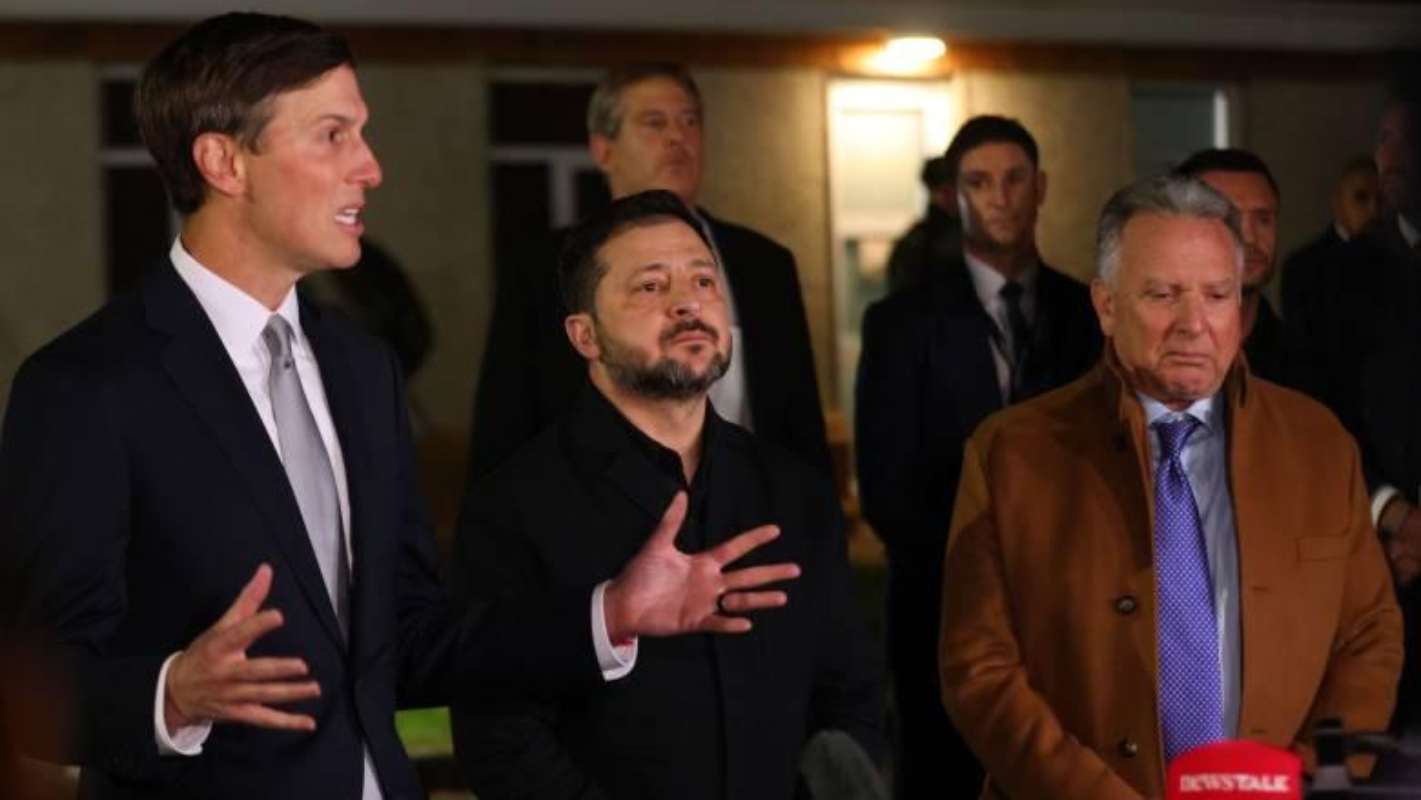
“Several new ideas emerged from the discussions and are now being explored.” With those words, Jared Kushner addressed the debate triggered by Volodymyr Zelenskyy’s disclosure that American negotiators had raised a possible Ukrainian withdrawal from Donbas in exchange for NATO membership.
Donald Trump’s envoy did not publicly confirm the specific scenario, but did not explicitly deny it either, choosing instead to discuss the broader diplomatic effort following the Abu Dhabi talks.
The distinction matters: an exploratory question raised during negotiations is different from a formal proposal backed by all the parties involved.
Kushner Points to Ideas and Compromises
Posting on X, Kushner said consultations were continuing and suggested that ideas discussed during the talks could develop into concrete proposals.
“Some may lead directly to breakthroughs, while others may evolve into new proposals that help bridge remaining gaps.”
He also referred to media reporting of “maximalist positions proposed by both sides, along with strong political rhetoric.”
According to Reuters, Kushner said both sides understood in private discussions that practical compromises would be necessary to end the war.
He did not identify those compromises, or clarify whether linking Donbas to NATO membership was an active negotiating framework.
What Zelenskyy Revealed
The Ukrainian president said American negotiators had asked for the first time whether NATO membership could be linked to a withdrawal from Donbas.
The question concerns territory that remains under Ukrainian control. It therefore goes beyond discussing the status of areas Russia has already occupied.
However, no agreement on Ukrainian NATO membership has been announced, and neither Kyiv nor Moscow has accepted such an exchange.
Russia’s opposition to Ukrainian membership remains a major obstacle to any scenario involving accession to the alliance.
Kyiv Wants a Ceasefire First
Zelenskyy opposes making an end to the war dependent on a comprehensive restructuring of European security.
“Real security in Europe means the EU and NATO. There is no other security for Europe,” he said.
Setting out Kyiv’s preferred sequence, he added:
“The order should be as follows: a ceasefire, an end to the war in Ukraine, and security guarantees for Ukraine.”
Ukraine wants to avoid a process in which the immediate task of stopping attacks becomes contingent on resolving every dispute between Russia and the West.
Security Guarantees, a Strong Army and Reconstruction
The Ukrainian president described discussions with partners as an effort to secure a “comprehensive package of security guarantees.”
That package would include support for a strong Ukrainian military, commitments involving NATO and the European Union, and arrangements for postwar reconstruction.
Zelenskyy said that, if Western governments confirmed their commitments, the overall framework would then have to be put before Ukrainian society.
Kushner, meanwhile, stressed that “a lasting peace requires credible security guarantees for Ukraine,” adding that “NATO will remain a critical pillar of European security.”


Disputes Over Energy and Kostiantynivka
Despite references to new ideas, substantial disagreements remain.
According to Zelenskyy, Moscow rejected Ukraine’s proposal for an energy ceasefire.
Kyiv, in turn, rejected Russia’s proposed humanitarian mission in Kostiantynivka, arguing that it could facilitate the advance of Russian troops. That assessment represents Ukraine’s interpretation of the Russian initiative.
Europe Seeks a Place at the Table
Meeting in Dublin, European leaders agreed that France, Germany, Britain, Poland and Italy, alongside representatives of EU institutions, would represent Europe in subsequent negotiations.
Their participation becomes particularly significant as the agenda expands beyond the Ukrainian battlefield.
The talks have not produced an agreement. They have brought territory, NATO membership and future security guarantees into the same discussion — while leaving major differences unresolved.
Source: pagenews.gr