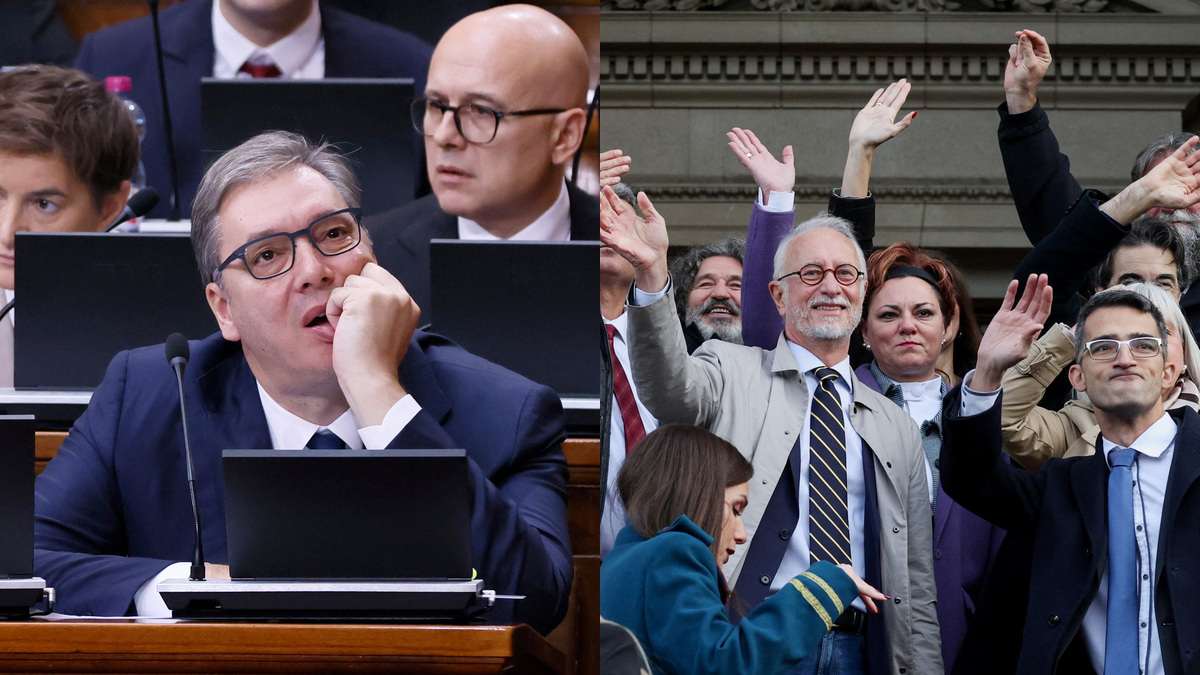
A political transformation that seemed almost unimaginable just months ago unfolded in Belgrade on Tuesday, November 17, as representatives of Serbia’s student-led movement entered the National Assembly—not as protesters, but as elected lawmakers.
The 140 MPs representing the Student List were sworn in during the inaugural parliamentary session following their extraordinary election victory in October.
Their arrival marks the end of 14 years of political dominance by Aleksandar Vučić and his Serbian Progressive Party (SNS), opening a new and uncertain chapter in Serbia’s political history.
Among the newly elected lawmakers are academics, lawyers, scientists, doctors and cultural figures. Most have never held political office.
They now face the challenge of turning a grassroots protest movement into a functioning parliamentary majority and, ultimately, a government.
Meanwhile, Vučić is showing little willingness to disappear from Serbia’s political landscape. The defeated populist leader has threatened to mobilise his own supporters in mass demonstrations, raising the prospect of renewed confrontation.
Celebrations Outside Parliament as Vučić’s Party Faces Hostility
Before the inaugural session began, supporters of the Student List gathered outside Serbia’s National Assembly in central Belgrade.
The atmosphere was festive.
Crowds applauded their newly elected representatives, while some celebrated by performing the traditional Serbian kolo circle dance.
The symbolism was unmistakable: a movement that had challenged the political establishment from the streets and universities was now entering the institution at the heart of Serbian democracy.
But the celebrations also revealed the country’s deep political divisions.
Lawmakers from Vučić’s SNS were greeted with jeers and whistles as they arrived.
In one incident, a woman in the crowd poured a bottle of drinking yoghurt over the head of SNS politician Lidija Vukićević.
The confrontation illustrated how much political anger remains beneath the surface despite the electoral transfer of power.
For the incoming majority, maintaining public order and preventing further polarisation will be among the first tests of its political leadership.


From Protest Movement to Parliament: Who Are Serbia’s 140 New Lawmakers?
The Student List did not emerge as a conventional political party.
It developed from a broader grassroots movement that challenged Serbia’s political establishment and demanded greater accountability, transparency and democratic reform.
Its candidates were selected largely from professional and academic backgrounds rather than traditional party structures.
The parliamentary group includes university professors, lawyers, medical professionals, scientists and people working in the arts.
Their election represents an unusual political experiment.
Individuals with little or no parliamentary experience must now navigate legislative procedures, oversee public institutions and prepare to assume responsibility for governing the country.
Supporters argue that their lack of political experience is precisely what makes them different from the previous establishment.
Critics question whether professional expertise can compensate for limited experience in government.
The answer will now emerge through their performance in parliament and, eventually, in office.
Sarah El Sarag: “None of Us Are Professional Politicians”
Sarah El Sarag, a human rights lawyer and newly elected Student List MP, described the extensive preparations undertaken by the movement’s parliamentary representatives.
“We have been having meetings and exercises for the parliament almost every day, because none of us are professional politicians. We are lawyers, doctors, professors – and it is the first time for us to do this kind of job,” she told the Guardian.
According to El Sarag, the new lawmakers have participated in simulated parliamentary sessions to familiarise themselves with legislative procedures.
“People who have had some experience of politics have been making some simulated exercises for us,” she explained.
The preparations are intended to address one of the central criticisms directed at the Student List: whether a group of political newcomers can effectively manage the responsibilities of government.
The movement insists that its representatives possess the professional competence and expertise needed to perform their duties.
But parliamentary politics will demand more than technical knowledge.
The new majority will need to negotiate, manage disagreements and make difficult decisions under intense public scrutiny.
“We Are There Because of Them”: Students Remain Central to the Movement
El Sarag emphasised that the broader student movement continues to participate in the process of selecting the future government.
“We are there because of them,” she said, referring to the students who built the movement.
“All the time, we are doing it together.”
Her remarks underline an important feature of the Student List’s political identity.
The newly elected MPs do not regard themselves as separate from the movement that brought them to power.
Instead, they are attempting to preserve a close relationship with the students and citizens who supported their campaign.
That connection could provide a powerful mechanism of democratic accountability.
It could also create challenges when government decisions require compromises that are unpopular with parts of the movement.
The Student List must now establish clear decision-making structures while preserving the participatory principles that helped it win the election.


Who Will Become Prime Minister? Serbia Awaits Its New Government
Despite the parliamentary swearing-in ceremony, the composition of Serbia’s next government remains uncertain.
The Student List has not publicly identified its candidate for prime minister or announced the individuals expected to lead the country’s major ministries.
El Sarag declined to reveal even the movement’s choice for parliamentary speaker.
The position is particularly significant because, according to the Guardian’s report, the new speaker is expected to assume the role of Serbia’s acting president.
The appointment will therefore be one of the first major decisions made by the new parliamentary majority.
It may also provide an indication of the movement’s broader political direction.
Until parliament approves the new cabinet, the outgoing administration will remain in office in a caretaker capacity.
Đuro Macut Remains Caretaker Prime Minister
The outgoing government led by Đuro Macut will continue to administer the country until a new cabinet receives parliamentary approval.
The arrangement is intended to ensure continuity during the transition.
However, the Student List must now move quickly to transform its electoral victory into a functioning government.
That requires agreement on a prime minister, a cabinet and a set of immediate political priorities.
The movement’s decentralised character adds another layer of complexity.
Unlike established political parties, it does not possess a traditional leadership hierarchy with long-standing mechanisms for resolving internal disagreements.
Its representatives must reconcile collective decision-making with the practical need for clear executive responsibility.
The coming weeks will reveal whether the movement can maintain unity as it prepares to exercise power.


Vučić Threatens Mass Protests After Historic Defeat
The election defeat has not removed Aleksandar Vučić from Serbia’s political confrontation.
The former dominant figure of Serbian politics has warned that his supporters could organise mass demonstrations.
His threats raise the possibility of renewed political tensions as the new parliamentary majority attempts to form a government.
Although the Student List defeated the SNS at the ballot box, Vučić’s party retains an organised political base.
The prospect of rival demonstrations creates additional pressure on Serbia’s institutions.
The crucial question is whether the competing political forces will accept the rules governing the transfer of power.
For the incoming government, securing a peaceful transition will be essential to establishing its authority.
The End of 14 Years of SNS Dominance
The Student List’s victory is historically significant because it ends a long period of rule by the Serbian Progressive Party.
Over more than a decade, the SNS consolidated its position within Serbia’s political system.
Vučić became the central figure of the country’s domestic and foreign policy, exercising considerable influence over its political direction.
His period of dominance was accompanied by repeated controversies over democratic accountability, media freedom and the independence of public institutions.
The election result demonstrates that a movement operating outside conventional party structures can become a major parliamentary force.
Yet defeating an established political organisation is different from governing the country it once controlled.
The Student List must now prove that its alternative approach can deliver effective public administration and meaningful institutional change.
Europe Watches Serbia’s Democratic Experiment
Serbia’s political transformation carries consequences beyond its borders.
Belgrade plays a central role in the stability of the Western Balkans.
Its relationships with the European Union, Russia and China are important elements of the region’s geopolitical balance.
The incoming government will eventually need to address Serbia’s European integration process, its regional relationships and its economic development.
However, the Student List has not yet presented a complete cabinet or detailed governing programme, making it premature to predict major foreign-policy changes.
European governments will be watching closely to see whether the movement can translate its electoral mandate into institutional reforms.
The arrival of academics, scientists and professionals in parliament may introduce new expertise into Serbian politics.
But effective government will depend on their ability to manage complex political, economic and diplomatic challenges.
From the Streets to Government: The Real Test Begins
The swearing-in of the Student List’s 140 MPs marks the institutional beginning of a remarkable political transition.
A movement that challenged Vučić’s political dominance has now become Serbia’s largest parliamentary force.
Its representatives must select a prime minister, establish a government and demonstrate that their professional expertise can translate into effective political leadership.
At the same time, Vučić’s threat of mass mobilisation suggests that the struggle over Serbia’s political future is far from over.
The Student List faces a delicate balancing act: preserving the democratic energy that brought it to power while developing the discipline and structures necessary to govern.
Serbia has entered a new political era, with 140 parliamentary newcomers preparing to take responsibility for the country and a defeated populist leader threatening to return to the streets. The Student List has achieved its first historic objective: ending the SNS’s 14-year hold on power. Its next challenge may prove even harder—turning a grassroots revolution into a stable, credible and effective government.
Source: pagenews.gr