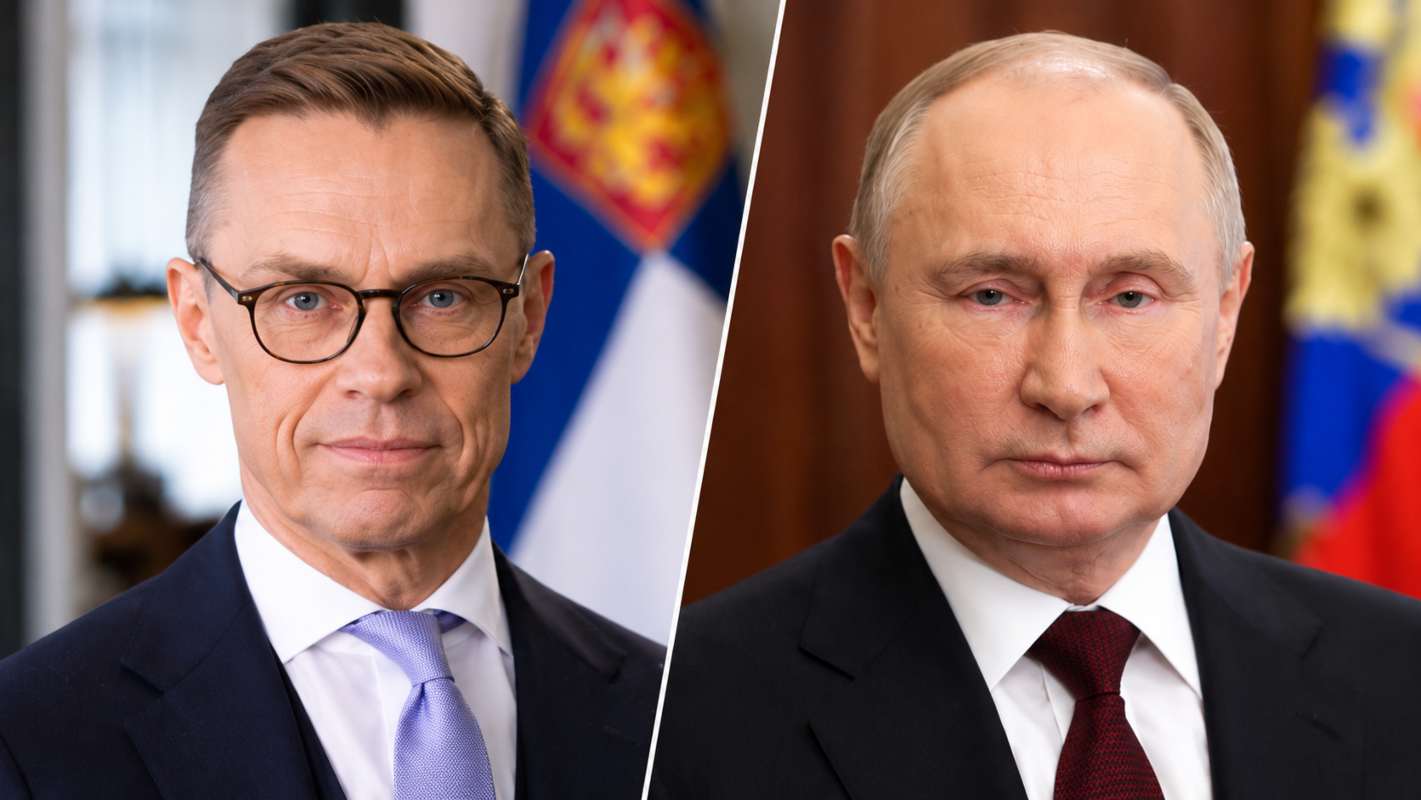
“We have outsourced European communication with Russia for far too long, and I think that is irresponsible.”
With that warning, Finnish President Alexander Stubb has reignited a fundamental debate over Europe’s diplomatic role: who should speak to Vladimir Putin, and who will ultimately determine the terms of any agreement to end Russia’s war in Ukraine?
In an interview with the Financial Times, published on November 17, 2026, Stubb called on European leaders to abandon their reliance on Washington as the principal channel of communication with Moscow and take greater responsibility for negotiations affecting their own security.
His intervention comes at a particularly sensitive moment, as US President Donald Trump’s administration seeks to establish a framework for talks with Russia while European governments express growing concern about potential agreements affecting Ukraine’s sovereignty, territorial integrity and long-term security.
Stubb does not question the importance of American involvement. On the contrary, he acknowledges that US negotiators have helped revive diplomatic efforts.
But his central argument is that Europe cannot remain a spectator when its own security order is being negotiated.
“Yalta or Helsinki”: The Historic Choice Facing Europe
One of the most striking elements of Stubb’s intervention is his comparison between two landmark moments in European diplomatic history.
The first is the Yalta Conference of 1945, when the Allied powers negotiated the postwar order and Eastern Europe subsequently fell under Soviet domination.
The second is the Helsinki Final Act of 1975, which established principles including respect for sovereignty, territorial integrity, human rights and the inviolability of borders.
For Stubb, the distinction is central to the future of European security.
A settlement based on the logic of Yalta would risk allowing major powers to determine the fate of smaller countries through negotiations over spheres of influence.
A settlement rooted in Helsinki would instead preserve the principle that sovereign nations have the right to determine their own political and security arrangements.
Asked whether the Trump administration was moving towards a Yalta-style approach, Stubb expressed hope that it was not, while making clear his concerns about the direction of American diplomacy.
His warning reflects a broader European anxiety: that a deal negotiated primarily between Washington and Moscow could produce arrangements affecting European security without sufficient European participation.
For Finland, which shares a long border with Russia and joined NATO in 2023, this is not an abstract historical debate.
It is a question of national security.


The Putin Phone Call That Divided European Leaders
Stubb’s position is not limited to public statements.
On October 27, the Finnish president and Norwegian Prime Minister Jonas Gahr Støre held a joint telephone conversation with Vladimir Putin lasting approximately 90 minutes.
The initiative was unusual because most European leaders had sharply restricted direct contacts with the Russian president following Moscow’s full-scale invasion of Ukraine.
The two Nordic leaders called for an end to the war and emphasized the importance of meaningful negotiations.
However, the initiative also exposed differences among European governments.
Some leaders questioned the wisdom of engaging directly with the Kremlin without first establishing a coordinated European position.
Polish Prime Minister Donald Tusk emphasized the need for caution and vigilance in contacts with Moscow.
The Kremlin, meanwhile, gave little indication that its fundamental negotiating position had changed.
Russia continued to insist that any peace settlement would have to take its interests fully into account.
Despite these concerns, Stubb defended direct communication as an essential diplomatic instrument.
His argument is that refusing to speak to Putin does not eliminate Russia’s role in determining whether a ceasefire or peace agreement can be reached.
“Russia Has Not Won This War — And It Will Not Win”
Stubb has also sought to draw a clear distinction between diplomatic engagement and acceptance of Russian demands.
He argues that Europe’s willingness to negotiate should not be interpreted as recognition of Moscow’s territorial claims or an admission of Ukrainian defeat.
“We have to understand that Russia has not won this war. And, to be honest, it is not going to win it either,” he said.
The statement is significant because it comes from a leader advocating renewed direct dialogue with the Russian president.
Stubb’s position combines continued support for Ukraine with the argument that Europe must participate actively in shaping the diplomatic process.
He maintains that negotiations should be conducted from a position of European unity rather than resignation.
The challenge is to establish a common position among governments that differ in their assessments of Russia, their exposure to security threats and their preferred diplomatic strategies.


Berlin Talks: Europe Moves to Build Its Own Negotiating Team
According to the Financial Times, European leaders agreed last week to establish a group representing European interests in negotiations concerning Ukraine.
The proposed format would include representatives from France, Germany, Italy, Poland and the United Kingdom, alongside the European Union and NATO.
Further discussions are taking place in Berlin as European governments seek to establish a common negotiating position.
Stubb is calling for a concrete timetable and a clearly defined agenda.
The issues under consideration include security guarantees for Ukraine, territorial questions, economic reconstruction, confidence-building measures, ceasefire arrangements and the future architecture of European security.
These are not merely technical matters.
They will determine whether Ukraine can rebuild its economy, protect its sovereignty and establish credible safeguards against renewed aggression.
Stubb also recognizes the limits of negotiations conducted exclusively by national security advisers.
While such discussions can establish the foundations of a settlement, the final political decisions will ultimately require engagement at the highest level.
And any agreement intended to end the fighting will have to address Russia’s position.
Donbas for NATO: The American Proposal Raising Difficult Questions
One of the most sensitive issues concerns the possibility of territorial concessions by Ukraine.
According to the Financial Times report, an American proposal has been floated linking Ukrainian concessions over Donbas to the country’s potential accession to NATO.
The idea has not become an agreed settlement, and significant political and security questions remain unresolved.
Stubb declined to endorse the specific proposal.
He emphasized that decisions concerning Ukrainian territory belong to President Volodymyr Zelenskyy and the Ukrainian people.
At the same time, he reiterated his support for Ukraine eventually joining NATO, without suggesting that membership was guaranteed or imminent.
The proposal highlights the difficult choices facing negotiators.
Russia continues to pursue territorial objectives, Ukraine insists on its sovereignty, and Western governments must determine what security commitments they are prepared to provide.
NATO membership would involve obligations extending well beyond a conventional diplomatic agreement.
It would also require political consensus among alliance members.
The central challenge is therefore not simply to identify a formula capable of ending the immediate fighting, but to establish a settlement that can endure.
Trump and Europe: Who Will Write the Terms of Peace?
Stubb’s intervention exposes a deeper disagreement over Europe’s place in the international security system.
The Trump administration has assumed a central role in efforts to revive negotiations between Moscow and Kyiv.
However, European governments are concerned that American priorities may not always align with those of Ukraine or its European partners.
Washington may prioritize securing a negotiated settlement, while European governments must also consider the long-term implications of any agreement for the continent’s security.
For countries bordering Russia, those implications are particularly immediate.
Finland’s argument is that European leaders should establish a common diplomatic position and communicate it directly to Moscow.
Other governments emphasize the importance of strict coordination, warning that separate contacts with the Kremlin could produce conflicting messages or weaken negotiating unity.
The disagreement is therefore not simply about whether Europe should talk to Putin.
It concerns who should speak on Europe’s behalf, under what mandate and with which negotiating priorities.
Finland’s Strategic Calculation: Dialogue Without Concessions
Finland occupies a distinctive position in the European debate.
Its history of relations with Russia, geographical proximity to the country and relatively recent accession to NATO have shaped its approach to security.
For decades, Helsinki maintained a policy of military non-alignment while developing extensive expertise in managing relations with Moscow.
Russia’s invasion of Ukraine fundamentally changed that calculation.
Finland joined NATO in April 2023, strengthening its security ties with Western allies.
Yet Stubb’s latest intervention suggests that NATO membership and support for Ukraine do not necessarily exclude direct diplomatic engagement with Russia.
His proposal does not amount to an endorsement of Russian territorial demands or a call for the immediate relaxation of sanctions.
Instead, it reflects an effort to combine deterrence, military support for Ukraine and a more active European diplomatic role.
The underlying argument is that Europe should not allow the future of its security arrangements to be determined entirely by negotiations conducted elsewhere.
A New European Security Order Is Taking Shape
The debate comes as European governments increase defence spending, strengthen military capabilities and confront uncertainty over the future direction of American foreign policy.
Russia’s war against Ukraine has already transformed the European security environment.
Finland and Sweden have joined NATO, European countries are expanding defence investment, and governments are reassessing assumptions about deterrence, energy security and strategic dependence.
Any eventual agreement concerning Ukraine will have consequences extending far beyond the country’s borders.
It could influence NATO’s future posture, the relationship between Russia and the West, European defence planning and the international principles governing territorial sovereignty.
That is why Stubb’s intervention carries significance beyond Finland.
It challenges European leaders to define whether they intend to act primarily as supporters of an American-led diplomatic initiative or as direct participants in negotiations over the continent’s future.
The distinction matters because the security arrangements emerging from the war could shape European politics for decades.
The question now confronting Brussels, Berlin, Paris and London is whether Europe will help negotiate the peace — or find itself managing the consequences of an agreement largely shaped by Washington and Moscow.
Source: pagenews.gr