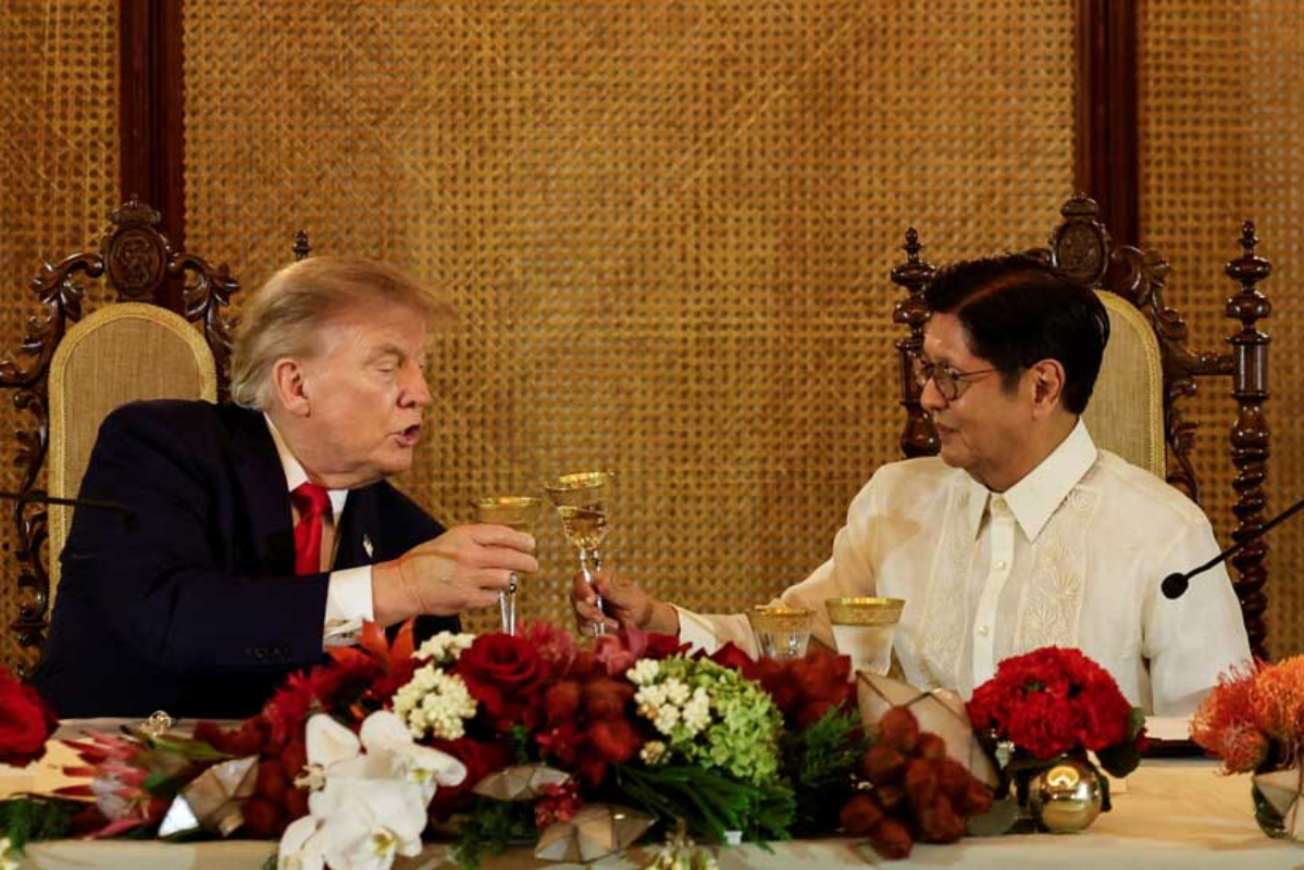
On November 18, Donald Trump reviewed an honor guard at Malacañang Palace in Manila. A day later, he was in Shenzhen, meeting Chinese President Xi Jinping and Russian President Vladimir Putin.
The two encounters reveal the competing priorities shaping Washington’s strategy in Asia.
In the Philippines, Trump offered more than $2.4 billion in proposed military financing and assistance, reinforcing an alliance that has endured since the 1951 Mutual Defense Treaty.
In China, he engaged directly with the leaders of the two powers challenging American influence across the region.
Yet behind the diplomatic choreography lies another calculation: American domestic politics.
Following Republican losses in the midterm elections, Trump has powerful incentives to present foreign policy agreements as victories for American workers, manufacturers and voters.
And among the constituencies attracting attention are approximately 4.6 million Filipino Americans, whose electoral influence could become increasingly important in the 2028 presidential election.
The result is a strategy operating on two fronts: strengthening the Philippines against China while building political advantages at home.
The $2.4 Billion Deal: American Weapons, Philippine Debt
Trump described the agreements reached in Manila as a major breakthrough in bilateral relations.
According to the White House figures cited in the underlying analysis, his regional visit generated more than $17 billion in announced commercial agreements involving aviation, defense, energy and technology.
The military component, however, offers the clearest indication of Washington’s priorities.
The proposed package includes more than $2 billion in foreign military financing loans for the purchase of American defense equipment.
An additional $400 million is intended to improve Philippine capabilities in the South China Sea, including long-range weapons, drones, command-and-control systems and military infrastructure.
The arrangement illustrates a central feature of Trump’s foreign policy: allies are encouraged to spend more on their own defense, preferably by purchasing American equipment.
The Philippines gains access to advanced military systems.
American manufacturers gain potential orders.
And Washington strengthens its strategic position without necessarily bearing the full cost.
There is an important distinction, however.
Much of the financing consists of loans rather than grants, meaning Manila would ultimately be responsible for repayment.
The package also requires congressional approval, and some of the proposed funding may overlap with previously authorized assistance.
Its implementation is therefore not guaranteed.


Fighter Jets, Boeing and the Politics of American Jobs
The White House has also highlighted more than $5 billion in previously approved potential arms sales to the Philippines.
A substantial portion relates to the possible sale of 20 fighter aircraft, approved in 2025.
But authorization does not necessarily translate into a completed purchase.
The same distinction matters in the commercial announcements.
A Philippine Airlines order for Boeing aircraft was presented as a $12 billion agreement supporting approximately 47,000 American jobs.
According to the source analysis, however, the arrangement formalized a deal initially signed in July, while its actual commercial value after discounts could be substantially lower.
These differences matter politically.
Trump needs agreements that can be presented to American voters as evidence that his administration is bringing investment and employment back to the United States.
Following the midterm setback, international diplomacy offers an opportunity to demonstrate executive leadership even as Congress becomes more difficult to manage.
The Philippines therefore serves two purposes: a strategic partner in Asia and a customer for American industry.
Why Subic Bay and Batanes Matter to the Pentagon
The most consequential elements of the agreement may not be the fighter jets or the headline figures.
They are the infrastructure projects.
A $40 million fuel storage facility at Subic Bay would support American military and commercial operations.
Meanwhile, the planned modernization of Basco Airport in the Batanes islands would improve access to a strategically sensitive area less than 200 kilometers from Taiwan.
The geography is critical.
The Philippines occupies the southern portion of the First Island Chain, a network of territories central to American military planning in the western Pacific.
In a potential confrontation over Taiwan, Philippine airfields, ports and logistics facilities could become essential to US operations.
President Ferdinand Marcos Jr. has already warned that a conflict involving Taiwan could draw the Philippines into the crisis.
Washington’s investment in runways, fuel facilities and military infrastructure reflects preparation for precisely that possibility.
For Beijing, these developments represent a further expansion of American military access close to China’s maritime approaches.
The South China Sea: A Dangerous Test of American Credibility
The Philippines is increasingly exposed to confrontations with Chinese vessels in disputed waters.
Manila has accused the Chinese coast guard of aggressive actions against Philippine personnel and supply missions.
The underlying analysis describes incidents involving alleged assaults on Filipino sailors, collisions with resupply vessels and interference with operations near Second Thomas Shoal.
China has also strengthened its claims around Scarborough Shoal, including through environmental measures that Manila views as assertions of sovereignty.
These confrontations carry risks beyond the immediate maritime disputes.
The United States and the Philippines are bound by a mutual defense treaty that could become relevant in the event of an armed attack against Philippine forces or public vessels.
The strategic objective is therefore delicate.
Washington wants to make Chinese coercion more expensive without creating conditions for a direct US-China military confrontation.
Every additional weapons system and logistics facility may strengthen deterrence.
But it can also increase the danger of miscalculation.
China’s Economic Power Complicates Washington’s Strategy
Military strength is only one part of the competition.
China remains deeply embedded in Southeast Asia’s economy.
According to figures cited in the source analysis, trade between China and ASEAN reached approximately $694 billion during the first eight months of 2025.
That commercial relationship gives Beijing influence that American military assistance cannot easily offset.
Regional governments face a difficult choice.
They may rely on Washington for security while depending heavily on China for trade, investment and manufacturing supply chains.
The dilemma is especially acute in countries seeking to avoid taking sides between the two superpowers.
Washington’s challenge is to offer economic benefits substantial enough to complement its military commitments.
This explains why the Manila discussions extended beyond defense to energy, aviation, technology and infrastructure.
Artificial Intelligence and Critical Minerals: The Other Front Against China
The United States is also seeking to reshape technology supply chains.
The source analysis identifies Pax Silica, a Washington-led initiative launched in December 2025, as part of the effort to secure semiconductors, artificial intelligence infrastructure and critical minerals outside Chinese-controlled networks.
The Philippines has particular importance in this competition.
It possesses significant nickel reserves and participates in semiconductor assembly and related manufacturing.
Nickel is a strategic material for batteries and industrial applications, while semiconductor production is essential to advanced computing and artificial intelligence.
Yet much of the Philippines’ nickel output continues to flow toward China.
Washington hopes that closer cooperation can gradually redirect investment and industrial capacity toward supply chains involving American partners.
The Philippines is therefore valuable not simply because of its location near Taiwan.
It is also a potential industrial partner in the technological competition between Washington and Beijing.


Russia Enters the Equation Through Energy
Russia’s influence in Southeast Asia is smaller than China’s, but it remains relevant.
Moscow has pursued regional relationships through energy exports, defense cooperation and diplomacy.
Disruptions to oil supplies from the Persian Gulf have increased the appeal of alternative suppliers, including Russia.
The source analysis describes growing interest in Russian crude and energy technology among several Southeast Asian governments.
For Washington, this creates an additional challenge.
The United States is not merely competing against China’s military and economic influence.
It is also attempting to limit the opportunities available to Moscow as an energy supplier and strategic partner.
During the Manila discussions, Trump promoted potential American involvement in Philippine civilian nuclear energy and raised the possibility of participation in an Alaska natural gas export project.
These proposals would provide alternatives to Russian energy arrangements while expanding opportunities for American companies.
The geopolitical competition is therefore increasingly connected to commercial decisions about fuel, electricity and industrial development.
The Deportation Question: Why Filipino Migrants Matter
The most politically sensitive dimension of Trump’s Philippine strategy concerns immigration.
According to estimates attributed to Manila in the underlying analysis, between 250,000 and 300,000 Filipinos living in the United States could potentially face deportation.
Yet the Philippines has avoided several restrictive measures applied to other countries under the Trump administration.
The analysis notes that Manila was excluded from certain travel restrictions and visa-related measures affecting other Asian states.
This differential treatment raises a political question.
Could the strategic importance of the Philippines encourage Washington to adopt a more accommodating approach toward Filipino migrants?
There is no established agreement linking military cooperation to immigration relief.
Nor is there evidence that the administration has formally promised special deportation protections in exchange for Philippine defense commitments.
Nevertheless, the possibility creates a political opportunity.
If the White House were to offer greater flexibility toward Filipino migrants, it could strengthen goodwill within a community that has growing electoral significance.
That would turn foreign policy into a potential domestic political advantage.
The Las Vegas Connection: 109,000 Eligible Filipino-American Voters
The Filipino-American community is among the largest Asian-origin populations in the United States.
The source analysis estimates that approximately 4.6 million Americans identify as Filipino, with around 2.5 million eligible to vote.
Their electoral importance is particularly visible in Nevada.
Filipino Americans account for a substantial share of the state’s Asian-American population, with more than 109,000 eligible voters, many concentrated around Las Vegas.
Nevada is a closely contested presidential battleground.
Trump won the state in 2024 by approximately three percentage points.
In such a competitive environment, even a relatively modest shift among Filipino-American voters could become politically consequential.
Surveys cited in the analysis suggest that Trump attracted roughly one-third of Filipino-American support ahead of the 2024 election.
That did not amount to a majority.
But it demonstrated that the community was electorally competitive rather than firmly aligned with one party.
The potential political appeal is straightforward: stronger American protection for the Philippines, economic benefits for US workers and a more favorable environment for Filipino families affected by immigration enforcement.
Whether those factors would translate into Republican votes remains uncertain.
Still, the calculation helps explain why an alliance thousands of miles from Washington could matter in the electoral politics of Nevada.
Two Elections in 2028: Manila and Washington
The strategic timetable is complicated by elections in both countries.
In the Philippines, President Ferdinand Marcos Jr. cannot seek another presidential term in 2028.
His successor could significantly alter the country’s relationship with Washington.
Sara Duterte, daughter of former President Rodrigo Duterte, has emerged as a prominent political contender.
The source analysis states that she announced her candidacy in February and led a September Pulse Asia survey with 50% support.
Her political future, however, remains affected by impeachment proceedings that could potentially prevent her from holding office.
Washington has reason to follow these developments closely.
Rodrigo Duterte previously pursued a dramatic rapprochement with China, challenging the traditional orientation of Philippine foreign policy.
A future administration more sympathetic to Beijing could complicate American military planning.
Long-term financing, infrastructure projects and defense arrangements extending beyond the current presidency may therefore help preserve the alliance regardless of who wins in Manila.
But they could also create political resentment if perceived as excessive American influence.
That tension could become a powerful issue in the Philippine election campaign.
Trump, Xi and Putin: The Strategic Contradiction
Trump’s Manila visit was followed by his meeting with Xi Jinping and Vladimir Putin in Shenzhen.
According to the source analysis, the leaders discussed international security, energy supplies, United Nations reform and nuclear risks.
Their subsequent declaration did not include concrete commitments concerning Ukraine or Iran.
It also avoided direct references to Taiwan and the maritime disputes involving China and Southeast Asian countries.
For Manila, that omission matters.
The Philippines depends on American security guarantees, but it also fears that Washington could eventually negotiate a broader understanding with Beijing that gives insufficient weight to Philippine interests.
Trump’s approach appears designed to preserve maximum negotiating flexibility.
He strengthens alliances while maintaining direct channels with rival powers.
He sells military equipment to countries confronting China while simultaneously pursuing diplomatic agreements with Beijing.
For smaller allies, however, that flexibility can look like uncertainty.
The central question is whether Washington’s commitments will remain reliable when American and Chinese interests collide.
A Strategic Alliance Built on Credit—and Political Calculation
The Manila package reflects several overlapping pressures.
Trump faces a more challenging political environment at home.
Marcos approaches the end of his presidency.
China continues to assert its maritime claims.
Russia seeks new energy markets.
And Washington wants to secure critical infrastructure and supply chains before the regional balance shifts further.
The Philippines sits at the intersection of all these developments.
For the United States, the proposed agreements could strengthen military deterrence, support American manufacturers and reinforce access to strategically important territory near Taiwan.
For Manila, they offer additional defense capabilities and deeper economic ties.
Yet the arrangement carries substantial risks.
Military loans can increase financial dependence.
Expanded US access may intensify tensions with China.
And political goodwill based on immigration exceptions can disappear when administrations change.
The historical irony is striking.
In 1991, the Philippine Senate voted against extending the American military presence at Subic Bay.
Approximately 35 years later, the United States is pursuing new infrastructure and logistics arrangements in the same strategic environment.
But the political foundations of the alliance may increasingly depend on voters far beyond the Philippines.
Trump’s Philippine gamble is ultimately about two electoral maps: the political future of Manila and the American battleground states of 2028.
The weapons may be delivered to Luzon, the fuel stored at Subic Bay and the military plans drawn up around Taiwan.
But some of the votes that determine the political future of this alliance may be cast in Las Vegas.
Source: pagenews.gr