


Gaza: Miami Becomes the New Diplomatic Front as the Second Phase of the Ceasefire Hangs by a Thread
 ΧΡΟΝΟΣ ΑΝΑΓΝΩΣΗΣ 5 '
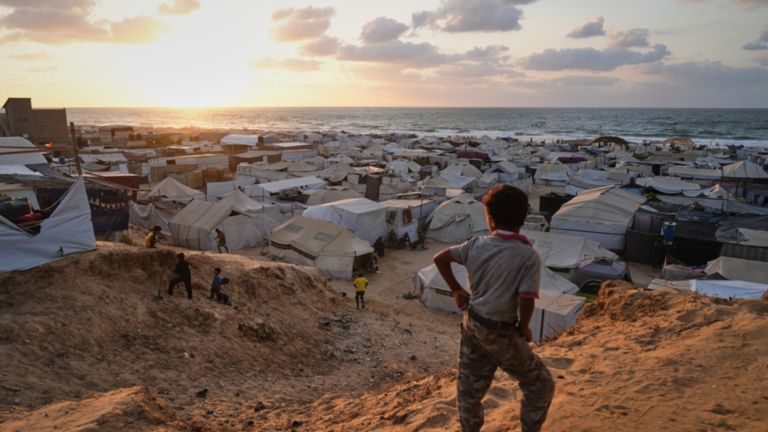
Πηγή Φωτογραφίας: AP Photo//Gaza: Miami Becomes the New Diplomatic Front as the Second Phase of the Ceasefire Hangs by a Thread



The ceasefire in Gaza is holding—but not because it is stable. It is holding because everyone fears what comes next. Fear of regional escalation, fear of diplomatic isolation, fear of losing what little leverage remains. That is why the center of gravity has quietly shifted away from the Middle East and landed in Miami, where the highest-level gathering of ceasefire mediators on U.S. soil since October is now underway.
This is not a routine diplomatic meeting. It is an intervention.
U.S. envoy Steve Witkoff is meeting with Qatar’s Prime Minister and Foreign Minister Mohammed bin Abdulrahman Al Thani, Turkey’s Foreign Minister Hakan Fidan, and Egypt’s Foreign Minister Badr Abdelatty in what American officials describe as a last attempt to “unlock” the second phase of the ceasefire. That phase is where diplomacy stops being procedural and becomes political—and dangerous.
Because phase two is not about stopping the fighting.
It is about deciding who controls Gaza when the fighting stops.
A Ceasefire Built on Delay, Not Agreement
The current truce survives on ambiguity. Israel and Hamas have both complied just enough to avoid collapse, while quietly avoiding the core questions they know will explode the deal.
Washington is increasingly convinced that both sides are dragging their feet—for different reasons, but with the same outcome. Israel fears that moving forward without ironclad guarantees will lock in Hamas’ survival. Hamas fears that moving forward at all could mean political erasure.
The status quo is weak—but it is comfortable.
That is why the Miami meeting is less about dialogue and more about coordinated pressure: how to force movement without triggering collapse.
The Strike That Changed the Tone
The real temperature of the crisis emerged last week, behind closed doors.
According to multiple reports, the White House sent a stern private message to Prime Minister Benjamin Netanyahu after an Israeli strike killed senior Hamas figure Raed Saad. U.S. officials reportedly viewed the attack not as a tactical necessity but as a political signal—one that risked redefining the ceasefire as optional.
The strike, carried out against a vehicle on Gaza City’s coastal al-Rashid road, was immediately framed by Hamas as a violation of the truce. Israel, in turn, defended it as legitimate self-defense.
But for Washington, the concern was strategic: how close is the ceasefire to sliding back into war?
The Core Contradiction of Phase Two
At the heart of the Miami talks lies an irreconcilable clash.
Israel insists that the second phase must include the disarmament of Hamas and its exclusion from any future governance role in Gaza. Hamas has rejected this outright. Senior leader Khalil al-Hayya has been unequivocal: there will be no surrender of weapons.
Even proposals for an international stabilization force reveal the depth of the divide. Hamas has floated conditional acceptance only if such a force remains outside Gaza’s internal security structure, effectively limiting it to border monitoring. Israel sees that as cosmetic.
What is presented publicly as a “solution” risks becoming the next battlefield.
Miami Is Not Neutral Ground
Turkey’s confirmation that Hakan Fidan will also discuss “other regional issues” on the sidelines is telling. Miami is not just about Gaza—it is about regional power alignment, U.S. leverage, and who shapes the post-war order.
In the background looms Donald Trump. Reports suggest pressure from Trump’s circle to accelerate decisions, with speculation about a possible late-December meeting with Netanyahu in Florida. If confirmed, such a meeting would not be symbolic—it would be disciplinary.
Either it would enforce a line, or it would open a new round of bargaining that could freeze everything again.
The Real Test
Miami is not about peace.It is about whether a ceasefire can be transformed into a process with timelines, enforcement, and political cost.
It is also a test of American power:
- Can Washington restrain Israel without breaking the alliance?
- Can it pressure Hamas without legitimizing it?
- Can it do both while Gaza’s humanitarian crisis continues to accelerate?
If this phase fails, Gaza will not simply return to war. It will return to war without illusions, without diplomatic buffers, and without a credible path back to negotiation.
And that is why what happens in Miami matters far beyond Florida.
Source: pagenews.gr
Διαβάστε όλες τις τελευταίες Ειδήσεις από την Ελλάδα και τον Κόσμο








Το σχόλιο σας