
While political debates in Greece continue to oscillate between claims of recovery and concerns over everyday hardship, new OECD data adds a more nuanced — and politically sensitive — layer to the economic picture.
Because beyond GDP figures, economists are increasingly focusing on a more direct indicator: real household disposable income per capita, which captures what citizens actually have left to spend or save after inflation, taxes, and essential costs.
And here, Greece delivers a surprise.
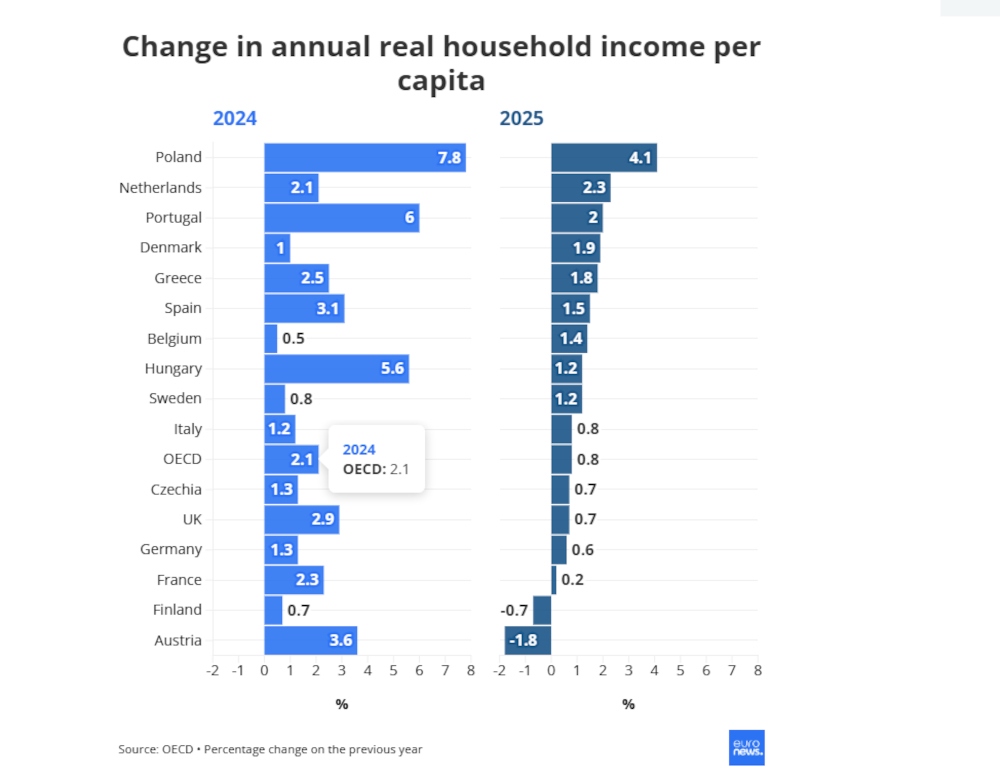
According to OECD data for 2025, Greece ranks 5th in Europe, recording a 1.8% increase in real household disposable income.
Only four countries performed better:
- Poland (+4.1%)
- Netherlands (+2.3%)
- Portugal (+2.0%)
- Denmark (+1.9%)
Greece, meanwhile, outperformed major economies including Germany, Italy, France, and the United Kingdom.

A politically sensitive signal
The figures have already begun to ripple through political circles in Athens.
Government officials interpret the data as evidence that economic growth is gradually translating into household gains.
One senior government source framed it bluntly:“This shows that recovery is no longer just statistical — it is reaching households.”
Opposition parties, however, remain cautious, arguing that the improvement starts from a low base and is being eroded by persistent inflation pressures, especially in:
- food prices
- housing costs
- energy bills
A leading opposition figure countered:“People do not live in GDP graphs. They live in supermarket receipts and rent payments.”
Why GDP no longer tells the full story
Traditionally, GDP has been the dominant measure of economic performance. But international institutions increasingly highlight its limitations in capturing lived experience.
That is why the OECD now closely tracks:
- real disposable income
- net wages after tax
- purchasing power
- household savings capacity
In Greece’s case, the improvement is linked to several structural factors:
- declining unemployment (at its lowest level since 2009)
- wage growth in selected sectors
- stronger employment absorption
- higher income from capital and assets
Still, economists warn the picture is uneven.
Inflation pressures in food, housing, and services continue to offset part of the gains for many households.

Poland leads a new European trend
At the top of the rankings, Poland stands out with a remarkable 4.1% increase, confirming its position as one of Europe’s fastest-rising income economies.
OECD analysts attribute this to:“strong wage growth offsetting reduced social transfers, boosting real household income growth.”
The broader implication is clear: economic momentum in Europe is gradually shifting eastward.
Winners and laggards in Europe
Alongside Greece’s strong showing, several countries recorded moderate gains:
- Spain: +1.5%
- Belgium: +1.4%
- Hungary: +1.2%
- Sweden: +1.2%
At the lower end, large economies lag behind:
- Germany: +0.6%
- UK: +0.7%
- Italy: +0.8%
- France: +0.2%
Meanwhile, Finland (-0.7%) and Austria (-1.8%) were the only countries registering declines.
A fragile recovery beneath the surface
Despite the positive headline figures, OECD analysts emphasize that Europe’s household income growth is slowing overall, dropping to 0.8% in 2025 from 2.1% in 2024.
This deceleration reflects:
- higher inflation volatility
- tighter fiscal policies
- weaker productivity growth in parts of the eurozone
In Greece, the tension between statistical improvement and lived experience remains central.
Because while incomes are rising on paper, household pressure remains visible in:
- rent inflation in urban areas
- persistent food price increases
- energy cost fluctuations
- depleted savings buffers for many families
The political question behind the numbers
The core debate now is not whether incomes are rising — but whether that rise is sufficient to change social sentiment.
As one economist summarized:“Growth exists, but confidence has not fully caught up.”
That gap — between macroeconomic performance and everyday experience — is becoming the defining political challenge across Europe, and particularly in Greece.
Because ultimately, the real test is not GDP growth, but whether citizens feel it in their daily lives.
And on that front, the verdict is still unfolding.
Source: pagenews.gr