Greece is preparing to take a historic step into the global space community by launching its first astronaut mission to the International Space Station (ISS), a flagship initiative that forms part of the country’s ambitious National Space Strategy 2035.
The announcement signals Greece’s intention to move beyond participation in European space programs and establish itself as an active contributor to scientific research, technological innovation and the rapidly expanding space economy.
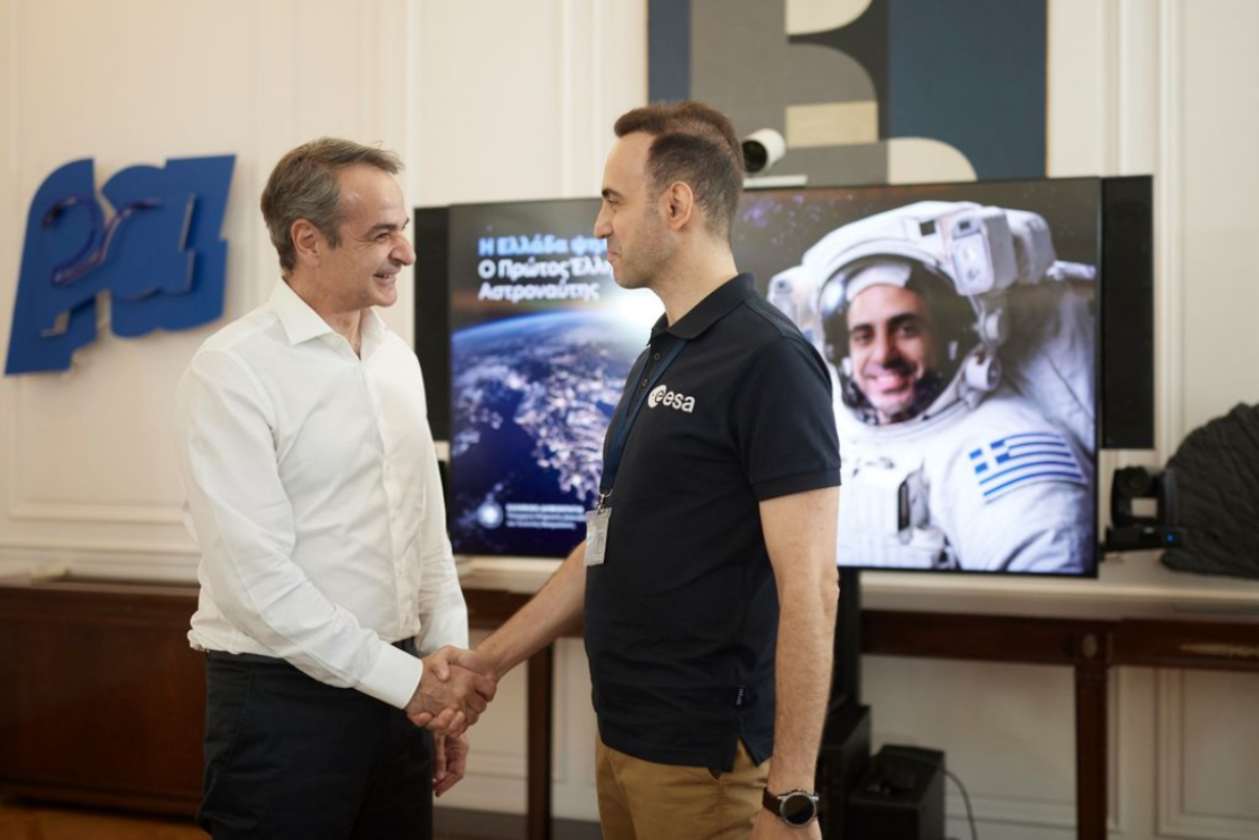
The initiative was presented during the “Greece in Orbit – Greece in Space: The Next Day” event, organized by the Ministry of Digital Governance and Artificial Intelligence, where Prime Minister Kyriakos Mitsotakis held a public discussion with astronaut trainee and space medicine physician Adrianos Golemis about the country’s first human spaceflight mission.
Launch Planned Within Two Years
According to the government’s timetable, the mission is expected to take place within the next two years, with the Greek astronaut spending up to three weeks aboard the International Space Station.
Far beyond its symbolic significance, the mission will include a broad scientific agenda. The astronaut will conduct research experiments and technology demonstrations proposed by Greek universities, research institutes, scientific organizations and technology companies.
The mission is expected to generate valuable scientific data while providing Greek researchers with access to one of the world’s most advanced laboratories operating in microgravity.


Mission Discussed at the Prime Minister’s Office
Preparations for the historic mission were also reviewed during a high-level meeting chaired by Prime Minister Mitsotakis at the Maximos Mansion, attended by Digital Governance and Artificial Intelligence Minister Dimitris Papastergiou, Secretary General for Telecommunications and Posts Konstantinos Karantzalos, and astronaut trainee Adrianos Golemis.
The participants examined the scientific, technological and economic opportunities that Greece’s first astronaut mission could create, including stronger cooperation with the European Space Agency (ESA) and international research partners.
Boosting Greek Science and Innovation
Government officials emphasized that the mission is designed to deliver tangible benefits for Greece’s scientific community and technology sector.
Greek companies will have the opportunity to test innovative technologies in the unique conditions of space, while universities and research institutions will gain access to data that could support advances in fields including biomedical sciences, advanced materials, telecommunications and space technologies.
The initiative is also expected to enhance Greece’s international profile in one of the world’s fastest-growing high-tech industries.


Inspiring the Next Generation
A central pillar of the National Space Strategy is encouraging young people to pursue careers in science, technology, engineering and mathematics (STEM).
Among the educational initiatives under consideration are:
- a nationwide student competition to design and build a satellite;
- national STEM competitions;
- educational outreach programs for schools; and
- opportunities for students to submit questions directly to astronauts serving aboard the International Space Station.
The government believes that direct engagement with a Greek astronaut will help inspire students to explore careers in science and innovation.


A Strategic Investment in Greece’s Space Future
The planned ISS mission represents one of the flagship projects of Greece’s National Space Strategy and reflects the government’s broader ambition to position the country within the emerging global space economy.
Beyond its symbolic value, the initiative seeks to build a long-term ecosystem connecting universities, research centers, startups and industry with major European and international space programs.
If completed according to schedule, the mission will mark the first time a Greek astronaut serves aboard the International Space Station, opening a new chapter for Greece’s scientific community and significantly expanding the country’s presence in international space exploration.
Source: pagenews.gr