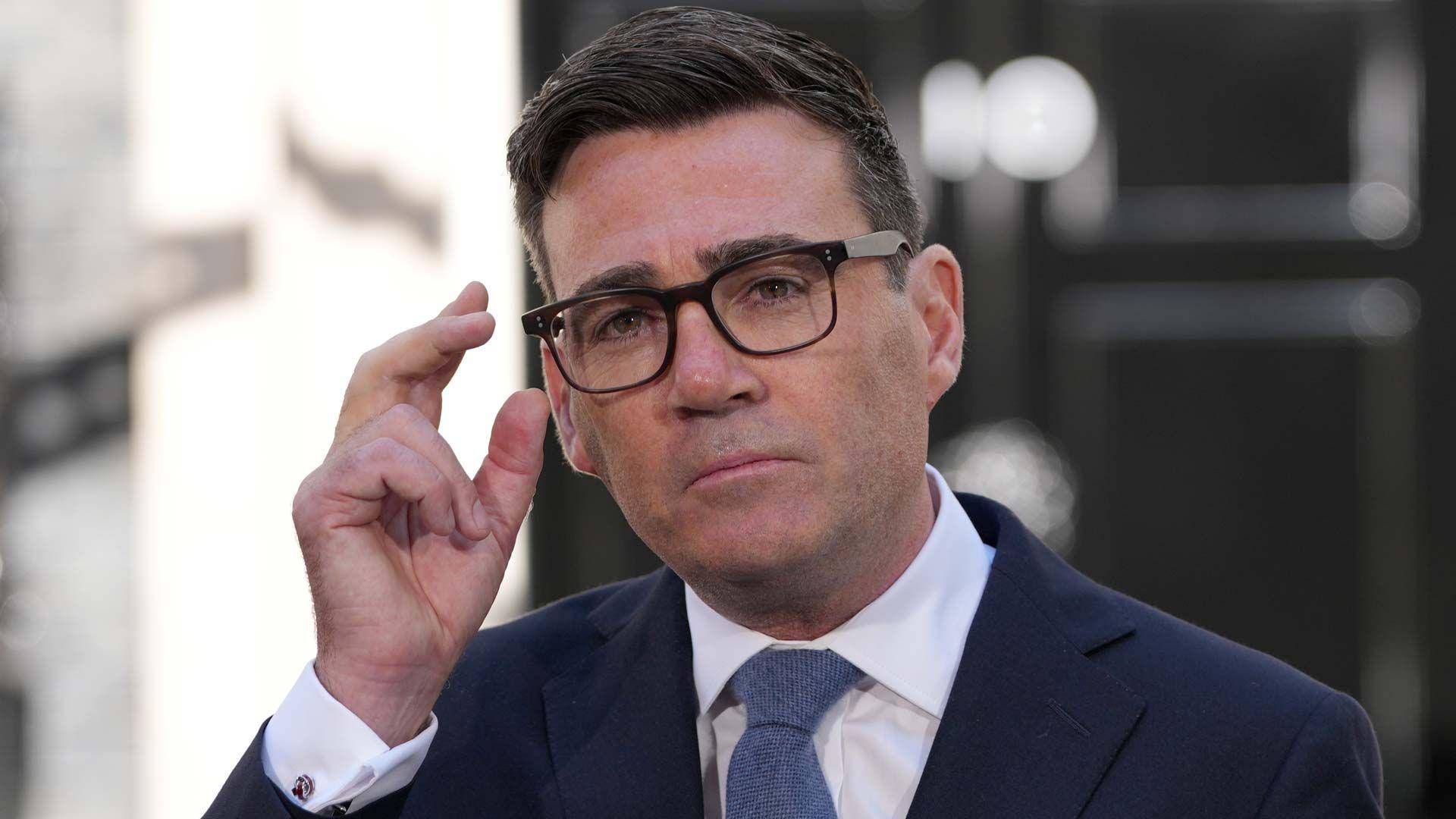
Andy Burnham Takes Office as UK Prime Minister, Promising a “New Beginning” for Britain
A New Chapter Begins at Downing Street
Andy Burnham officially became the 59th Prime Minister of the United Kingdom on Monday after being invited by King Charles III to form a new government at Buckingham Palace, bringing an end to Keir Starmer’s premiership and opening a new chapter for the governing Labour Party.
Burnham’s appointment marks another remarkable leadership transition in British politics, making him the country’s sixth prime minister in a decade—a reflection of the prolonged political volatility that has defined the post-Brexit era.
Following the traditional audience with the King, Burnham arrived at 10 Downing Street, where he delivered his first address as prime minister before beginning the process of appointing his Cabinet.


“People Have Had Enough of Politics”
In a speech that sought to combine humility with ambition, Burnham acknowledged the growing frustration many Britons feel toward politics and public institutions.
“I want to be honest with you. We have not lived up to the moment, and we must do better. And we will.”
Recognizing the erosion of public confidence, the new prime minister argued that politicians must raise their standards if they hope to rebuild trust.
“People have had enough of politics,” Burnham said, calling on the political class to adapt to a new era in which governments will be judged not by rhetoric but by tangible results.
The remarks represented an implicit acknowledgment of the political turbulence that ultimately led to Starmer’s resignation after two years in office.


A Ten-Year Vision for Britain
Seeking to define his premiership from the outset, Burnham announced that his government will prepare a ten-year national strategy designed to reshape Britain’s economy and public services.
“Let this be the moment Britain begins to believe again. The moment we restore hope. I will present a new plan for Britain—a ten-year plan.”
The emphasis on long-term planning reflects Burnham’s argument that Britain’s structural economic and social problems cannot be addressed through short-term political cycles.
He has repeatedly argued that policy choices made during the 1980s fundamentally altered the country’s economic model, with consequences that continue to affect regional inequality, public services and social cohesion today.
Cost of Living at the Top of the Agenda
While outlining a long-term vision, Burnham also promised immediate action to address one of the most pressing concerns facing British households—the rising cost of living.
He announced that the government will begin presenting measures as early as Tuesday, aimed at providing rapid financial relief to families struggling with higher living costs.
According to Burnham, there are practical interventions that can be implemented quickly, with further details on both the measures and their funding to be announced in the coming days.
The commitment signals that economic affordability will become the defining priority of the new administration during its opening weeks.
Homelessness Becomes the First Government Directive
Among Burnham’s earliest policy announcements was an ambitious commitment to tackle homelessness.
“The work starts now,” he declared, adding that his first instruction to ministers would focus on ending rough sleeping across Britain.
The pledge received a warm reception from supporters gathered outside Downing Street and reflects Burnham’s long-standing focus on social policy, developed during his tenure as Mayor of Greater Manchester.
He also pledged to place care, dignity and social responsibility at the heart of every government decision.
“I will put caring for people at the centre of everything I do. I ask everyone to work with me. Let us build a new national spirit of unity, shared purpose and optimism.”


A Difficult Inheritance
Burnham assumes office at a particularly challenging moment for Britain.
The country continues to grapple with sluggish economic growth, persistent cost-of-living pressures, strained public services and broader geopolitical uncertainty, while Labour has struggled to maintain the political momentum generated by its 2024 election victory.
His immediate task will be to assemble a cabinet capable of restoring confidence within both the Labour Party and the electorate while delivering on promises of economic renewal without significantly increasing the tax burden on working households.
More Than a Change of Leadership
Burnham’s arrival at Downing Street represents more than another change of prime minister. It is also an attempt to reset Labour’s political narrative after a period of growing public dissatisfaction and internal pressure.
Whether his emphasis on decentralisation, social investment and long-term economic planning can reverse Britain’s political fatigue remains uncertain. Yet his first message was unmistakably clear: restoring public trust, easing the financial pressures on households and rebuilding confidence in government will define the opening chapter of his premiership.
As Britain’s latest leader begins assembling his government, expectations are already high that his promised “new beginning” will be judged less by its rhetoric than by its ability to deliver tangible improvements in the daily lives of British citizens.
Source: pagenews.gr