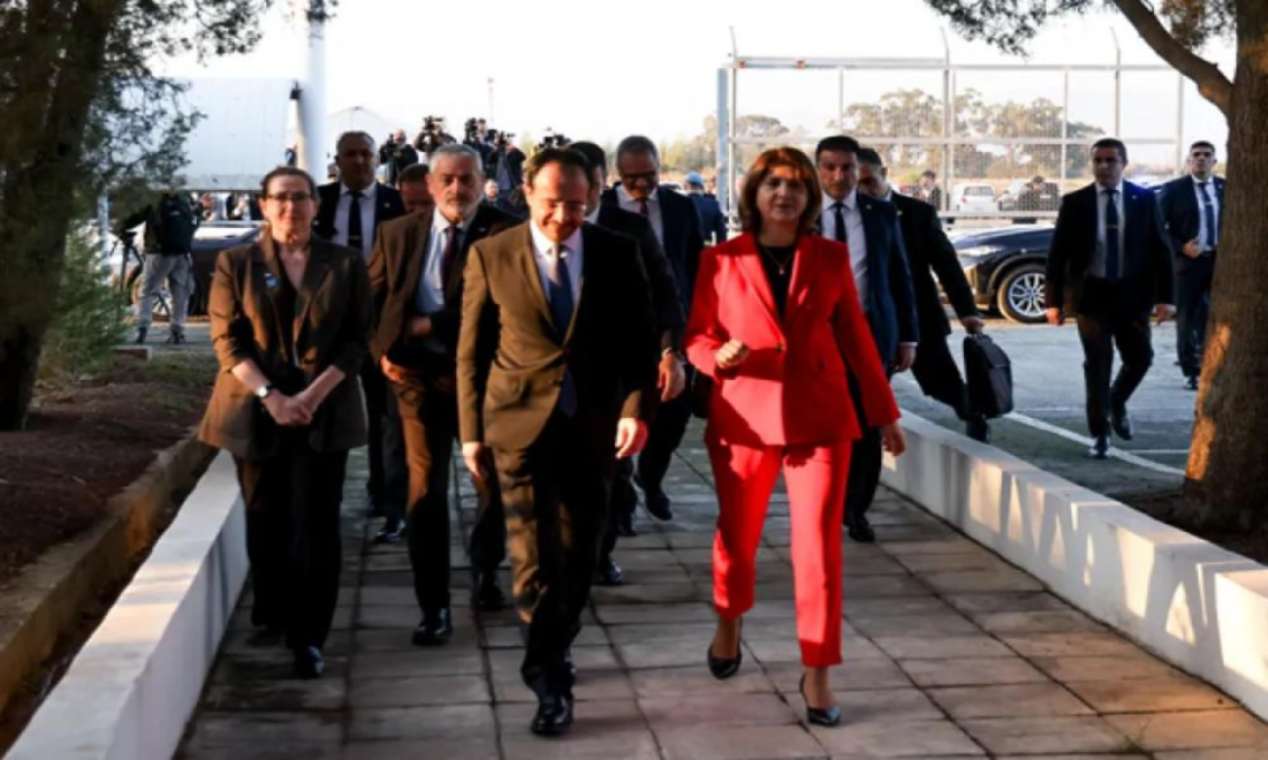
The forthcoming visit of António Guterres to Cyprus encapsulates perhaps the most difficult equation currently facing the Cyprus issue.
The United Nations Secretary-General is arriving on the island with the aim of testing whether there is sufficient political space to revive the process and prepare the ground for a new informal five-party conference.
His visit is not merely symbolic. In reality, it is a political test on three levels at once:
whether Ankara is prepared to move away from its two-state doctrine, whether the European Union can turn EU–Turkey relations into a meaningful instrument of leverage, and whether Guterres himself can leave behind an active diplomatic process rather than yet another dead end.
The Cyprus issue has now reached a point where the resumption of negotiations depends less on the production of new ideas and more on a political decision by Turkey to allow a return to a commonly accepted framework.
From that perspective, two principal scenarios are currently before the Secretary-General.
Scenario One: A New Five-Party Conference With a Guaranteed Follow-Up
The more positive scenario for the United Nations would be the securing of sufficient political commitments to convene a new informal five-party conference.
Such a meeting would bring together the two Cypriot communities, the three guarantor powers — Greece, Turkey and the United Kingdom — and the United Nations.
However, António Guterres appears unwilling to call another international meeting merely to record the already familiar disagreements.
The precondition is that a new five-party conference must have a political horizon.
In other words, the parties would need to provide prior assurances that the informal meeting would be followed by a concrete process aimed at restarting substantive negotiations.
The United Nations has already pursued a gradual approach, attempting to create a minimum level of confidence through lower-intensity issues such as new crossing points, demining, environmental cooperation, youth initiatives and solar-energy projects in the buffer zone.
Confidence-building measures, however, are not a solution to the Cyprus problem.
They can preserve contact between the two sides, but they cannot by themselves bridge the fundamental disagreement over the nature of a final settlement.
Nicosia continues to insist on a solution based on United Nations resolutions and the European acquis.
The Turkish side, by contrast, continues to prioritise “sovereign equality” and “equal international status”, terms which in practice form the basis either for a two-state solution or for an extremely loose confederal arrangement.
This is not a semantic dispute.
It touches the very core of Cyprus’ international status.


Scenario Two: Managing the Deadlock and Handing Over the File
If the meetings in Cyprus confirm that no common ground exists, Guterres is expected to move towards a strategy of controlled continuity.
In that case, no five-party conference would be announced without a realistic prospect of progress.
The Secretary-General would instead keep diplomatic channels open and seek further contacts with the parties in September, on the sidelines of the United Nations General Assembly.
The objective would be institutional rather than genuinely negotiating in nature: to prevent the process from collapsing entirely and to hand his successor an active, albeit weak, diplomatic mechanism.
This is the minimum scenario.
It would not resolve the Cyprus problem and would not necessarily create new momentum. It would, however, reduce the risk of complete disengagement between the sides and the further consolidation of partition as the only reality on the ground.
For Guterres, such an outcome would also amount to an acknowledgement of the limits of his mission.
Despite his sustained personal involvement in the Cyprus issue, the United Nations has repeatedly failed to establish sufficient common ground between the two sides.
The Turkish Key: Participation Does Not Mean Movement
Ankara does not reject talks.
It does not refuse meetings and does not wish to be portrayed as the side blocking every diplomatic initiative.
That, however, does not mean that Turkey has changed the substance of its position.
The Turkish strategy consistently separates participation in the process from commitment to the framework of a solution.
Ankara may agree to attend an informal conference while maintaining as a precondition for any formal negotiations the recognition of Turkish Cypriot “sovereign equality”.
That distinction is critical.
Turkey can say yes to a meeting without saying yes to a federal basis for a settlement.
For the United Nations, a general declaration of willingness to engage can be presented diplomatically as a sign of movement.
It is not, however, enough to create a viable negotiating process.
The real question is whether Ankara will allow a process to begin without prior acceptance of its demand for separate sovereignty.
So far, there is no clear evidence of such a shift.


The Leadership Change in the North and the Limits of Optimism
The emergence of Tufan Erhürman as the leader of the Turkish Cypriot community initially generated expectations of a more pragmatic approach than that of the previous period.
Yet the Turkish Cypriot argument continues to rest on the position that any final settlement must derive from the “equal and inherent sovereign rights” of the two peoples on the island.
This language allows for a more flexible presentation, but it does not eliminate Turkey’s central strategic objective.
The tone may change without the strategy necessarily changing.
For Nicosia, the decisive issue is not whether the other side sounds more conciliatory, but whether it accepts that the Republic of Cyprus will evolve through a solution compatible with UN resolutions, the European acquis and Cyprus’ status as an EU member state.
The European Key: EU–Turkey Relations as a Political Bargaining Tool
The second instrument in the Guterres strategy lies in Brussels.
Nicosia has invested politically in linking the Cyprus issue with EU–Turkey relations, seeking to establish that the upgrading of ties between Brussels and Ankara cannot proceed independently of the continued occupation of territory belonging to an EU member state.
The idea is simple in principle, but difficult in practice.
Turkey has major economic, commercial, financial and defence interests in Europe.
The European Union could offer gradual progress in some of these areas, provided Ankara contributes to a meaningful restart of the Cyprus process.
This approach appears to have been absorbed into the broader European strategy towards Turkey.
Recent EU–Turkey contacts have covered the modernisation of the Customs Union, visa liberalisation, cooperation in security and defence, investment, energy and migration.
The problem is that the European Union does not operate as a single state capable of offering a comprehensive geopolitical package through one decision.
Every concession requires procedures, conditions, unanimity or broad political agreement, depending on the policy area.
And the Republic of Cyprus, as a full member state, is directly able to influence the European negotiation with Turkey.


SAFE: Defence as a New Arena of EU–Turkey Bargaining
Turkey’s participation in Europe’s emerging defence architecture is arguably one of the strongest incentives Brussels can place on the table.
The Turkish defence industry has developed significant capabilities in drones, armoured vehicles, missile systems, electronic warfare and shipbuilding.
Europe’s renewed focus on defence creates a major economic and geopolitical opportunity for Ankara.
Turkey also emphasises that it possesses NATO’s second-largest army and argues that excluding it would weaken European security as a whole.
However, direct and institutional participation in European defence funding mechanisms faces serious objections.
Greece links the issue to Turkey’s continuing casus belli, while Cyprus cannot accept the full defence integration of a country that maintains occupation forces on the territory of an EU member state.
Turkey nevertheless has access to indirect participation through partnerships and joint ventures with European defence companies.
This reduces the effectiveness of the European pressure mechanism.
Ankara can obtain part of the economic benefit without first changing its policy on Cyprus.
Visa Liberalisation: Desirable for Ankara, Politically and Technically Difficult
Visa liberalisation for Turkish citizens remains a long-standing priority for Ankara.
Turkey argues that its cooperation on migration and its role in containing refugee flows should be accompanied by greater European flexibility.
Yet visa liberalisation cannot proceed purely as a political reward.
There are technical benchmarks, rule-of-law requirements, document-security concerns, data-protection standards and issues related to anti-terror legislation.
Several member states also remain cautious.
The European Union therefore cannot offer full visa liberalisation immediately in exchange for Turkey’s mere participation in talks.
The Customs Union: The Strongest but Most Complex Incentive
The upgrading of the EU–Turkey Customs Union is the most significant economic incentive available.
The current arrangement, based on the 1995 agreement, mainly covers industrial goods and does not fully include agriculture, services or public procurement.
A modernised agreement could give Turkey:
- easier access to the single market,
- lower trade costs,
- broader exchanges in services and agricultural products,
- deeper integration into European supply chains,
- stronger investor confidence.
The economic interest is mutual.
Turkey is a major market for European companies and a crucial production base in sectors such as automotive manufacturing, machinery, textiles and electrical appliances.
Yet an upgraded Customs Union cannot proceed automatically.
Turkey would have to fulfil specific European obligations, including the full implementation of the Additional Protocol towards all EU member states, including the Republic of Cyprus.
This is one of the central structural obstacles.
Ankara’s Demand for an Advance Payment
Turkey appears to favour the reverse sequence.
Rather than making substantive moves on the Cyprus issue first and receiving European incentives afterwards, Ankara wants the European Union to offer steps of goodwill in advance.
The Turkish argument is that EU–Turkey relations constitute an independent field of technical, economic and geopolitical cooperation and should not remain hostage to a political dispute such as Cyprus.
For Nicosia, however, this logic would mean that Turkey could collect the benefits of European engagement without assuming any meaningful cost on the Cyprus issue.
This is the core of the bargaining process.
Europe may be able to offer a gradual, reversible and conditional positive agenda.
It cannot credibly hand over all the incentives in advance and simply hope that Turkey will alter its position later.
The European Union’s Strategic Dilemma
Brussels faces its own contradiction.
On the one hand, it needs Turkey:
- for migration management,
- for stability in the Black Sea and the Caucasus,
- for security in the Eastern Mediterranean,
- for Middle East diplomacy,
- for energy and trade corridors,
- and for Europe’s evolving defence architecture.
On the other hand, the European Union cannot ignore the fact that Turkey still refuses to recognise an EU member state, maintains troops in Cyprus and promotes a settlement model that conflicts with the island’s single international personality and the European acquis.
Europe is therefore forced to balance geopolitical realism with institutional credibility.
If it moves towards full normalisation with Turkey without progress on Cyprus, it will weaken Nicosia’s negotiating position.
If it blocks every form of cooperation with Ankara, it risks losing an important regional partner and pushing Turkey towards an even more autonomous strategic posture.
The most likely approach is a policy of incremental steps, with each European concession linked to a specific and verifiable Turkish move.
The Guterres Framework or a New “Loose” Architecture?
A critical question concerns the substance that the Secretary-General will place before the parties.
One option is to remain committed to the framework presented in 2017, preserving the basis of a bizonal, bicommunal federation, political equality and a comprehensive settlement of security, guarantees, territory, property and governance.
The second option is to allow the exploration of more “flexible” or “out-of-the-box” ideas that could point towards a very weak central structure and two almost autonomous entities.
Such a shift could be presented as creative diplomacy designed to overcome the stalemate.
It would, however, carry serious risks.
A “loose relationship” could easily become a disguised confederation or the gradual legitimisation of partition.
The red lines for Nicosia remain clear.
Any agreement must guarantee:
- one sovereignty,
- one international personality,
- one citizenship,
- a functioning state,
- full implementation of the European acquis,
- and compatibility with Cyprus’ EU membership.
A structurally ambiguous arrangement cannot be created inside the European Union if it allows one of the two entities to exercise a separate foreign or European policy.
Nicosia’s Strategy
The Republic of Cyprus enters the discussions seeking to present itself as the side calling for the immediate resumption of negotiations without artificial preconditions.
Its strategy rests on four pillars.
First, preservation of the agreed UN framework.
Second, active European Union involvement not merely as an economic actor, but as the institutional guarantor that any solution remains compatible with EU law.
Third, linkage of the EU–Turkey agenda with concrete Turkish moves on Cyprus.
Fourth, avoidance of the impression that the Greek Cypriot side rejects new ideas before they are even discussed.
The final balance is the most difficult one.
Nicosia must appear open to creative diplomacy without accepting a gradual shift from federation towards a two-state solution under another name.
Guterres’ Legacy and the Real Fate of the Process
For António Guterres, the Cyprus mission also carries personal political weight.
The Cyprus issue was one of the first major diplomatic challenges he handled after assuming leadership of the United Nations.
The collapse of the Crans-Montana talks in 2017 marked his tenure and has remained an unresolved diplomatic chapter.
The Secretary-General knows that he cannot impose a solution.
He can, however, determine what kind of process he leaves behind.
He can leave a process with a clear framework and political horizon, or a diplomatic mechanism that simply manages partition.
His legacy will not be judged by whether one more meeting takes place.
It will be judged by whether that meeting creates a genuine prospect of progress or merely gives all sides a diplomatic excuse to prolong the deadlock.
The Real Test Lies in Ankara
Despite the significance of the United Nations, the European Union and Nicosia’s diplomatic strategy, the decisive variable remains Turkey.
Ankara must choose whether it wants:
- a functional relationship with the European Union that includes economic and defence benefits,
- or the continuation of a rigid Cyprus policy that limits its European ambitions.
Until now, Turkey’s leadership has calculated that its geopolitical weight is so significant that Europe will eventually be forced to separate EU–Turkey relations from the Cyprus issue.
Nicosia and Athens are trying to prove the opposite: that Turkey’s regional importance cannot override international law, European obligations and solidarity towards a member state.
This is the real contest behind the current diplomatic activity.
It is not only about the form of a future settlement in Cyprus.
It is also about whether the European Union can act as a geopolitical power with principles, conditions and a coherent strategy.
A Final Opportunity or Another Extension of the Deadlock?
The Guterres visit could produce a carefully structured new step.
It could equally confirm that the parties remain trapped in incompatible strategic objectives.
In the positive scenario, Ankara would accept a process without prior recognition of separate sovereignty, Nicosia would show flexibility on governance, and the European Union would construct a gradual mechanism of incentives.
In the negative scenario, Turkey would limit itself to a general declaration in favour of dialogue while maintaining its two-state policy.
Guterres would keep the process alive until September and then hand the file over to his successor.
The first scenario requires political cost from all sides.
The second requires only diplomatic management.
That is why it is the easier one.
The difficult unlocking of the Cyprus problem truly runs through two capitals: Ankara, which holds the key to substantive movement, and Brussels, which holds the key to incentives.
António Guterres can create the moment.
He cannot substitute for political will.
And that political will will determine not only his legacy, but whether Cyprus can regain a genuine prospect of reunification or enter an even deeper period of entrenched partition.
Source: pagenews.gr