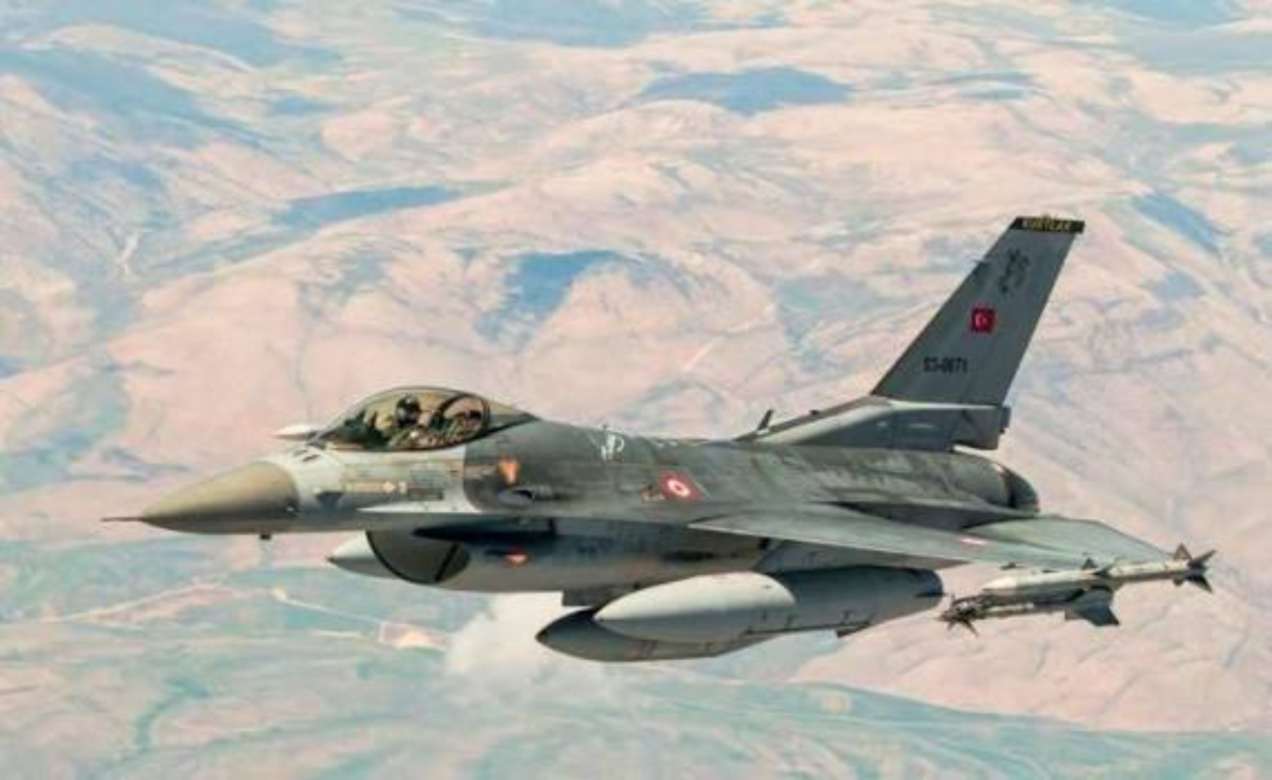
Tensions rose sharply over the Aegean Sea as Turkish military aircraft carried out 25 violations of Greek national airspace, while armed F-16s were involved in an engagement with Greek fighter jets during interception operations.
A total of 12 Turkish aircraft operated across the northeastern, central and southeastern Aegean on August 18, according to Greek military data.
They included three formations comprising seven F-16 fighter jets, one CN-235 aircraft and four unmanned aerial vehicles.
Crucially, two of the Turkish F-16s were armed.
Greek fighter jets intercepted the Turkish aircraft according to established procedures, with one encounter developing into an engagement.


Seven Turkish F-16s – Two of Them Armed
The scale and composition of the Turkish activity are significant.
The seven F-16s operated in three formations – one consisting of three fighters and another two formations of two aircraft each.
Alongside them flew a Turkish CN-235, commonly used for surveillance and reconnaissance missions, as well as four UAVs.
Of the 25 violations recorded by the Greek authorities, eight were attributed to the Turkish fighter formations and 17 to UAVs.
Another 14 violations of air traffic rules within the Athens Flight Information Region were recorded: three involving the fighter jets, nine involving UAVs and two involving the CN-235.
The figures illustrate the increasingly important role drones play in Turkey’s military presence over the Aegean.
But the deployment of armed F-16s adds a different dimension to the incident.


Greek Fighters Scramble – One Engagement
Greek Air Force aircraft were scrambled to identify and intercept the Turkish aircraft.
According to the Greek military authorities, all Turkish aircraft were identified and intercepted in accordance with international rules and established operational practice.
During one of those interceptions, however, Greek and Turkish fighter aircraft became involved in an engagement.
The fact that two Turkish F-16s were armed adds particular significance to the encounter.
No overflight of Greek territory was reported.
The episode does not in itself indicate that Ankara is preparing for a broader military confrontation. But it demonstrates how quickly routine military activity over the Aegean can move into a significantly more dangerous phase.
Not an Isolated Incident
The latest episode becomes more important when viewed against the broader pattern of Turkish military activity during 2026.
According to official data from Greece’s National Defence General Staff, 247 violations of Greek national airspace, 386 air traffic infringements and six engagements had already been recorded during the first six months of the year.
A total of 268 Turkish aircraft were involved in those activities.
August has brought further incidents.
On August 6, Greek authorities recorded 17 airspace violations and one engagement involving Turkish aircraft, including two armed jets.
On August 17, one day before the latest escalation, four Turkish aircraft were responsible for 12 violations.
Twenty-four hours later, the number jumped to 25.


The Message Behind the Armed F-16s
The presence of armed fighters matters from a military perspective.
A surveillance drone operating over the Aegean carries a different level of risk from formations of combat aircraft, particularly when some of those fighters are armed and an interception develops into an engagement.
That distinction should not be exaggerated into evidence of an imminent Turkish military operation. There is no available evidence supporting such a conclusion.
But the incident does demonstrate that Ankara retains both the capability and the willingness to rapidly increase military pressure in the Aegean, even after periods of relative calm in Greek-Turkish relations.
For Athens, this means diplomacy and deterrence must continue to operate simultaneously.
Greece Responds with Readiness
The Greek response remains based on continuous monitoring and rapid interception.
Aircraft entering Greek national airspace are identified and intercepted by the Hellenic Air Force, while the Greek Ministry of Foreign Affairs is informed of relevant incidents.
Athens has also invested heavily in strengthening its air power.
The acquisition of Dassault Rafale fighters, the modernisation of Greece’s F-16 fleet to the advanced Viper configuration, and the planned acquisition of F-35 stealth fighters are transforming the capabilities of the Hellenic Air Force.
The objective is not simply technological superiority.
It is deterrence: ensuring that any attempt to alter the military balance in the Aegean would carry an unacceptable operational cost.
The Aegean Remains the Barometer of Greek-Turkish Relations
Athens and Ankara have moved repeatedly between periods of confrontation and diplomatic rapprochement.
Political dialogue can reduce tensions, establish channels of communication and lower the risk of escalation.
But the geography of the Aegean means that military aircraft from the two NATO countries can still find themselves operating in close proximity.
Every interception therefore carries an inherent risk of miscalculation, technical failure or human error.
That is why the return of armed Turkish F-16s and the recording of an engagement deserve attention beyond the raw number of violations.
The Aegean remains the most immediate military barometer of Greek-Turkish relations.
Twenty-five airspace violations in a single day, armed fighters and an engagement with Greek jets are a reminder that periods of political calm do not eliminate the underlying strategic rivalry.
For Athens, the conclusion is straightforward:
dialogue with Turkey may continue, but Greece cannot afford to relax its operational readiness in the Aegean – even for a single day.
Source: pagenews.gr