Fidan Raises Tensions Over Thrace and the Dodecanese as Turkey Defends Libya Maritime Deal
 ΧΡΟΝΟΣ ΑΝΑΓΝΩΣΗΣ 13 '
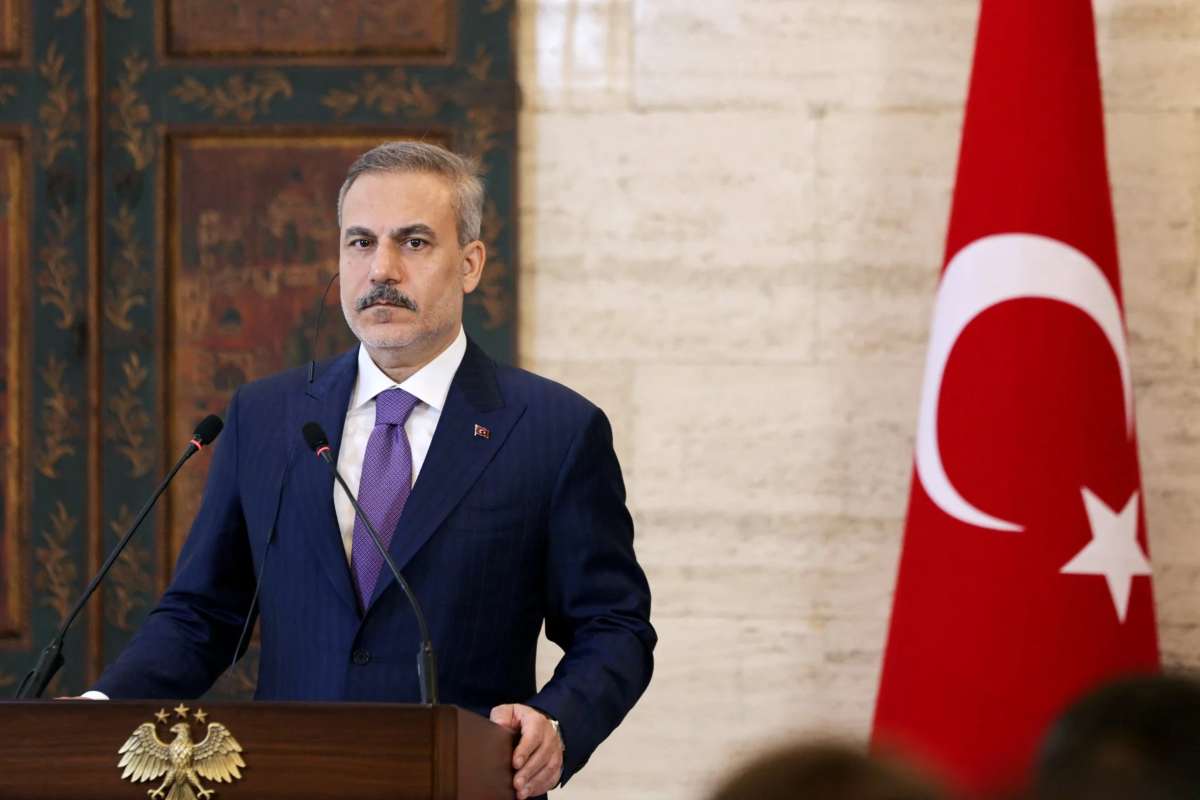
Πηγή Φωτογραφίας: AP Photo//Fidan Raises Tensions Over Thrace and the Dodecanese as Turkey Defends Libya Maritime Deal



“We will maintain our firm stance against any steps that would jeopardise our national interests and the rights of our compatriots in Western Thrace and the Dodecanese.”
With this statement, Turkish Foreign Minister Hakan Fidan brought two particularly sensitive issues in Greek-Turkish relations back into the diplomatic spotlight, explicitly linking Western Thrace and the Dodecanese to Ankara’s national interests.
His remarks, reported by Turkey’s state-run Anadolu Agency, come at a time when Athens and Ankara are seeking to maintain diplomatic communication despite persistent disagreements over sovereignty, maritime rights, minority issues and the future of Cyprus.
Fidan referred to the sixth meeting of the Greece–Turkey High-Level Cooperation Council, held in Ankara in February 2026 under the leadership of Greek Prime Minister Kyriakos Mitsotakis and Turkish President Recep Tayyip Erdoğan.
Yet his emphasis on cooperation was accompanied by a warning that Turkey would continue to defend positions it considers essential to its national interests.
The Turkish foreign minister also reiterated Ankara’s support for a two-state settlement in Cyprus, defended Turkey’s maritime agreement with Libya and pointed to improving relations with Egypt.
The statements underline a central contradiction in Greek-Turkish diplomacy: both governments want to preserve dialogue, but fundamental disagreements remain unresolved.
Fidan: Good-Neighbourly Relations, but No Compromise on Turkish Interests
The Turkish foreign minister began by stressing Ankara’s commitment to cooperation with Greece.
“Our fundamental objective in our relations with Greece is to move forward with an understanding of good-neighbourliness and cooperation. We believe that this approach is the most appropriate path for the common interests of both countries,” Fidan said.
However, he immediately followed that message with a warning.
“Nevertheless, we will maintain our firm stance against any steps that would jeopardise our national interests and the rights of our compatriots in Western Thrace and the Dodecanese.”
The reference to both regions is particularly significant.
Turkey has frequently raised questions concerning the Muslim minority in Western Thrace, but Fidan’s explicit inclusion of the Dodecanese broadens the geographical scope of his remarks.
The statement did not identify a specific Greek government action that Ankara considers a violation of the rights mentioned.
Nevertheless, the language reflects Turkey’s continued interest in raising minority-related issues as part of its wider diplomatic engagement with Greece.
For Athens, these questions must be addressed within the framework of Greek sovereignty, domestic legislation and international treaties.
Why the Reference to the Dodecanese Matters
Fidan’s reference to the Dodecanese carries particular historical and legal significance.
The islands became part of Greece following the 1947 Treaty of Peace with Italy, under which Italy ceded the Dodecanese to Greece.
Greek sovereignty over the islands is established under that international treaty.
Turkey was not a party to the 1947 agreement.
The Dodecanese, particularly Rhodes and Kos, are home to Muslim communities with a long historical presence.
Ankara has periodically raised questions concerning the cultural, religious and educational rights of these communities.
The protection of individual and religious rights, however, is legally distinct from questions of territorial sovereignty.
The presence of Muslim communities in the islands does not alter their internationally recognised status as Greek territory.
This distinction is essential when assessing Fidan’s remarks.
His statement does not, by itself, constitute an explicit Turkish claim to sovereignty over the Dodecanese.
It does, however, demonstrate that Ankara continues to include the islands in its public discussion of bilateral issues.
For Greece, the relevant legal framework includes the Constitution, national legislation and international human rights obligations.
Western Thrace: The Continuing Dispute Over Minority Rights
Western Thrace remains one of the most persistent areas of disagreement between Athens and Ankara.
Greece recognises the Muslim minority of Thrace, as provided for under the 1923 Treaty of Lausanne.
The minority includes Greek citizens with different ethnic and linguistic backgrounds, including people of Turkish, Pomak and Roma origin.
Turkey frequently uses the term “Turkish minority”, arguing that ethnic identity and self-identification should be recognised and protected.
Athens maintains that the relevant international treaty defines the minority in religious terms.
Greek authorities also emphasise that minority rights are protected under domestic law and international obligations.
The debate encompasses education, religious representation, cultural rights and freedom of association.
Questions surrounding ethnic self-identification have also been the subject of European human rights litigation.
These disagreements have persisted despite efforts to improve bilateral relations.
Fidan’s latest remarks bring the minority issue back into the foreground of Greek-Turkish diplomacy.
Mitsotakis and Erdoğan: Dialogue Continues, but Differences Remain
Fidan also referred to the sixth meeting of the Greece–Turkey High-Level Cooperation Council, held in Ankara in February 2026.
The meeting between Kyriakos Mitsotakis and Recep Tayyip Erdoğan formed part of the continuing effort to maintain communication and expand cooperation in areas of mutual interest.
Both governments have sought to strengthen economic relations, tourism and contacts between their societies.
However, improved diplomatic relations have not resolved the underlying disputes in the Aegean and Eastern Mediterranean.
Athens maintains that the central maritime dispute requiring delimitation concerns the continental shelf and exclusive economic zone.
Ankara presents a broader agenda of outstanding issues.
This difference remains a major obstacle to a comprehensive settlement.
Fidan’s remarks suggest that Turkey intends to continue diplomatic engagement while maintaining its established positions.
The challenge for both governments is to prevent these disagreements from undermining the channels of communication they have developed.
Cyprus: Ankara Reaffirms Its Two-State Position
Turning to Cyprus, Fidan reiterated Turkey’s position that the island is home to two distinct peoples, two democracies and two states.
Ankara continues to advocate a settlement based on sovereign equality between the Greek Cypriot and Turkish Cypriot sides.
This position differs fundamentally from the framework supported by the Republic of Cyprus and Greece.
Relevant United Nations Security Council resolutions envisage a settlement based on a bizonal, bicommunal federation with political equality.
Turkey argues that recognition of Turkish Cypriot sovereign equality is necessary before a new negotiating process can succeed.
The Republic of Cyprus and Greece maintain that negotiations must remain within the framework established by UN resolutions and previous agreements.
Fidan stressed that Ankara would continue defending what it considers the rights of Turkish Cypriots in international forums.
His remarks indicate that Turkey is maintaining its two-state approach.
The disagreement remains one of the most significant obstacles to restarting substantive negotiations over the island’s future.
The Aegean and Eastern Mediterranean: Competing Interpretations of Maritime Rights
Fidan also argued that turning the Aegean and Eastern Mediterranean into regions of stability and prosperity requires an approach that considers the legitimate interests of all parties.
The language reflects Ankara’s longstanding position that regional disputes should be addressed through a broad political and diplomatic framework.
Greece maintains that maritime delimitation must be governed by international law, including the law of the sea.
Turkey is not a party to the United Nations Convention on the Law of the Sea.
The two countries consequently maintain different positions on issues involving maritime zones, the entitlements of islands and the delimitation of continental shelves and exclusive economic zones.
These disagreements have direct implications for energy exploration, maritime activities and regional security.
Fidan’s reference to the interests of all parties should therefore be understood within the broader context of competing legal and diplomatic positions.
Libya: Fidan Defends the Controversial Turkey–Libya Maritime Memorandum
Libya featured prominently in the Turkish foreign minister’s remarks.
Fidan described the country as an integral part of Turkey’s vision for the Eastern Mediterranean.
He said Ankara remained committed to supporting Libya’s political unity, territorial integrity and stability.
Turkey has also sought to maintain dialogue with different political actors within Libya.
Fidan cited the reported approval of the Turkey–Libya maritime memorandum by Libya’s House of Representatives on October 20, 2026, presenting it as evidence of the effectiveness of Turkish diplomacy.
The development is particularly significant for Greece.
The 2019 Turkey–Libya maritime delimitation memorandum has been a major source of disagreement between Athens and Ankara.
Greece argues that the agreement disregards the maritime entitlements of Greek islands, including Crete, and conflicts with international maritime law.
Athens maintains that the geographical and legal assumptions underpinning the agreement cannot override Greek sovereign rights.
Turkey rejects these objections and considers the memorandum legally valid.
The dispute has also attracted sustained attention from European institutions.
The European Union’s Position on the Turkey–Libya Agreement
The European Union has repeatedly expressed objections to the Turkey–Libya maritime memorandum.
Its position is that the agreement infringes upon the sovereign rights of third states and cannot produce legal consequences for them.
The dispute concerns the maritime entitlements of Greek islands and the principles governing the delimitation of exclusive economic zones and continental shelves.
For Greece, the issue is not simply bilateral.
Athens has sought to keep the memorandum on the European diplomatic agenda because it considers the agreement relevant to the sovereign rights of an EU member state.
The renewed attention follows discussions in the European Parliament concerning the memorandum and its compatibility with international law.
European lawmakers are expected to examine the issue again, including its implications for Greece and the wider Eastern Mediterranean.
Any parliamentary resolution would have political significance, but it would not automatically invalidate the memorandum as a matter of international law.
That distinction remains important when assessing the possible consequences of further European action.
Turkey’s Libya Strategy: Expanding Influence Across the Eastern Mediterranean
Fidan’s remarks demonstrate the importance Ankara attaches to its relationship with Libya.
Turkey has invested considerable diplomatic and security resources in developing its position in the country.
Its engagement extends beyond maritime delimitation.
Ankara maintains political contacts and seeks to strengthen economic and strategic cooperation.
Libya’s geographical position makes it particularly important to the Eastern Mediterranean.
The country’s coastline, energy resources and internal political divisions have attracted the attention of several regional powers.
For Turkey, cooperation with Libya supports its wider efforts to expand its regional influence.
For Greece, the maritime memorandum remains a central concern because of its potential implications for maritime delimitation.
The two governments therefore approach Libya through different strategic and legal priorities.
Turkey and Egypt: A New Strategic Relationship Takes Shape
Fidan also highlighted the improvement in relations between Turkey and Egypt.
According to the Turkish foreign minister, bilateral cooperation has reached a strategic level.
He said further progress was expected through high-level contacts during 2026.
The rapprochement between Ankara and Cairo represents a significant development in Eastern Mediterranean diplomacy.
The two countries experienced years of political tension before beginning a process of normalising relations.
Their renewed engagement has implications for regional diplomacy, economic cooperation and security.
Egypt is also an important partner for Greece.
Athens and Cairo concluded a partial exclusive economic zone delimitation agreement in 2020, strengthening their cooperation on maritime issues.
Improving Turkish-Egyptian relations does not automatically change Egypt’s existing international agreements.
Nevertheless, the rapprochement introduces another dimension to regional diplomacy.
For Athens, developments in Turkey’s relations with Egypt and Libya are particularly relevant to the evolving balance of interests in the Eastern Mediterranean.
Thrace, Cyprus and Libya: Ankara’s Wider Diplomatic Agenda
Fidan’s statements cover several interconnected areas of Turkish foreign policy.
His reference to Western Thrace and the Dodecanese highlights continuing disagreements over minority-related issues.
His reaffirmation of the two-state position on Cyprus demonstrates the distance between Ankara and the settlement framework supported by Athens, Nicosia and the United Nations.
His defence of the Turkey–Libya maritime memorandum confirms that Ankara continues to regard the agreement as an important component of its Eastern Mediterranean policy.
Meanwhile, the strengthening of relations with Egypt illustrates Turkey’s efforts to expand its regional diplomatic partnerships.
These positions are not new, but their presentation together is significant.
They show that Ankara is seeking to maintain dialogue with Greece while continuing to advance its established positions across several sensitive issues.
For Athens, the challenge is to preserve diplomatic communication without compromising its positions on sovereignty, sovereign rights and international law.
The statements also demonstrate the limits of the recent improvement in Greek-Turkish relations.
Although both governments continue to emphasise cooperation, substantial differences remain over the Aegean, Cyprus and maritime arrangements in the Eastern Mediterranean.
Fidan’s message combines an offer of good-neighbourly relations with a warning that Turkey intends to maintain its positions on Thrace, the Dodecanese and regional maritime disputes.
Whether the two countries can manage those disagreements without renewed tensions will depend on their future diplomatic engagement and actions.
Source: pagenews.gr
Διαβάστε όλες τις τελευταίες Ειδήσεις από την Ελλάδα και τον Κόσμο