The battle to succeed António Guterres is entering a far more consequential phase.
The 15 members of the UN Security Council hold their second closed-door “straw poll” on Friday, August 21, testing support for the candidates seeking to become the next UN Secretary-General.
But behind the numbers lies the real contest: which candidate can survive without running into one of the five permanent members’ vetoes.
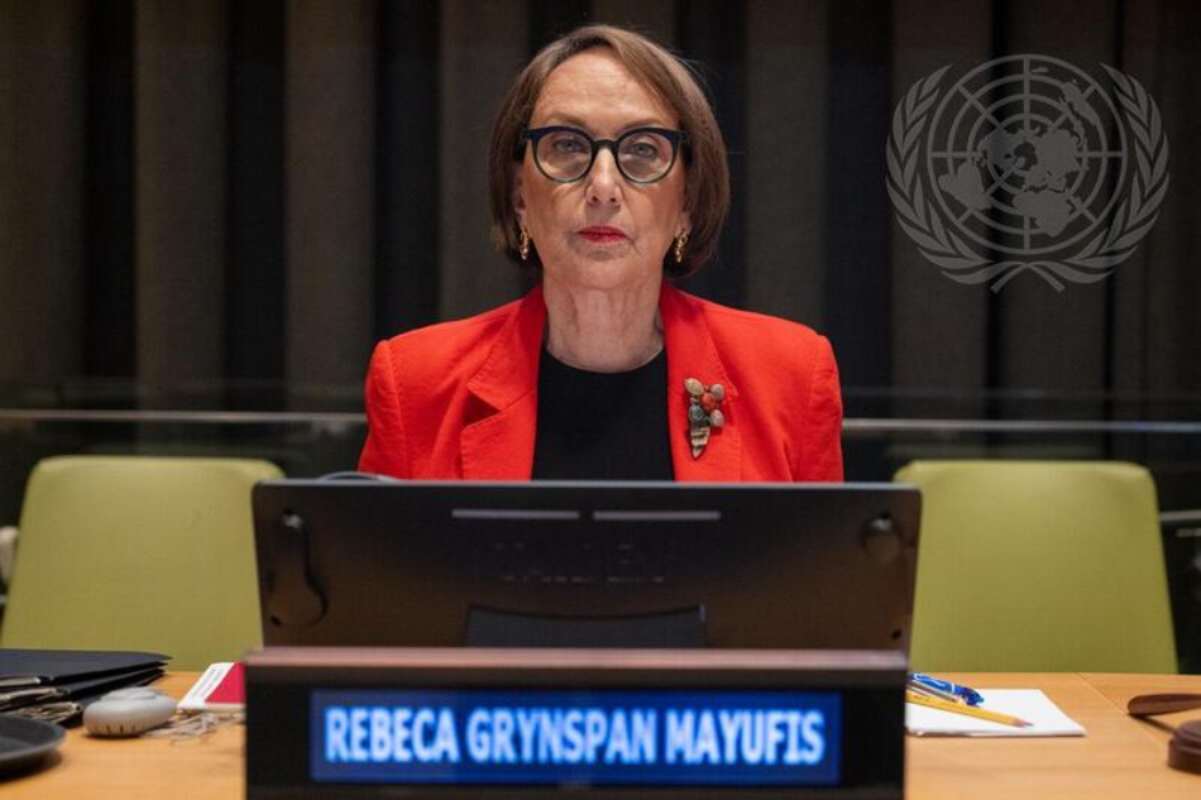
Rebeca Grynspan, head of UNCTAD and former vice-president of Costa Rica, enters the new round as the frontrunner after finishing clearly ahead in the first ballot.
The problem is that nobody yet knows who voted against her.
Grynspan Leads — But One Vote Could Change Everything
In the first straw poll on July 30, Grynspan received 10 “encourage” votes, four “no opinion” votes and only one “discourage”.
Former Guyanese foreign minister Carolyn Rodrigues-Birkett followed with nine positive votes, while Rafael Grossi, director-general of the International Atomic Energy Agency, received seven.
Numerically, Grynspan has established a significant advantage.
Politically, however, that single negative vote may matter far more than the ten votes supporting her.
At this stage, ballots cast by the five permanent members are indistinguishable from those of the ten elected members. It is therefore impossible to know whether Grynspan’s lone “discourage” came from the United States, Russia, China, France or the United Kingdom.
If it did, and that opposition eventually becomes a veto, her current lead could prove meaningless.


The Five Vetoes Are the Real Ballot
The selection of a Secretary-General is one of the clearest examples of the gap between the UN’s formal institutional architecture and geopolitical power.
Article 97 of the UN Charter states that the Secretary-General is appointed by the General Assembly upon the recommendation of the Security Council.
In practice, a successful candidate needs at least nine Security Council votes — and, crucially, must avoid a veto from any of the five permanent members.
Washington, Moscow, Beijing, Paris and London therefore each possess a key capable of locking the door to the UN’s top job.
And so far, the P5 have largely kept their preferences hidden.
Latin America Says It Is Its Turn
Another powerful factor is shaping the contest.
The informal principle of regional rotation has strengthened expectations that the next Secretary-General should come from Latin America and the Caribbean.
Several leading contenders satisfy that criterion, including Grynspan of Costa Rica, Rodrigues-Birkett of Guyana, María Fernanda Espinosa of Ecuador and Argentina’s Grossi.
At the same time, pressure is growing for the United Nations to appoint a woman for the first time in its history.
After eight decades of male leadership, Grynspan therefore combines two politically powerful arguments: Latin American representation and the prospect of the UN’s first female Secretary-General.
Neither, however, can neutralise a P5 veto.
Baerbock Opens a Second Front
Meanwhile, a separate political confrontation has erupted around General Assembly President Annalena Baerbock.
The former German foreign minister has pushed for a more transparent and public selection process, including interactive dialogues in which candidates present their programmes and answer questions from member states and civil society.
Those dialogues form part of the UN’s formal selection process.
But controversy intensified over efforts to ensure that candidates undergo the General Assembly’s public scrutiny before the Security Council moves towards its final choice.
And that has brought Baerbock into confrontation with two unlikely partners.

US and Russia Unite Against Baerbock
The striking feature of the dispute is that Washington and Moscow — adversaries across most major geopolitical fronts — have found themselves pushing back against Baerbock’s approach.
The US side has argued that the President of the General Assembly cannot restrict the Security Council’s ability to consider candidates it deems suitable.
Russia has also expressed concerns about attempts to expand the General Assembly presidency’s role in the process.
The dispute therefore goes beyond Baerbock herself.
It touches the fundamental question behind every UN succession battle:
Who really chooses the Secretary-General — the 193 member states, or the five permanent powers of the Security Council?
A Battle Over the Future of the UN
This succession carries considerably greater geopolitical weight than a routine change at the top.
Guterres’ successor will inherit an organisation facing wars, deepening great-power confrontation, financial pressure and growing challenges to the multilateral international order itself.
Guterres’ second term ends on December 31, 2026. His successor is due to take office on January 1, 2027, for a five-year term.
Several more rounds of secret voting may be required before the Security Council converges on a single name.


Grynspan currently leads.
Rodrigues-Birkett remains a serious challenger.
Grossi has the international profile to remain in contention as compromises begin to emerge.
But the eventual name sent to the General Assembly will not necessarily be the candidate who won the most early votes.
It will be the candidate none of the five most powerful states at the UN decided to kill with a veto.