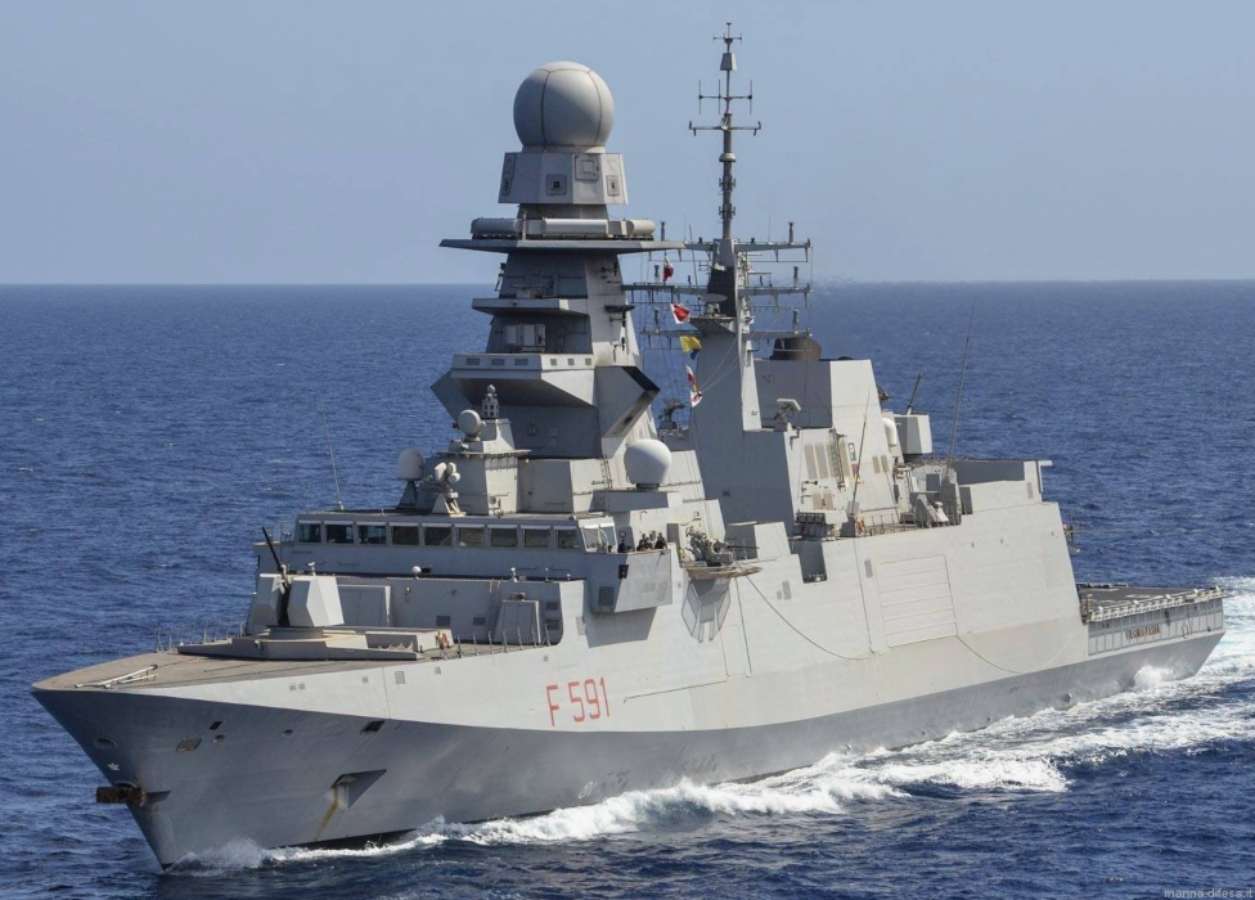
Greece is moving into the next major phase of its naval modernization, with Athens and Rome preparing to formally activate the acquisition of two Italian FREMM frigates — a deal that could significantly strengthen the Hellenic Navy’s deterrence posture in both the Aegean and the Eastern Mediterranean.
On September 8, 2026, the Implementing Arrangement between Greece and Italy will be signed in Rome in the presence of Greek Defence Minister Nikos Dendias, his Italian counterpart Guido Crosetto and the chiefs of the two countries’ navies.
The agreement will finalize the legal, financial and technical terms for the acquisition of the first two FREMM frigates of the Bergamini class, as well as the timetable for their transfer and arrangements for operational support.
The significance of the deal, however, goes well beyond the purchase of two warships.
Together with Greece’s four FDI frigates and the planned modernization of the MEKO fleet, the FREMM acquisition forms part of Athens’ effort to build a Hellenic Navy capable not only of defending the Aegean but also of sustaining high-end operations across the wider Eastern Mediterranean.
Carlo Bergamini in 2028, Virginio Fasan in 2029
The two ships have already been identified.
The Carlo Bergamini (F-590) is scheduled to be sold and transferred to Greece during the first half of 2028.
The Virginio Fasan (F-591) is expected to follow during the first half of 2029.
The Implementing Arrangement will also cover initial and follow-on support designed to maintain the vessels’ operational availability after their entry into Hellenic Navy service.
Another important element is Greek industrial participation, with domestic shipyards expected to be involved in maintenance work and in the adaptation and integration of new systems aboard the vessels.


From the 2025 “2+2” plan to an actual acquisition
The September agreement builds on the framework established in La Spezia on September 29, 2025.
Greece and Italy then signed a Memorandum of Cooperation on naval matters and a Declaration of Intent concerning the potential acquisition of two plus two FREMM frigates.
Dendias had made the ambition clear at the time:
“One of the two agreements effectively opens the door for us to acquire two FREMM frigates, with the possibility of acquiring another two.”
He also emphasized the relatively young age and operational condition of the Italian vessels:
“Two ships, or four ships, around ten years old, with excellent capabilities and in excellent condition.”
The September 8 signing therefore moves the project from political intent toward implementation.
Dendias: “The Hellenic Navy has entered a new era”
For Athens, the FREMM program is part of a broader restructuring of Greek naval power under the “Agenda 2030” defence modernization strategy.
Dendias has previously described the transformation in explicit terms:
“With ‘Agenda 2030’, the Hellenic Navy has now entered its new era.”
He has also outlined the fleet architecture Greece wants to create:
“Four Belharra frigates — indeed Standard 2++. Two plus two FREMM frigates, excellent ships. Modernized MEKO frigates. A truly significant navy capable of defending the sovereignty and sovereign rights of our country both in the Aegean and in the Eastern Mediterranean.”
That is the strategic core of the acquisition.
Athens is not simply replacing aging vessels. It is attempting to create a fleet with greater endurance, firepower, survivability and reach.


More than 6,000 tonnes — and built for blue-water operations
The Bergamini-class FREMMs are large surface combatants designed for operations well beyond coastal waters.
Dendias has previously described the ships as vessels of more than 6,000 tonnes and highlighted their ability to operate in the open sea.
“Frigates around ten years old, large ships, even larger than the FDI, over 6,000 tonnes, capable of operating in the open sea.”
That capability matters for Greece.
The country’s strategic maritime environment increasingly extends beyond the Aegean into the Eastern Mediterranean, where energy infrastructure, shipping routes, maritime zones and wider Middle Eastern security dynamics intersect.
The FREMMs provide Athens with platforms capable of remaining at sea for longer periods and participating in more demanding multinational and long-range operations.
The next big question: Strategic missiles
One of the most consequential elements of the Greek plan concerns the future weapons configuration of the ships.
Athens has already raised the possibility of adapting the FREMMs to carry next-generation strategic weapons.
Dendias said in La Spezia:
“For us, it would be important for the FREMM frigates also to have the capability to carry the new-generation ELSA missile, which the Belharra frigates will also carry.”
According to the minister, the industrial side had indicated that such an adaptation was technically feasible.
“The company tells us that this is entirely feasible.”
Dendias has also referred to plans involving the Sylver A70 vertical launch system for the Italian FREMMs if the program proceeds as envisaged.
The final weapons configuration should not yet be treated as a completed capability. But the direction of travel is strategically important: Greece wants major surface combatants capable of contributing to deterrence at substantially greater ranges.
“An enormous deterrent capability”
Dendias has openly linked the future fleet configuration to a broader Greek deterrence strategy.
“You understand, therefore, the enormous deterrent capability that the Hellenic Navy can acquire.”
On another occasion, discussing Greece’s future naval posture, he said:
“Frigates that will be able to carry strategic missiles. And this will constitute our means of deterrence, but also our ability to participate in operations that safeguard freedom at sea.”
The objective is therefore not simply fleet renewal.
It is to expand the geographical and operational depth of Greek naval power.
Aegean defence, Eastern Mediterranean reach
The timing also gives the agreement a clear geopolitical dimension.
The Aegean and Eastern Mediterranean remain central to Greek defence planning, while maritime security is increasingly intertwined with energy routes, subsea infrastructure and instability in the broader Middle East.
Dendias has rejected suggestions that Greece’s growing emphasis on larger blue-water platforms could come at the expense of defending the Aegean.
“Of course, we will safeguard the Aegean. We will safeguard the Aegean much better than we have until now, but we will do so in a much more sophisticated way.”
The emerging doctrine is therefore two-dimensional: stronger defence of Greece’s immediate maritime space combined with greater capacity to project and sustain naval power deeper into the Eastern Mediterranean.
Greek shipyards enter the equation
The agreement also carries an important industrial component.
Greek shipyards are expected to participate in maintenance and in work required to integrate or adapt new systems aboard the FREMMs.
That matters economically and strategically.
Keeping a meaningful share of lifecycle support in Greece could strengthen domestic technical expertise, generate industrial activity and reduce dependence on foreign facilities for long-term maintenance.
The scale of the benefits will ultimately depend on the final industrial agreements and support packages.
FDI + FREMM + MEKO: The new Hellenic fleet
If the current modernization plan is fully implemented, Greece’s principal surface fleet will increasingly revolve around three pillars:
four FDI frigates, two FREMMs initially with the possibility of additional vessels, and modernized MEKO frigates.
The combination represents a major shift from the years of the sovereign debt crisis, when the renewal of the Hellenic Navy was effectively frozen.
Dendias has described the current effort as an attempt to rapidly close “the enormous gap left by the ten years of the economic crisis.”
The result could be a considerably younger and more technologically advanced surface fleet, with a combination of air defence, anti-submarine warfare, anti-surface warfare and potentially long-range strike capabilities.
Greece and Italy deepen their strategic relationship
There is also a broader European dimension.
Greece and Italy occupy two strategically important positions in the Mediterranean and share interests in maritime security, energy corridors, protection of sea lines of communication and NATO’s southern flank.
The FREMM agreement creates a long-term relationship not only between the two defence ministries and navies, but also between their defence industries.
That could become increasingly significant as European governments seek greater defence-industrial cooperation and more resilient supply chains.
Greece is building more than a bigger navy
The September 8 signing should not be viewed simply as another procurement milestone.
It locks in the planned arrival of two large blue-water combatants:
Carlo Bergamini in 2028.
Virginio Fasan in 2029.
It brings Greek shipyards into the support equation, keeps open the prospect of additional FREMMs and creates a platform for potentially much more powerful weapons configurations.
The decisive question will be how the FDI, FREMM and modernized MEKO fleets are integrated into a single networked force.
If Athens succeeds, the payoff will not merely be two additional frigates. It will be greater firepower, endurance and strategic depth for the Hellenic Navy.
And that is the wider geopolitical message behind the Greece–Italy agreement:
Athens is no longer designing a navy solely to defend the Aegean. It is building maritime power with the entire Eastern Mediterranean in view.
Source: pagenews.gr